
Live speech → real-time translation
Real-time speech translation for meetings and live conversations. Translated captions and voice-to-voice translation while people are speaking.

Comparison
Searching for a comparison of DeepL Voice vs VClar? You are in the right place.
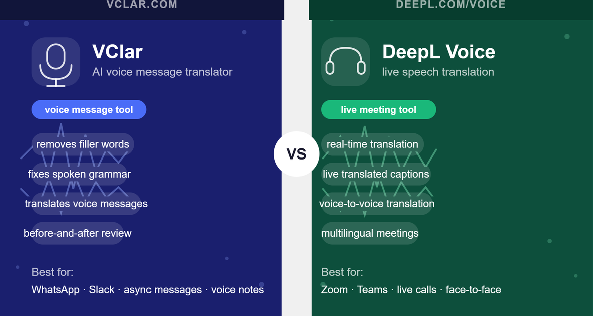
VClar and DeepL Voice both handle spoken language, but they are not built for the same job, and choosing the wrong one will not solve your actual problem.
DeepL Voice is designed for real-time speech translation in meetings and live conversations. If people are speaking different languages right now, DeepL Voice helps them understand each other as the conversation unfolds.
VClar is designed for recorded voice messages. If you have already recorded a voice note, voice memo, voicemail, WhatsApp audio, or any short spoken message, VClar cleans, corrects, and translates it, and shows you what changed before you send it.
The better choice comes down to one question: Is the communication happening live, or has it already been recorded?
Live speech → real-time translation
Real-time speech translation for meetings and live conversations. Translated captions and voice-to-voice translation while people are speaking.
Recorded message → clean & translate
Clean, correct, and translate recorded voice messages before sending — with filler words removed, grammar fixed, and your natural voice preserved.
Quick answer
If you need real-time translation for meetings, live conversations, translated captions during a Zoom or Microsoft Teams call, or voice-to-voice communication across languages.
If you need to translate recorded voice messages, remove filler words, fix spoken grammar, improve clarity, and review what changed before sending.
DeepL Voice is DeepL's speech-translation product for real-time spoken communication. It is built on the same language technology that has made DeepL one of the most trusted names in translation, and it brings that quality into real-time spoken situations.
DeepL Voice has two main products:
DeepL Voice for Meetings is designed for virtual multilingual meetings. It works in Microsoft Teams and Zoom Meetings, providing live, translated captions so each participant can follow the conversation in their preferred language. It supports simultaneous translation across multiple spoken languages in a single meeting, helping global teams communicate without language barriers. DeepL Voice can translate speech from 17 languages and generate translated subtitles in all 35 languages available for DeepL Translator. Real-time voice-to-voice translation has also been introduced as part of DeepL's ongoing product development.
DeepL Voice for Conversations is designed for face-to-face conversations between people who speak different languages. It enables businesses to communicate face-to-face with customers and partners in different languages via the DeepL mobile apps or on the web. It is particularly useful for frontline workers, customer service teams, and anyone who needs to hold in-person cross-language conversations quickly.
DeepL Voice is built with enterprise-grade security and data privacy, and DeepL does not permanently store transcription or translation data on a server. Data is processed temporarily in memory and deleted once a call ends.
DeepL Voice is a serious and trusted language technology company. DeepL Voice is not a basic translation widget; it is a purpose-built AI voice translator and speech translation tool for real-time multilingual communication at scale. DeepL Voice uses DeepL's specialized language models to balance speed, accuracy, and nuance in spoken translation, since real-time voice translation involves incomplete input, pronunciation issues, latency, and more.
If your need is live conversation, DeepL Voice is a strong option.
VClar is an AI voice message translator and enhancer, and more specifically, a spoken message translator that cleans, corrects, and translates short spoken messages. It removes filler words, fixes spoken grammar, improves clarity, translates across 13 supported languages, and shows what changed so users can improve their speaking over time while keeping their natural voice.
The core VClar workflow is:
Clean the audio → Fix the message → Translate the meaning → Improve the speaker
VClar is not a live meeting tool. It is built for short recorded spoken messages: voice messages, voice notes, voice memos, voicemail, WhatsApp voice messages, Telegram voice messages, Slack voice updates, client audio messages, and async team communication. It is also useful for students and language learners, non-native speakers, creators recording rough spoken ideas, salespeople sending follow-ups, founders sending team updates, and anyone who does not want to re-record the same message several times just to sound clear.
Here is what VClar can help with in practice:
VClar is not built for live meeting interpretation, real-time multilingual meetings, live conference interpreting, video dubbing, podcast editing, long-form audio production, meeting notes, or full meeting transcription. If you need those things, it is not the right tool.
What VClar is built for is the moment between recording and sending, that gap where a message could be cleaner, clearer, and more useful to the person receiving it.
This is the most important distinction between the two products.
DeepL Voice is built for live spoken translation. The conversation is happening right now, and the tool helps participants understand each other in real time. It solves the problem of multilingual meetings, live face-to-face conversations, and real-time speech translation where waiting is not an option.
VClar is built for recorded spoken messages. The audio already exists, and the tool helps the sender clean it, correct it, translate it, and review the result before it reaches anyone. It solves the problems of messy voice messages, unclear spoken grammar, filler-word overload, and multilingual async communication.
DeepL Voice helps people understand live conversations. VClar helps people send clearer recorded voice messages. These are different communication problems. Picking the tool based on your actual problem makes the comparison straightforward.
| Feature | VClar | DeepL Voice |
|---|---|---|
| Best for | Recorded voice messages and short spoken audio | Live meetings and live conversations |
| Main use case | Clean, correct, and translate voice messages before sending | Translate speech in real time during meetings and conversations |
| Input type | Recorded or uploaded voice message | Live speech |
| Output type | Cleaned, corrected, and translated message | Live translated captions or voice-to-voice translation, depending on product/version |
| Real-time translation | No, not the main use case | Yes |
| Recorded voice message translation | Yes | Not the main focus |
| Live meeting captions | No | Yes |
| Filler word removal | Yes | Not the main focus |
| Spoken grammar correction | Yes | Not the main focus |
| Clarity improvement | Yes | Not the main focus |
| Before-and-after review | Yes | Not the main focus |
| Natural voice preservation | Designed to keep the user's natural voice, tone, accent, rhythm, and identity | Built for live translation and understanding |
| Learning from corrections | Yes | Not the main focus |
| Best users | Non-native speakers, students, founders, salespeople, creators, remote workers, async teams | Global teams, enterprises, meeting participants, and customer-facing teams |
| Choose it when | You need to clean and translate a recorded message before sending | You need live translation while people are speaking |
DeepL Voice is the right fit when the communication is happening live, and people need to understand each other in the moment.
Use DeepL Voice when:
DeepL Voice for Meetings turns multilingual calls into live, inclusive conversations where every voice can contribute. If the conversation is live, interactive, and needs to be understood now, DeepL Voice is designed for that.
VClar is the right fit when a message has already been recorded or when the user wants to prepare a message carefully before sending it.
Use VClar when:
If your main use case involves translating voice messages, translating voice notes, translating voice memos, translating voicemail, or WhatsApp voice messages, VClar is built for that workflow.
One thing that sets VClar apart from direct translation tools is the cleanup step that comes before translation.
When you translate spoken audio directly, the translation carries whatever is in the source message, including filler words, broken grammar, repeated phrases, and unclear structure. A raw voice message that sounds like "um, so basically what I was trying to say is like, the proposal is kind of ready, I think" does not become clearer in Spanish or Japanese. The confusion travels with it.
VClar's approach is different. It acts as an audio grammar fixer and speech clarity improvement tool before translation even begins:
Original voice message → cleaned message → translated message
Here is a concrete example:
Original: "So basically um I think we should maybe send the proposal today because the client ask yesterday and we don't want to wait too much."
Cleaned: "I think we should send the proposal today because the client asked yesterday, and we should not wait too long."
Translated: The cleaned version can then be accurately translated into the target language without grammatical errors or vague phrasing that could confuse readers.
This is why VClar is useful beyond simple translation. It not only converts the audio to another language. It improves the source message first, which makes the translation significantly more useful and accurate. This is the AI voice message translator workflow, and it is what makes VClar different from tools that go straight from audio to translation without the correction step in between.
Example 1: Sales Follow-Up Voice Message
“Hey um I was just like checking if you maybe saw the proposal and if we can uh move forward this week because we are kind of running late on it.”
“Hey, I wanted to check whether you saw the proposal and if we can move forward this week. We are running a little late, and I want to make sure we do not miss anything important.”
What changed: Removed filler words, improved sentence flow, fixed clarity, and made the message sound more confident before translation or sending. The client receives a professional voice message instead of a hesitant first draft.
Example 2: Remote Team Update
“So basically I think we should maybe delay the launch because the client changed the scope and we were still waiting for final approval. I mean like they added extra stuffs at the last minute and it don't make sense to rush it.”
“I think we should delay the launch because the client changed the scope, and we are still waiting for final approval. They added extra requirements at the last minute, so it does not make sense to rush the release.”
What changed: Removed filler words, corrected grammar, removed ambiguous phrasing, and made the update easier for the remote team to understand, especially useful when the message needs to be translated for team members in other countries.
Example 3: Language Learner Voice Note
“Yesterday I go to class and teacher explain the topic but I don't understood properly because she was speaking too much fast.”
“Yesterday, I went to class, and the teacher explained the topic, but I did not understand it properly because she was speaking very quickly.”
What changed: Corrected past tense, fixed grammar throughout, improved sentence structure, and gave the learner a clear version to study alongside their original recording. This is the kind of spoken grammar correction that helps language learners improve over time rather than just sending a corrected version once.
These examples show what VClar fixes on recorded voice messages before translation or sending — a workflow DeepL Voice is not built for, since it focuses on live meeting and conversation translation.
This question comes up for users who know DeepL Voice but are looking for something that handles recorded audio rather than live meetings.
VClar is not a direct replacement for DeepL Voice in live meetings. DeepL Voice is better for real-time speech translation in meetings and live conversations. VClar is better described as a DeepL Voice alternative for recorded voice messages, voice notes, voice memos, voicemail, and async spoken communication.
The key distinction is the input type:
If you need live translation while people are speaking, choose DeepL Voice. If you need to clean and translate a recorded message before sending, choose VClar. In some cases, users may need both DeepL Voice for meetings and VClar for voice messages and async audio outside of meetings.
Both tools can help non-native speakers, but they help in different situations.
DeepL Voice helps non-native speakers participate in live multilingual conversations. If someone is in a meeting where others are speaking a different language, DeepL Voice provides real-time captions so they can follow along and contribute without being held back by the language barrier.
VClar helps non-native speakers improve how they deliver spoken messages. When a non-native speaker records a voice message, they may make tense errors, use unclear grammar, or include filler words and repeated phrases that make the message harder to understand. VClar shows what was changed so the speaker can learn from each correction over time.
For example:
For a language learner sending voice notes as practice, or a non-native professional sending client messages, this before-and-after review is a practical way to become a more confident spoken communicator over time.
Async voice communication has become common for remote teams, distributed startups, and anyone who prefers speaking over typing. But speed and clarity do not always go together, and sending a rough first take to a client or investor is not the impression most people want to make.
VClar is useful when speed matters, but clarity still matters too.
Use cases where VClar fits:
DeepL Voice is useful in live conversations, such as sales calls, team meetings, or customer interactions. VClar is useful when the message has been recorded and can be reviewed and improved before it reaches anyone.
VClar supports voice message cleanup and translation workflows across 13 supported languages:
English, French, Japanese, Korean, German, Russian, Portuguese, Spanish, Italian, Chinese, Arabic, Hindi, and Danish.
You can view the full list of VClar supported languages on the VClar website.
For DeepL Voice, language support should be verified on the official DeepL pages. According to official DeepL sources, DeepL Voice can translate speech into 17 languages and generate translated subtitles in all 35 languages available in DeepL Translator. DeepL is known for strong multilingual coverage, and its language support continues to expand. Check the DeepL Voice languages page for the current list.
Both tools are well-suited to what they are built for. Whether you need a live meeting translation solution or an AI tool for spoken communication that handles recorded audio, the right choice depends entirely on the problem you are trying to solve.
If your main problem is a live multilingual meeting, use DeepL Voice. If your main problem is a messy voice message, filler words, spoken grammar mistakes, unclear phrasing, or translating a recorded audio message clearly, VClar is built for that.
You can try VClar and check VClar pricing to see which plan fits your needs.