
Voice in → polished text out
Your spoken words become clean written text — emails, summaries, bullet points. The audio disappears.

Comparison
AudioPen and VClar start from the same place. You speak. Something messy comes out. An AI cleans it up.
That shared starting point is where the similarity ends.
AudioPen takes your spoken words and turns them into polished, structured written text. The audio disappears. What you get back is a clean document, an email draft, a summary, and a set of bullet points ready to paste somewhere and use. Your voice is not in the output. The text is.
VClar takes your spoken words and returns a cleaner version of the same voice message. The grammar is fixed. The filler words are gone. The sentence flow is tighter. But the audio is still audio, still in your own voice, still ready to send as a voice message, just better.
Same starting point. Completely different outputs. Completely different use cases.
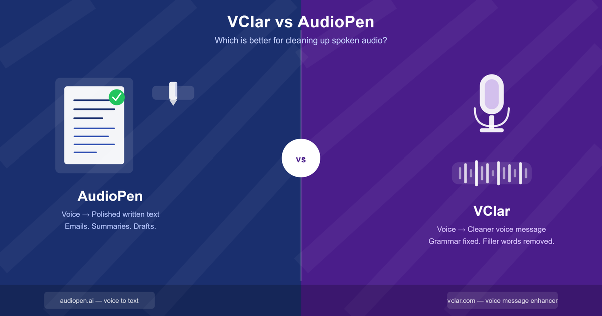
Voice in → polished text out
Your spoken words become clean written text — emails, summaries, bullet points. The audio disappears.
Your voice in → cleaner voice out
Grammar fixed, filler words gone, sentence flow tighter — still in your own voice, ready to send as audio.
Quick answer
If you want to speak freely and get polished written text back — emails, summaries, bullet points, drafts, and structured writing in any style.
If you send voice messages and want a cleaner audio version of what you said, with grammar fixed, filler words removed, spoken sentences improved, and your natural voice preserved.
According to audiopen.ai, AudioPen is a voice-to-text tool trusted by over 200,000 people. Its tagline says it clearly: "Speak like a human. Write like a pro." The product takes your spoken recording, transcribes it, and then rewrites the output into clean, structured written text in whatever style you choose. It does not just transcribe verbatim; it rewrites. Filler words are cut. Rambling is reorganized. The result is polished written text, not a cleaned-up audio file.
AudioPen supports recordings up to 15 minutes per session and offers a wide range of output styles, including formal emails, bullet points, summaries, blog drafts, legal prose, and more. You can create custom writing styles based on your own past writing samples so the output matches your personal tone. The SuperSummaries feature lets you combine multiple recordings into a single cohesive written summary, useful for research, meeting recaps, or ongoing projects.
The platform is available on iOS, Android, Chrome extension, and Mac. It uses a one-time payment model with no auto-renewals: $33 for 3 months, $99 for one year, or $159 for two years. It supports multiple languages, allowing you to speak in one language while having AudioPen write the output in another.
AudioPen is built for writers, thinkers, content creators, and professionals who communicate better by speaking than by typing, and who need the output in written form. If you think out loud and want clean documents at the end, AudioPen is genuinely well-suited for that job.
What AudioPen is not built to do: clean up a voice message and give it back as audio. The output is always text. If the person you are sending a message to is expecting a voice message on WhatsApp or Slack, AudioPen does not solve that problem. It turns your voice into text. VClar turns your voice into a better version of itself.
VClar is an AI voice message enhancer that fixes grammar, removes filler words, improves clarity, and shows what changed so users can improve their speaking over time while keeping their natural voice.
The starting point is the same as AudioPen: you record something, and it comes out messy. The destination is different. VClar gives you back a clean audio file in your own voice, not a written document. Your spoken message stays spoken. It just sounds the way it would if you had recorded it on your best day, with your words in the right order and without the um, uh, like, basically, and you know, getting in the way.
VClar works as an AI grammar checker for audio, correcting spoken grammar mistakes that occur naturally in real time, such as incorrect tenses, missing articles, double negatives, and run-on sentences. It removes filler words from the audio itself. It tightens rambling sentences and restructures unclear phrasing. And it gives you a before-and-after comparison so you can see exactly what changed, turning every message into a small lesson in clearer speaking.
Critically, all of this happens while your voice stays intact. Your accent, your rhythm, your tone, your identity, none of it changes. The message still sounds like you. It just sounds like a more polished version of you.
Fixes spoken grammar mistakes in real time.
Removes filler words from the audio itself.
Tightens rambling sentences and shows a before-and-after comparison.
Keeps your accent, rhythm, tone, and identity completely intact.
VClar is also a voice message translator. It supports 13 languages: English, French, Japanese, Korean, German, Russian, Portuguese, Spanish, Italian, Chinese, Arabic, Hindi, and Danish, covering 156 possible one-way translation combinations. You can record in English and send a clean, natural-sounding version in Korean in your own voice, not a synthetic one.
It is built for the short, fast voice messages that represent you the moment they arrive: WhatsApp audio, Slack voice updates, Telegram messages, sales follow-ups, client check-ins, and founder updates.
You can see everything VClar does at vclar.com. Pricing is at vclar.com/pricing.
This is the clearest way to separate these two tools, and once you see it, the rest falls into place.
Polished written text. You speak. You get a document. The audio is gone.
Clean voice message in your own voice. You speak. You get a better version of your own audio. The voice stays.
Both tools remove filler words. Both clean up messy spoken language. But what they clean it into is completely different, and that difference determines everything about which one you actually need.
If the person on the other end is reading something — an email, a Notion page, a Slack message in text form — AudioPen is the right path.
If the person on the other end is listening to something — a WhatsApp audio, a Slack voice update, a Telegram voice message — VClar is the right path.
Here is how those different jobs break down in practice:
| Feature | VClar | AudioPen |
|---|---|---|
| Best for | Voice messages and spoken communication | Converting speech into polished written text |
| Input type | Short voice recordings or uploaded audio | Voice recordings up to 15 minutes |
| Output type | Cleaned audio voice message ready to send | Polished written text in a chosen style |
| Grammar correction | Yes, spoken grammar, fixed in audio | Yes, rewritten into clean written text |
| Filler word removal | Yes, from the audio itself | Yes, filler words removed from the written output |
| Natural voice preservation | Yes, keep your accent, rhythm, and tone | No — output is text, not audio |
| Audio output for messaging | Yes, clean voice message ready to send | No — output is always text |
| Written text output | No | Yes, emails, bullet points, summaries, drafts |
| Translation | Yes, 13 languages, 156 combinations, in your voice | Yes, speak in one language, write in another |
| Learning from corrections | Yes — shows exactly what changed and why | No speaking feedback feature |
| Writing styles | No | Yes, presets, custom styles, and personal style training |
| Note storage and organization | No | Yes, unlimited storage, SuperSummaries, Zapier |
| Learning curve | Low, no project setup needed | Low — clean interface, fast to use |
| Best users | Founders, salespeople, remote teams, non-native speakers | Writers, thinkers, content creators, professionals |
AudioPen earns its place when the final output needs to be something someone reads, not something someone listens to. If your thoughts come out more clearly when you speak them, but the destination is a written document, AudioPen bridges that gap well.
Use AudioPen when you are:
If your goal is polished writing that starts with speaking, AudioPen does that job cleanly.
VClar fits the moments when the message needs to stay spoken, but sounds better. It is an AI speech-polishing tool designed for real-time voice communication, not for document creation.
Use VClar when you are:
Seeing what VClar fixes is the fastest way to understand what it does.
Example 1: Founder Team Update
“So basically um I think we should maybe delay the launch because the client changed the scope and we were still waiting for final approval. I mean like they just decides to add all these extra stuffs at the very last minute, you know, and it literally don't make no sense for us to rush it right now.”
“I think we should delay the launch because the client changed the scope, and we are still waiting for final approval. They added extra requirements at the last minute, so it does not make sense to rush the release right now.”
What changed: Removed filler words, corrected tense, fixed grammar, shortened the message, and made the update clear and easy to act on. The output is still audio, still the founder's own voice, just cleaner.
Example 2: Sales Follow-Up Voice Message
“Hey i it's just checkings like if you would see the proposals and if we cans maybe moving forwards this week because um we is run much lates on it and i wants for make sure we doesn't miss as nothing importances you knows.”
“Hey, I wanted to check whether you saw the proposal and if we can move forward this week. We are running a little late, and I want to make sure we do not miss anything important.”
What changed: Fixed sentence structure, corrected grammar throughout, removed filler words, and made the follow-up sound professional — exactly the kind of spoken grammar correction for founders and sales teams that makes a real difference to response rates.
Example 3: Language Learner Practice Recording
“Yesterday i go to class and teacher explain the topic but i don't understood properly like um she was talked so much fast and writes many thing on board you knows i tries for listenings to her but my brain is just like stop works completely.”
“Yesterday, I went to class, and the teacher explained the topic, but I did not understand it properly. She spoke very quickly and wrote many things on the board. I tried to listen, but my brain just stopped working completely.”
What changed: Corrected past tense throughout, fixed grammar, removed filler words, improved sentence flow, and showed the learner exactly what to work on next time.
Notice the key difference from what AudioPen would produce: AudioPen would turn any of these into a clean written text document. VClar turns them into a clean spoken audio message. Same starting point, completely different output for a completely different destination.
Both tools have translation, but they work in different ways for different purposes.
AudioPen lets you speak in one language and receive the written output in another. So if you dictate notes in French, AudioPen can write the summary in English. The output is text. It is useful for multilingual writers, researchers, and content creators who think in one language and publish in another.
VClar translates voice messages in your natural voice. You record in English, and the person on the other end receives a clean, natural-sounding version in Korean, French, Spanish, Hindi, or any of the 13 supported languages—156 possible one-way combinations. The output is audio, still in your own voice, ready to send as a voice message.
The distinction matters for the use case. AudioPen translation is for people who want written output in a different language. VClar translation is for people who want to send a voice message to someone who speaks a different language without having to re-record it themselves.
See how VClar handles voice message translation at vclar.com/languages
They share some surface-level features — both clean up messy spoken language — but the outputs and use cases are different enough that neither one is a true alternative to the other.
AudioPen is a voice-to-text writing tool. Its output is always written text. VClar is a voice message enhancer. Its output is always audio. If someone is using AudioPen to capture written notes and drafts, VClar does not replace that workflow. If someone is using VClar to send cleaner voice messages, AudioPen does not replace that either.
Where VClar fits as an AudioPen alternative is the narrow case where someone is using AudioPen specifically to clean up voice messages before sending them — converting audio to text, cleaning it up, and then... what? If the goal was to send a voice message, the person still has to re-record it. VClar cuts out that entire loop and gives back clean audio directly.
Think of it this way: AudioPen is the tool for people who think out loud and write for a living. VClar is the AI speech-polishing tool for people who communicate by voice and want their spoken messages to represent them well.
Both AudioPen and VClar offer real value to non-native speakers, but in different parts of their communication.
AudioPen helps non-native speakers produce clean written content in a second language. You can speak in your native language and receive the output as written English, or speak imperfectly in English and get a polished written draft back. The tool explicitly calls out this use case; its creator built it partly because his father, a non-native English speaker, needed a way to capture thoughts in English without worrying about grammar and structure.
VClar covers the speaking side, which is where most non-native speakers feel most exposed in their day-to-day communication. When you are recording a voice message, you cannot stop and revise. Grammar errors happen in real time. According to research published by Cambridge University Press, spoken language production in a second language is significantly more error-prone than written output because speakers have no opportunity to revise before delivery. VClar closes that gap directly.
You speak in your own accent and in your own voice, and VClar corrects the grammar, removes filler words, and cleans up the sentence structure, all while keeping your identity intact. And because it shows exactly what it changed and why, it becomes a learning tool. Users start noticing their own patterns and improving their spoken English over time — something AudioPen, which is focused on written output, does not offer. You can see more at vclar.com/fix-grammar-in-voice-memo.
Founders, salespeople, and remote workers are heavy voice communicators. They send updates, follow-ups, and check-ins quickly by voice, and they rarely have time to re-record.
Founders record investor updates, client messages, and team briefings. A polished, clear voice message projects confidence and competence. A rambling one, filled with grammatical mistakes, undermines the message, no matter how strong the point underneath it is.
Sales teams depend on how they come across in follow-ups. According to HubSpot research, clear and confident communication consistently outperforms hesitant or poorly structured messages in sales response rates. The filler words remover feature addresses one of the most common credibility problems in voice-based sales communication, and unlike AudioPen, the output remains a voice message, not text you have to copy and paste somewhere.
Remote workers are sending async voice updates on Slack, Loom, or Telegram, replacing meetings with voice messages. When those messages are clear and tight, they save time for everyone. When they are full of filler words and grammar errors, they create more confusion than they solve.
AudioPen genuinely helps this same group when they need the output written. A founder who wants a clean, written summary of their thoughts. A salesperson who needs an email draft from a quick voice dictation. A remote worker writing up async meeting notes. But for the voice message that needs to go out as audio to a client or a team? That is VClar's lane.
AudioPen is the right tool when you want to speak and have the text written back. It is well-built, easy to use, and genuinely useful for professionals, writers, and thinkers who communicate best by talking but need the output in document form. If that describes your workflow, AudioPen earns its place.
VClar is the right tool when you want to speak and get a better version of your own voice message back. If your problem is messy voice messages, spoken grammar mistakes, filler words, rambling delivery, or a voice message that needs to reach someone in another language, VClar is the AI voice message enhancer built exactly for that.
One tool turns your voice into text. The other turns your voice into a cleaner version of itself. Both are useful. Neither replaces the other.