

A founder records a voice note with a pricing figure, and the transcript diff quietly changes "fifteen" to "fifty." The deal nearly collapses before anyone catches it. If you review audio transcript diffs daily, you know that sinking feeling: the changes look fine at a glance, but you're never quite sure what slipped through. The mistakes when reviewing audio transcript diffs are rarely about effort, they're about where you aim that effort.
You're right that diff review feels tedious. This guide promises a faster, higher-catch-rate approach. You'll learn the seven mistakes that cause missed errors, then get a Three-Pass Diff Review Framework that makes review mechanical instead of exhausting. That pattern, and how to break it, is resolved below.
If you send voice notes for founders with numbers, names, or deadlines, VClar's audio-to-transcript pipeline preserves your spoken intent while cleaning filler words and grammar, but you still need a review habit that catches what any AI can miss.
What Is the Three-Pass Diff Review Framework?
The Three-Pass Diff Review Framework is a structured method for reviewing audio transcript diffs in three sequential passes: Pass 1 checks meaning preservation, Pass 2 checks grammar accuracy, and Pass 3 checks voice authenticity. Each pass has a single focus, which prevents the scattered attention that causes most missed errors.
Before starting, have your original audio, the cleaned transcript, and the diff view open side by side. You'll need roughly 90 seconds per 60 seconds of audio.
- Pass 1. Meaning preservation (30 seconds per minute of audio). Open the diff and scan only for changes to numbers, names, dates, negations, and technical terms. Compare each changed instance against the original audio. Expected outcome: you confirm every factual element survived unchanged or flag discrepancies immediately. You should see zero unexplained numeric or name changes before moving on.
- Pass 2. Grammar accuracy (30 seconds per minute of audio). Review every grammar correction the AI applied. Ask: does the correction preserve the speaker's intended meaning? For example, if the AI changes "I ain't gonna lie" to "I am not going to lie," the grammar is technically correct but the emphasis and tone shift. Expected outcome: you accept or reject each grammar change individually, not in bulk.
- Pass 3. Voice authenticity (30 seconds per minute of audio). Read the final transcript aloud in your head and compare it to the speaker's natural cadence. Listen for phrases that sound stiffer or more formal than the original. Expected outcome: the transcript reads like the speaker on their best day, not like a different person.
The framework works because each pass isolates one failure mode. When you try to check meaning, grammar, and voice simultaneously, your attention splits and errors slip through. When you check one dimension at a time, you catch changes that would otherwise hide in plain sight.
If grammar corrections are a recurring pain point, VClar's fix grammar in voice message capability applies corrections conservatively, but Pass 2 still matters, because no automated grammar engine understands intent perfectly.
Mistake #1: Reviewing Linearly Instead of by Risk
Linear diff review is the habit of reading a transcript diff from top to bottom, giving equal attention to every changed line. It feels thorough but wastes attention on low-risk changes while high-risk errors hide in the middle of the document.
Think of a diff like an airport security line. You don't screen every passenger with the same intensity, you route certain bags to secondary inspection based on risk. Numbers, names, dates, negations, and technical terms are the bags that need secondary inspection. A changed "not" flips an entire sentence's meaning. A changed "15" to "50" alters a contract. A misspelled client name erodes trust instantly.
Instead of reading top to bottom, triage first: scan the diff for every changed number, name, date, negation, and technical term. Review those changes against the original audio before touching anything else. Then skim the remaining changes quickly.
This reordering takes the same total time but catches dramatically more errors, because you're spending your attention where errors actually live. Next, we'll look at why accepting grammar corrections without checking intent is the second most common review failure.
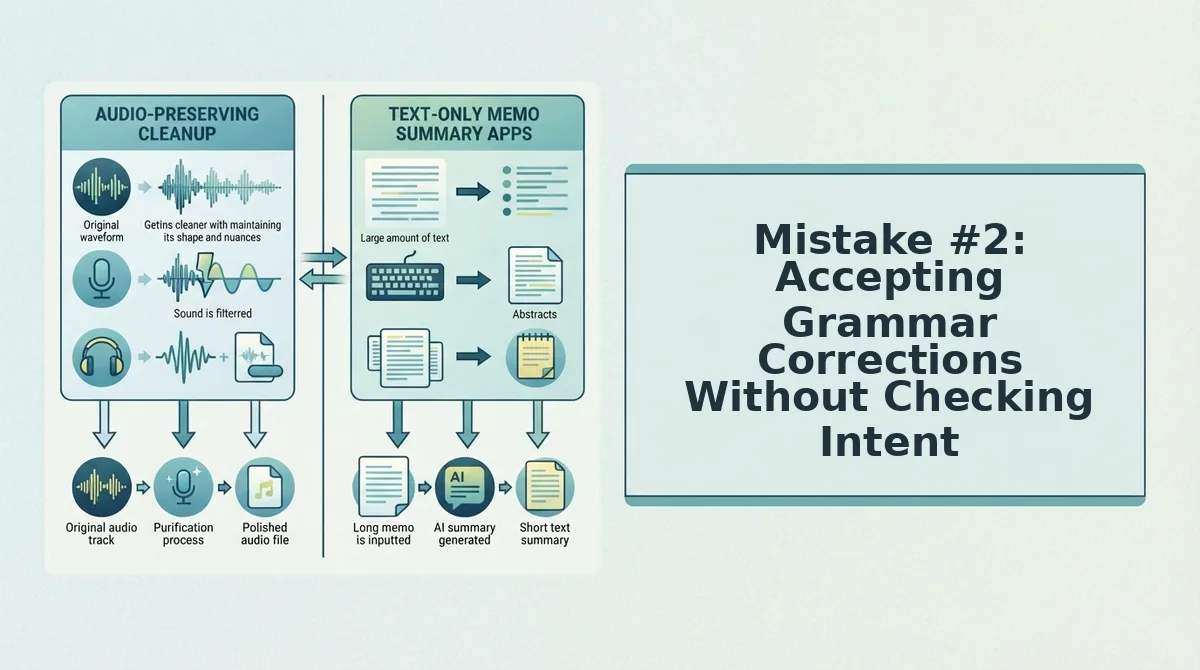
Mistake #2: Accepting Grammar Corrections Without Checking Intent
AI grammar tools often "fix" sentences by changing what you actually meant. The False Correction Taxonomy below catalogs five ways automated edits silently alter meaning, and why you must verify each correction against your original intent before accepting it.
- Terminology swaps: The AI replaces a domain-specific term with a generic synonym that loses precision. A phrase like "churn cohort" becomes "customer group," which sounds correct but means something different to a SaaS founder. Check every replaced noun against your industry vocabulary before accepting.
- Tone flattening: The tool converts emphatic, conversational phrasing into neutral textbook English. "We absolutely crushed that quarter" becomes "We performed well that quarter," stripping the confidence your listener needs to hear. Reject any edit that removes intensity you deliberately included.
- Idiom destruction: The AI "corrects" a regional or cultural expression into literal language. "Let's table this" means postpone in the US but discuss now in the UK, an AI may not know which audience you are addressing. Verify any edited idiom against the recipient's regional context.
- Meaningful false starts removed: A false start you intended as a rhetorical device gets deleted as filler. "It's not, well, actually, it is urgent" loses the pivot that signals honesty. Review every deletion to confirm it was truly non-communicative.
- Punctuation changes that alter emphasis: A comma or dash shift changes which clause carries weight. "Ship it, then test" and "Ship it, then test" read differently to an engineering team. Inspect every punctuation edit for emphasis shifts before approving.
For a deeper comparison of how different tools handle these correction types, see our VClar vs Grammarly breakdown.
Mistake #3: Ignoring Voice and Tone Changes
Voice authenticity is the degree to which a corrected transcript still sounds like the original speaker, same cadence, same emphasis, same conversational rhythm. When you accept grammar edits without checking voice, you risk turning a warm, human message into sterile prose.
Think of voice like a fingerprint on a handwritten letter. Grammar correction that flattens tone is like retyping that letter in a generic font: the words are cleaner, but the person disappears. Start by reading the diff aloud. Does it still sound like you, or like a chatbot wrote it?
At the intermediate level, check emphasis markers. "That's a HUGE deal" becomes "That is a huge deal", grammatically identical, emotionally empty. The capitalization or vocal stress you used carried meaning that text edits erase.
For advanced review, run the voice authenticity checklist: Does it still sound like the speaker? Are emphasis markers intact? Is the conversational rhythm preserved? If any answer is no, reject the edit. Tools like VClar's filler word remover are built to clean audio without flattening that authentic delivery.
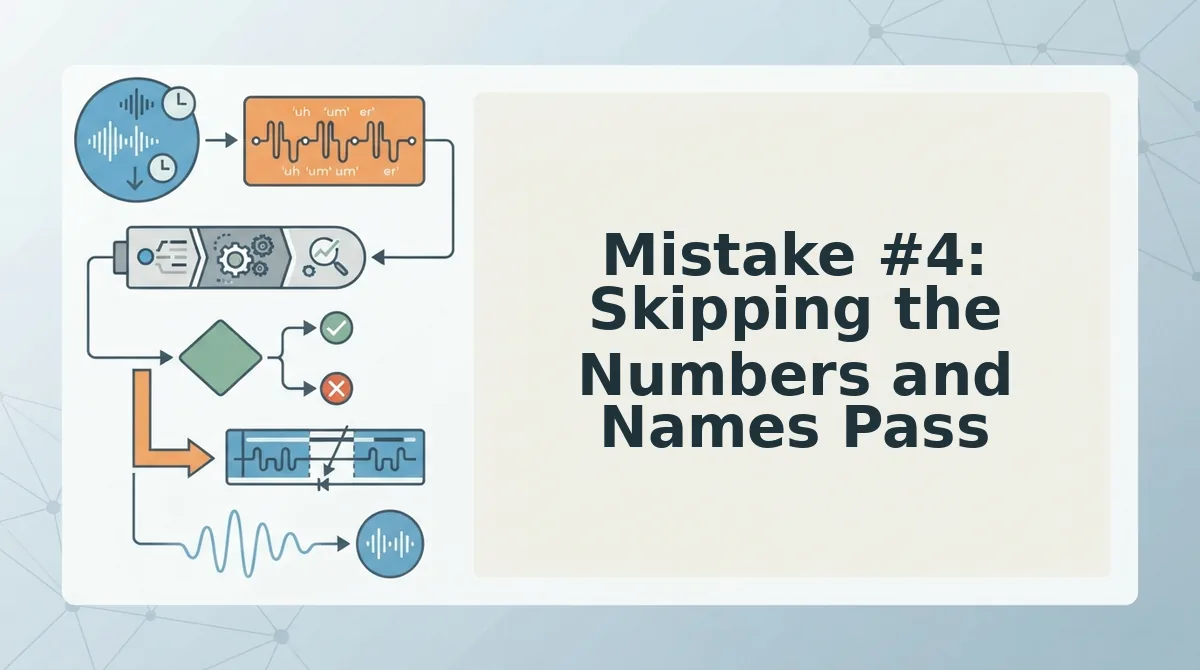
Mistake #4: Skipping the Numbers and Names Pass
Numbers and names are the highest-risk elements in any transcript diff, a single wrong digit or misspelled name can collapse a deal. Before reviewing anything else, isolate every numeric value and proper noun in the diff and verify each one against the original audio.
- Open the diff and filter to numeric changes only. Scan for any digit that changed between the original and corrected transcript. You should see a list of every number the AI touched, typically 5 - 15 per 10-minute message.
- Replay the original audio at each flagged number. Listen specifically for the digit in question. "Fifteen" and "fifty" sound nearly identical at speed; "2024" and "2020" blur in casual speech. Confirm each number matches what was actually said.
- Check every proper noun against a known reference. Verify names like "Sarah" vs "Sara," company names, and product names against your CRM, calendar, or prior correspondence. A misspelled client name in a follow-up signals carelessness.
- Run the founder pricing scenario test. Imagine this diff is a sales follow-up where the price was quoted as $15,000 but the transcript reads $50,000. One unchecked number nearly collapses a deal. Confirm every currency figure, percentage, and date before approving the diff.
Success looks like a diff where every number and name has been explicitly verified, no "probably fine" assumptions. Next, we cover the final mistake: reviewing when fatigued.
Mistake #5: Reviewing When Fatigued
Diff review fatigue is real: reviewers miss more errors after 20 minutes of continuous review, so structure your sessions around short sprints instead of marathon passes.
- Review in 15-minute sprints. Attention degrades sharply after roughly 20 minutes of continuous diff inspection, so break review sessions into focused 15-minute blocks with a short reset between each. This keeps error detection sharp across the entire transcript.
- Triage high-risk sections first. Start each session with the segments most likely to contain consequential errors, numbers, names, negations, and client-facing statements. Front-loading the highest-stakes content ensures it gets your freshest attention.
- Use a checklist to anchor each pass. A written checklist removes the cognitive load of remembering what to look for, letting you focus energy on spotting errors rather than recalling your process. Check items off as you complete each section.
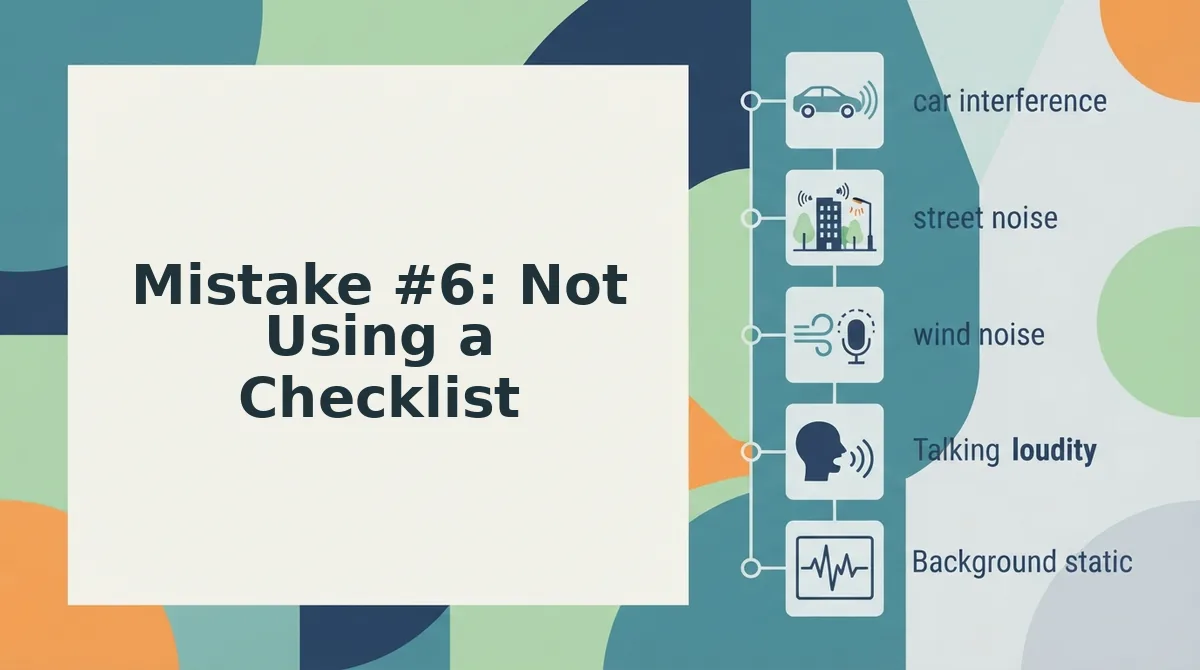
Mistake #6: Not Using a Checklist
A diff review checklist turns an inconsistent, memory-dependent process into a repeatable workflow that catches the same error classes every time.
- Check numbers and names. Verify every figure, date, phone number, and proper noun against the original audio, since these are the highest-consequence errors and the easiest to miss when scanning quickly.
- Verify negations. Confirm that words like "not," "never," "don't," and "can't" survived the transcription and any grammar correction intact, because a dropped negation reverses meaning entirely.
- Confirm technical terms. Ensure industry-specific vocabulary, product names, and acronyms were not replaced by phonetically similar words during cleanup or translation.
- Check speaker intent. Ask whether each corrected sentence still means what the speaker originally intended, especially where grammar correction may have altered nuance.
- Check voice authenticity. Confirm the cleaned audio still sounds like the original speaker, same tone, cadence, and accent, not a flattened or synthetic version.
- Review formatting. Verify paragraph breaks, punctuation, and speaker labels match the structure of the original message and the intended delivery format.
Pair this checklist with VClar's grammar correction workflow to handle cleanup automatically while you focus review time on the items that need human judgment.
Mistake #7: Treating Every Diff the Same
Diff triage is the practice of assigning different levels of scrutiny to transcript changes based on who will hear the message, what's at stake, and how long the recording will exist.
Think of diff review like proofreading: you read a text to a friend differently than a contract you're about to sign. The same change, a rephrased sentence, a removed filler word, carries different weight depending on context.
Use a simple context matrix to decide how deeply to review each diff. First, identify the audience: a client-facing voice message needs stricter review than an internal team note. Second, assess the stakes: a pricing quote or deadline is high-stakes, while a casual status update is low. Third, consider permanence: a recorded message that will be replayed or archived demands more care than an ephemeral note.
Apply the matrix before you start reviewing, not after. High-audience, high-stakes, high-permanence diffs get a full three-pass review; low-context diffs can be accepted with a quick scan. This keeps your attention where errors actually hurt.
Next, see the most common questions readers ask about audio transcript diff review.
FAQ: Common Questions About Audio Transcript Diff Review
Reviewing audio transcript diffs means comparing the AI-corrected transcript against your original spoken words, then deciding which changes to accept or reject before sending the final message.
What mistakes should you avoid when reviewing audio transcript diffs?
Avoid reviewing linearly, accepting grammar fixes without checking intent, ignoring tone shifts, skipping the numbers-and-names pass, reviewing while fatigued, working without a checklist, and treating every diff as equally important. Prioritize high-risk changes like names, figures, and sentiment-altering edits first.
How do you spot false corrections in a transcript diff?
Look for changes that alter meaning rather than polish grammar. A false correction often replaces a colloquial phrase with a formal one, swaps a homophone, or "fixes" a number that was actually correct. Compare each flagged change against the original audio, not just the raw transcript.
When should you accept an AI grammar correction vs. reject it?
Accept a correction when it removes a filler word, fixes subject-verb agreement, or tightens word order without changing your meaning or tone. Reject it when the edit shifts emphasis, replaces your phrasing with something you would not say, or alters a proper noun, figure, or technical term.
Why does my transcript diff show changes I never made in the audio?
Speech-to-text engines sometimes mishear words, especially with accents, background noise, or fast speech. The diff then shows a "correction" that was actually a transcription error. Always verify surprising changes against the original recording before accepting them.
How do I review transcript diffs faster without missing errors?
Use the Three-Pass Framework: first scan for high-risk items like numbers and names, then review grammar and filler-word removals for intent, and finally listen to the corrected audio once to confirm tone and cadence. A checklist keeps each pass consistent.
Make Diff Review a Habit, Not a Chore
The Three-Pass Framework, risk scan, intent check, tone listen, plus awareness of the seven mistakes turns daily diff review from a tedious scroll into a 90-second quality gate. The payoff is not just cleaner transcripts; it is confidence that every accepted change still sounds like you.
Start your next review by opening VClar's side-by-side comparison and running the risk pass first: names, numbers, and anything that changes meaning. Then accept grammar fixes that preserve intent, reject edits that flatten your voice, and send the message in one take.