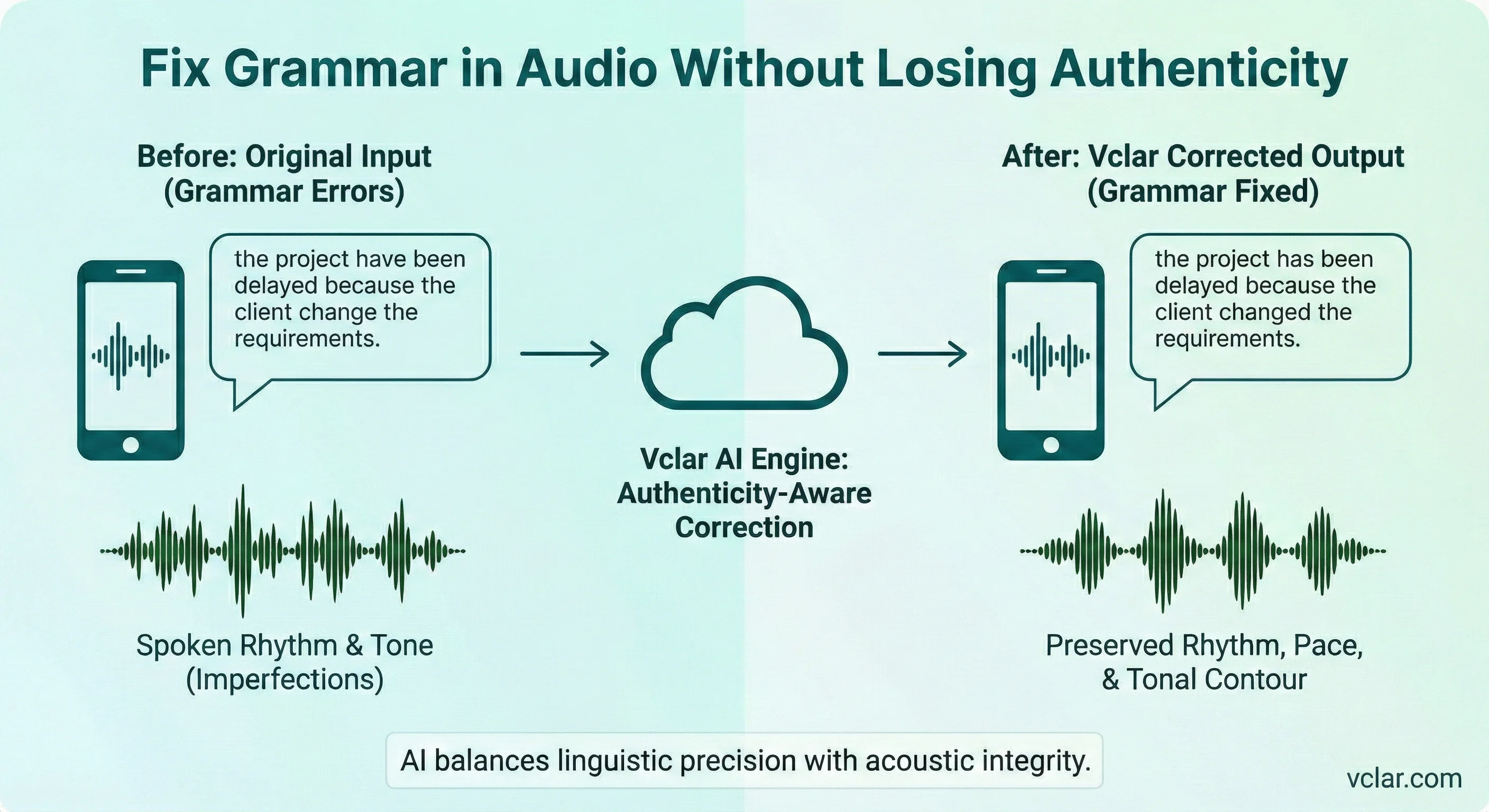
Speaking a second language in public often feels terrifying. You hesitate, drop prepositions, scramble verb tenses, and fill every silent gap with nervous “um”s and “er”s. VClar provides a private, zero-judgement sandbox: speak your honest thoughts into quick voice notes, let AI excise hesitation fillers and repair spoken grammar, and hear your authentic voice speaking with polished, native-grade clarity.
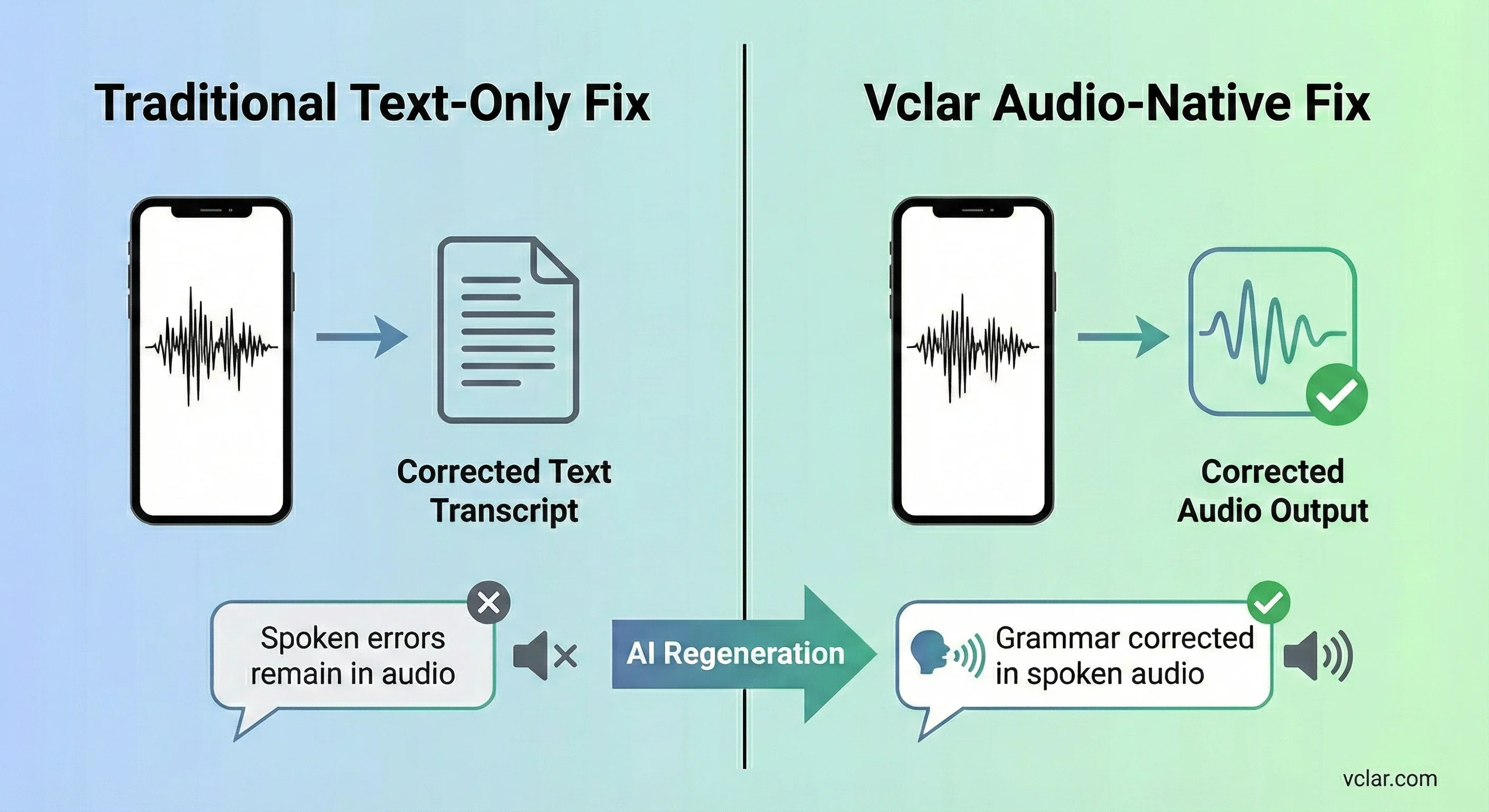
Textbooks, flashcard apps, and written grammar drills rely entirely on receptive recognition memory: you recognize a rule on paper when given unlimited time to deliberate. However, spontaneous spoken communication requires instantaneous productive oral retrieval under strict temporal pressure. When speaking out loud, your brain struggles to balance message formulation, lexical retrieval, syntactic concord, and pronunciation simultaneously, causing learners to default to crutch words (“like”, “um”) and native-language grammatical structures.
VClar bridges the critical gap between theoretical knowledge and spontaneous speech. By speaking unscripted 60-to-120 second voice notes, learners generate raw conversational data. VClar automatically excises vocal hesitations, corrects grammatical slips (such as irregular past tense drift, dropped articles, or incorrect prepositions), and outputs two vital artifacts: (1) polished audio retaining the learner's genuine vocal identity, and (2) a side-by-side comparative transcript. This enables students to execute Richard Schmidt’s classic “Noticing Hypothesis”—hearing their own voice speaking flawlessly and internalizing correct structural rhythms without speech anxiety.
Thousands of intermediate and advanced language learners experience the painful paradox: they can score 95% on written grammar exams, read complex foreign literature, and write detailed academic essays, yet stumble awkwardly when asked a simple spontaneous question in a live conversation.
According to cognitive psycholinguistics, human working memory can only manage 4 to 7 informational chunks simultaneously. In conversation, non-native speakers must mentally manage concept generation, vocabulary lookup, tense alignment, subject-verb agreement, and phonological articulation simultaneously. When working memory overloads, grammar is the very first system that collapses.
As formulated by renowned second-language acquisition researcher Stephen Krashen, the Affective Filter is a subconscious emotional defence mechanism. When a student feels judged by peers, professors, or native speakers, anxiety spikes, the filter rises, and the brain's language acquisition apparatus shuts down. Fear of embarrassing grammar mistakes prevents practice, creating a vicious cycle of silence.
When you speak, bone conduction and internal cognitive processing distort what you hear of your own voice. You cannot objectively hear your own preposition errors, repeated verbal tics (“like, um, you know”), or incorrect stress patterns. Without listening back to a clean recording, learners calcify bad habits through fossilized repetition.
“Learners do not learn from input alone; they must consciously ‘notice’ the gap between what they produce in their current interlanguage and how native speakers express the same semantic concepts.”
How does asynchronous voice note deliberate practice compare against traditional tutors, mobile gamification apps, and speech-to-text dictation tools?
| Methodology | Spontaneous Speech Output | Spoken Grammar Correction | Anxiety / Affective Filter | Audio Feedback in Your Voice | Cost & Availability |
|---|---|---|---|---|---|
| Textbook Grammar Drills | None (0% oral production) | Written answer key only | Zero social pressure | None | $30–$80 one-time |
| Gamified Apps (e.g. Duolingo) | Isolated scripted sentences | Binary right/wrong tap | Low anxiety | Robotic synthetic TTS only | Free / $12/month |
| 1-on-1 Human Tutors (e.g. iTalki) | High (Live conversational) | Interrupts conversational flow | Very high anxiety for beginners | Rarely recorded or reviewed | $25–$60 per single hour |
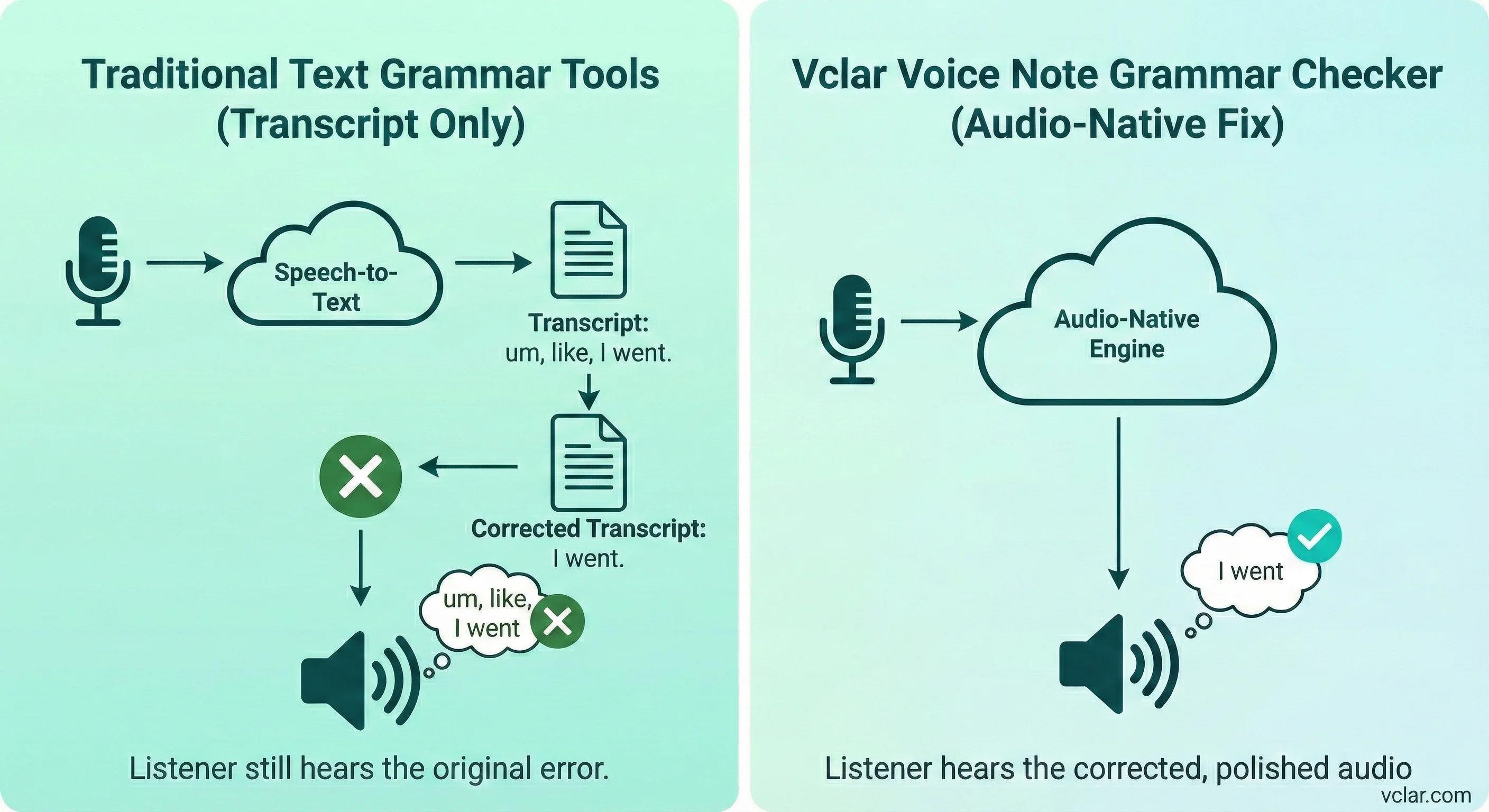
| Standard Speech-to-Text | Freeform speech supported | Transcribes errors verbatim; no fixes | Zero social anxiety | No polished audio output | Included in OS |
| VClar Voice Note Sandbox | Continuous freeform 1–5 min speech | Deep syntax, tense, and filler repair | Zero-stakes private practice sandbox | 100% genuine voice audio playback | Free 2 mins; affordable credits |
Language fluency is not an innate gift—it is an iterative feedback loop. The S.P.E.A.K. Framework provides a structured 5-stage daily ritual that transforms casual spoken voice notes into rapid grammatical mastery.
Record 60 to 120 seconds of unscripted thoughts. Do not write an advance script. Pick an open prompt, tap record in VClar, and speak continuously without stopping when you stumble.
VClar's neural linguistic pipeline excises crutch sounds (“um, uh, like”) and rectifies broken syntactic clauses, irregular past tenses, and preposition mismatches while maintaining your personal vocal timbre.
Put on headphones and listen to your polished recording. Hearing your own voice speak with grammatically pristine phrasing triggers strong neuro-linguistic self-affirmation and internal auditory modeling.
Because no human is judging your hesitations or missteps, your anxiety levels remain low. This opens the neurobiological channels necessary to absorb feedback without ego-defensiveness.
Review the dual transcripts. Note down the 2 or 3 recurring grammar slips you made. Over 30 days of daily voice notes, your error frequency drops exponentially as correct patterns automate.
Whether you are aiming for a Band 8.0 on your IELTS Speaking test, presenting your PhD dissertation, or chatting with native penpals on WhatsApp, VClar adapts to your specific spoken objective.
In high-stakes oral exams like the IELTS Speaking Assessment, examiners grade candidates on four strict pillars: Fluency & Coherence, Lexical Resource, Grammatical Range & Accuracy, and Pronunciation. Candidates who panic during Part 2 (the 2-minute uninterrupted monologue) frequently suffer from chronic tense switching and prolonged awkward pauses.
International graduate students, postdocs, and researchers frequently possess groundbreaking experimental insights but hesitate to raise their hands during university colloquia because they fear tripping over complex technical syntax or sounding unpolished in front of prestigious faculty.
Platforms like WhatsApp, Telegram, Tandem, and HelloTalk are ideal for exchanging voice notes with native speakers in Madrid, Tokyo, Paris, or Berlin. But sending a 3-minute rambling audio full of false starts makes conversations exhausting for your language exchange partner.
Language acquisition requires consistent, high-frequency oral output. Traditional written diaries help writing, but leave speech muscles untrained. Spoken journaling—spending 2 minutes every evening describing what happened during your day—rewires your neural pathways for instantaneous lexical retrieval.
Examine how VClar handles real spontaneous student voice notes—repairing grammatical syntax, excising filler pauses, and preserving genuine vocal personality.
“Uh, well, if I talk about my future job, um, I have been wanting to work in renewable energy since three years. Because, you know, when I was in university, I was studying how climate change affect the agriculture, and, uh, I think it is very important that we must to find new solutions. So, um, actually, I am searching for a company that give me the opportunity to learn more.”
Errors Detected: “since three years” (should be for three years), “affect” (subject-verb agreement: affects), modal double auxiliary “must to find” (must find / have to find), “company that give” (gives).
“Regarding my future career, I have wanted to work in renewable energy for three years. When I was at university, I studied how climate change affects agriculture, and I believe it is crucial that we find new solutions. Currently, I am seeking a company that gives me the opportunity to expand my expertise.”
Result: Preposition repaired, subject-verb concord restored, filler words removed, and tone elevated to Band 8.0 academic register while preserving the speaker's natural voice.
“Um, hi professor. Like, I wanted to discuss about the thesis methodology. Uh, basically, the dataset what we collected last week, it have many missing values. And, er, we did not noticed this problem until yesterday when my colleague runned the script. So, you know, we need to decide if we should recollect or, like, impute the data.”
Errors Detected: Transitive verb redundancy “discuss about”, relative pronoun error “dataset what we collected”, irregular past tense “did not noticed” & “runned”, subject-verb agreement “it have”.
“Hi Professor, I would like to discuss the thesis methodology. The dataset that we collected last week contains numerous missing values. We did not notice this issue until yesterday when my colleague ran the script. Therefore, we need to decide whether we should recollect the samples or impute the missing data.”
Result: Crisp academic terminology, eliminated awkward repetitions, rectified irregular verbs, and formatted into an authoritative 34-second voice update.
“Hey Mark! Uh, sorry for not answer before, I was very busy with my work. Actually, this weekend, I will go to the countryside with some friends of me. We will do some hiking and I hope that the weather will make beautiful. What about you? Did you already went to that Italian restaurant you told me?”
Errors Detected: Preposition after gerund “not answer” (not answering), possessive calque “friends of me” (friends of mine), French idiomatic calque “make beautiful” (be nice/warm), past auxiliary double-marking “did you already went” (have you already been / did you go).
“Hey Mark! Sorry for not answering sooner—I was swamped with work. This weekend, I am going to the countryside with some friends of mine to do some hiking, and I hope the weather stays nice. What about you? Have you already been to that Italian restaurant you mentioned?”
Result: Natural native phrasing replaced direct French word-for-word calques, hesitation sounds removed, and warm conversational camaraderie preserved in the learner's genuine voice.
Why do these specific grammatical slips happen during live speech even when you know the rule perfectly well on paper? Let's unpack the linguistic mechanics.
When telling a story about the past, learners frequently begin in the past tense (“I visited the museum”), but as they become immersed in the visualization, they mentally slide into the present tense (“and then the guide is explaining to us and we see this painting”).
Prepositions are rarely semantic; they are idiomatic syntactic glue. Non-native speakers either add redundant prepositions based on native tongue habits (“discuss about”, “order for food”) or omit mandatory dependent prepositions (“listen music”, “wait my friend”).
When a prepositional phrase or dependent clause separates the grammatical subject from the predicate verb, working memory loses the subject's grammatical number, matching the verb to the nearest noun instead.
When the brain needs 800 milliseconds to find a foreign word, silence triggers social panic. To hold the conversational floor, learners insert verbal fillers (“um, uh, like, you know, actually, er”) every three words, destroying listener comprehension.
Under spontaneous speaking pressure, the subconscious brain formulates the sentence architecture in the mother tongue and translates words one-by-one into the target language, resulting in unnatural, awkward phrasing.
VClar's linguistic engine specifically targets these five spoken vulnerabilities. It repairs the syntax without flattening your natural cadence, training your brain to produce correct patterns autonomously.
Language acquisition researchers emphasize the “Dual Coding Theory”—information is retained significantly better when encoded through both auditory and visual verbal channels simultaneously.
Hearing the corrected sentence in your own authentic vocal pitch and accent builds phonological loop familiarity. Your brain registers: “I am capable of speaking this fluently,” eliminating the cognitive dissonance caused by generic synthetic robot voices.
Reading the clean transcript alongside your original speech allows you to visually inspect syntax changes, highlight new vocabulary, and copy-paste key phrases into your personal Spaced Repetition System (SRS) such as Anki or Notion.
You do not need expensive immersion trips or 60-minute tutoring sessions every day. A focused 10-minute daily voice note habit generates exponential compound gains in grammatical accuracy and vocal ease.
Choose a thought-provoking question, explain an article you read today, or describe an event from your week. Avoid pre-writing notes—keep it spontaneous.
Hit Record on your phone or laptop. Speak for 60 to 120 seconds. Do not restart if you stumble or hesitate—push through to the finish line.
Review the side-by-side comparative transcript. Note the prepositions, verb forms, or word order changes VClar repaired. Add key corrections to your notes.
Play the polished audio and shadow the phrases aloud at the same tempo. Build vocal tract muscle memory articulating correct grammar in your own voice.
Standard digital audio workstations and text editors are not built for second language acquisition. See how dedicated neural speech editing revolutionizes language practice.
Discover how asynchronous voice notes, automated grammar correction, and filler excision power productivity across teams, solopreneurs, and global communicators.
Linguistic, pedagogical, and practical guidance for ESL/EFL students, polyglots, and test candidates.
Most popular language learning apps rely on multiple-choice taps, drag-and-drop word puzzles, and isolated vocabulary drills. These exercises engage receptive recognition memory rather than productive speech retrieval. In real-world conversation, your brain must simultaneously formulate ideas, retrieve lexical items, execute grammatical rules, and coordinate articulatory muscles in fractions of a second. Deliberate freeform speaking practice with voice notes develops genuine communicative competence that multiple-choice quizzes cannot replicate.
When speaking out loud, your cognitive bandwidth is occupied with expressing meaning, making it nearly impossible to monitor your own syntax errors in real time. VClar provides both polished audio and a clear comparative transcript. By comparing what you said with the polished version, you immediately observe systemic patterns such as tense shifting, dropped plural markers, awkward preposition choices, or mother-tongue calques.
No. VClar strictly preserves 100% of your genuine vocal identity, timbre, pitch, and acoustic resonance. It does not replace you with an artificial computer voice or synthetic voice avatar. You hear your own voice speaking with grammatical precision and confident pacing, which provides profound psychological reinforcement for second language learners.
Yes. Examiners assess candidates across four specific criteria: Fluency and Coherence, Lexical Resource, Grammatical Range and Accuracy, and Pronunciation. Recording daily 2-minute timed responses to past exam questions trains your pacing, eliminates distracting hesitation fillers ('um', 'er'), and reveals grammatical bottlenecks that cap your score at Band 6.0 so you can push into Bands 7.5 to 9.0.
Linguist Stephen Krashen demonstrated that high anxiety, self-consciousness, and fear of making public mistakes raise an emotional barrier called the Affective Filter, which blocks effective language acquisition. In a live classroom or with a stranger, students frequently freeze up. Recording private voice notes in VClar creates a zero-stakes, judgement-free sandbox where learners can experiment freely, make mistakes safely, and build self-efficacy before speaking in public.
Yes. VClar supports 10 major global languages: English, Spanish, French, German, Japanese, Korean, Portuguese, Italian, Russian, and Chinese (Mandarin). You can practice speaking in any of these languages, polish conversational syntax, and even translate your voice notes bidirectionally across 90 language pairs.
Yes. Every registered user receives 2 free lifetime minutes at $0 with no credit card required. Students can test their first voice note recordings, analyze their spoken grammar, and experience the learning workflow completely free before deciding on an extended practice plan.
Overcome language anxiety in a private, supportive sandbox. Excise verbal hesitations, correct spoken grammar slips, and build effortless conversational confidence today.
No credit card required. Free tier includes 2 lifetime minutes. Instant export in MP3, WAV, and text.