
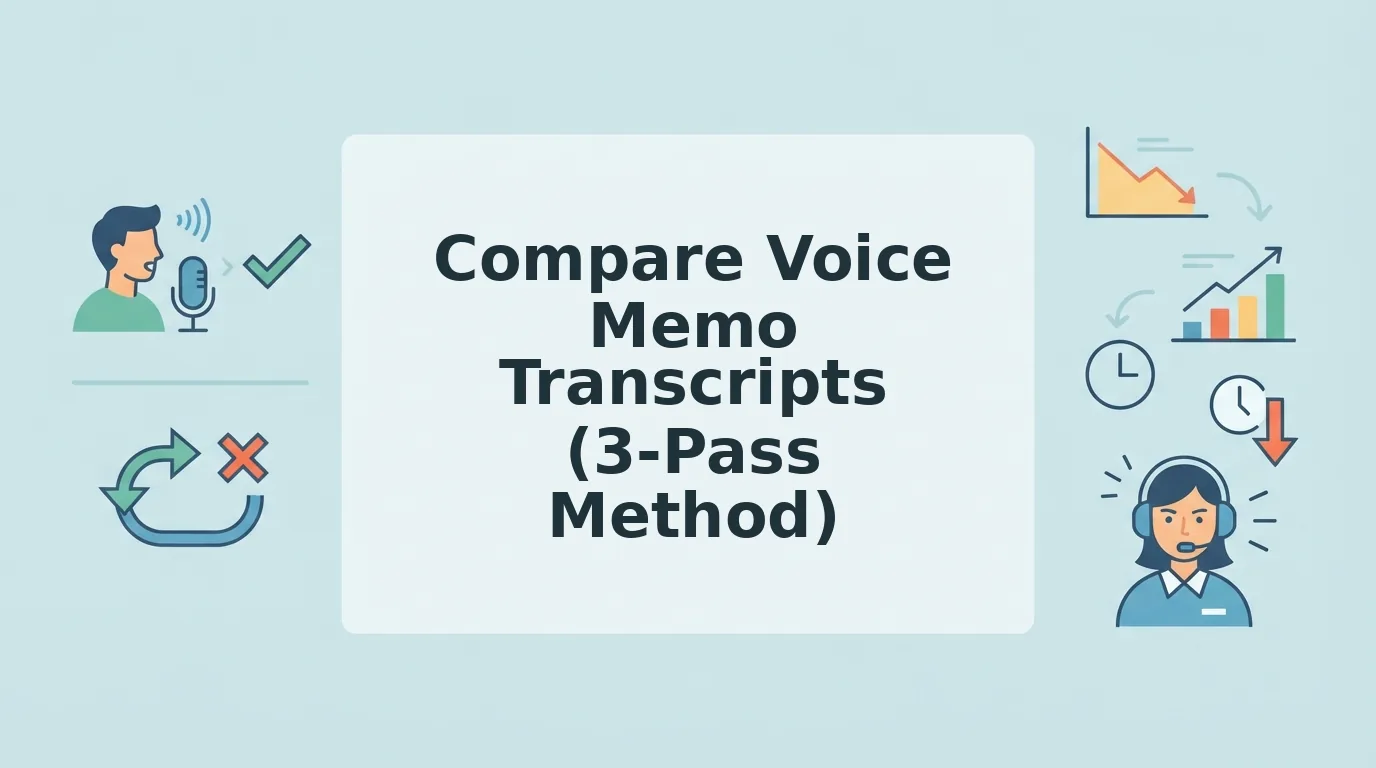

You record 10 voice memos a week but never listen back, because hearing your own voice stumble through "um" and "like" is awkward enough to avoid entirely. That avoidance is costing you more than you think. Comparing voice memo transcripts side by side turns that cringe into a diagnostic tool, and it's the fastest way to spot the speech habits that quietly undermine your authority in every message you send.
You're not alone if reviewing your own recordings feels uncomfortable. The good news: you don't need to listen to a single second of audio to find the patterns. A transcript does the listening for you.
This guide walks you through a repeatable Three-Pass Audit that takes under 5 minutes per memo, reveals the exact habits dragging down your clarity, and sets you up to fix them in one take. Stick around for the third pass, the scoring step exposes a pattern most people never notice until it's pointed out.
Once you've identified your recurring fillers, tools like VClar's filler word remover can strip them from audio automatically, so the fix doesn't require re-recording.
What Comparing Voice Memo Transcripts Actually Reveals
Comparing voice memo transcripts is the practice of placing two or more written versions of your spoken messages side by side to identify recurring speech patterns that are invisible in real time. The value isn't in any single transcript, it's in the repetition across them.
Think of it like reviewing game footage instead of trying to remember how you played. During the game, you're too busy executing to notice that you always dribble left under pressure. The transcript is the replay: it freezes your speech so you can finally see what you actually do, not what you think you do.
At the simplest level, a single transcript shows you the fillers, "um," "ah," "like," "you know", and the false starts where you begin a sentence, abandon it, and restart. One Reddit user described reading their first transcript as "seeing your speech in writing for the first time," and the patterns became impossible to ignore.
At the intermediate level, comparing two or three transcripts reveals structural habits: sentence fragments that trail off without a verb, run-ons that string four ideas into one breath, and circular phrasing where you restate the same point three different ways before landing it.
The advanced insight comes from frequency tracking. When you compare five or more transcripts, you can count how often each habit appears per memo and spot your dominant pattern, the one that shows up in every recording regardless of topic, audience, or time of day. That dominant pattern is your highest-leverage fix, because eliminating it improves every message you send at once.
The Three-Pass Transcript Audit: A Repeatable Method
The Three-Pass Transcript Audit is a structured method for reviewing voice memo transcripts in three focused passes, filler inventory, structural gap marking, and clarity scoring, to identify and rank your most damaging speech habits in under 5 minutes per memo.
Before starting, gather at least three transcripts of your recent voice memos. You'll need a way to highlight text (any notes app or PDF reader works) and a simple 1 - 5 scoring sheet. If you don't have transcripts yet, record three short memos and generate text versions using any transcription tool.
- Pass 1: Filler Inventory (2 minutes). Open your first transcript and highlight every instance of "um," "ah," "like," "you know," "basically," and any false start where a sentence begins and restarts. Count the highlights. You should see a clear number of fillers per transcript, most people land between 8 and 20 in a 60-second memo. Repeat for the remaining transcripts and note which filler appears most often across all of them.
- Pass 2: Structural Gap Marking (2 minutes). Go through each transcript again and mark sentence fragments that lack a complete thought, run-ons that cram multiple ideas into one breath, and circular phrasing where you restate the same point. Use a different color or symbol than Pass 1. You should see a visual map of where your sentences break down, typically clustered at the start of a memo when you're warming up, or at the end when you're rushing to wrap.
- Pass 3: Clarity Scoring (1 minute per transcript). Read each transcript once and rate it 1 - 5 on how clearly the main point comes through, where 1 means "I can't tell what I was asking for" and 5 means "the ask is obvious in the first sentence." Write the score at the top of each transcript. You should see a pattern emerge: memos with high filler counts almost always score lower on clarity, which confirms which habit to fix first.
Once you've identified your dominant filler, you can remove filler words from audio automatically with VClar's filler word remover, no re-recording required, and your natural tone stays intact.
With your raw transcripts marked up, the next step is placing them next to cleaned versions to see exactly what changes.
Side-by-Side Comparison: Raw vs. Cleaned Transcripts
A raw transcript captures exactly what you said, including every hesitation and false start. A cleaned transcript shows what you meant to say, with fillers removed, fragments merged, and grammar corrected while preserving your vocal identity.
| Dimension | Raw Transcript | Cleaned Transcript |
|---|---|---|
| Filler words | Captured verbatim (um, ah, like, you know) | Removed seamlessly from the audio timeline |
| Grammar | Reflects spoken grammar, including fragments and run-ons | Corrected to grammatically sound sentences |
| False starts | Preserved as repeated or abandoned phrases | Merged or removed so the message reads decisively |
| Voice authenticity | 100% original delivery | Original tone, cadence, and accent retained |
| Best for | Self-auditing speech habits and spotting patterns | Sending polished messages to clients, investors, or teams |
Here's the learning loop: a founder records a voice memo to a client, then compares the raw transcript with the cleaned version to see exactly what changed. The delta reveals which habits the cleanup tool fixed, fillers removed, fragments merged, hedging tightened.
Raw transcripts are best for founders and creators who want an unfiltered mirror of their speaking style. Cleaned transcripts are best for anyone sending voice messages that need to land with authority in one take. VClar's fix grammar in voice message capability makes this comparison automatic, so you can review the delta without manually editing anything.
The Speech Pattern Scorecard: 6 Tics to Track
Most people have two or three recurring speech tics they never notice until they see them in writing. Tracking these six patterns across your voice memo transcripts turns vague self-criticism into a fixable checklist.
- Filler words (um, ah, like, you know). These signal hesitation and buying time. Fix by pausing silently instead, a one-second pause reads as confidence, not uncertainty.
- False starts. Beginning a sentence, abandoning it, and restarting signals uncertainty. Fix by thinking one beat before speaking, then committing to the full sentence.
- Run-on sentences. Stringing three or more clauses together signals excitement that can overwhelm the listener. Fix by adding deliberate pauses between complete thoughts.
- Fragments. Incomplete sentences signal scattered thinking. Fix by completing the thought before moving to the next point.
- Hedging (basically, sort of, I think maybe). These qualifiers signal low authority and undercut your message. Fix by stating directly what you mean without softening.
- Trailing off. Letting a sentence fade without a clear ending signals a lost train of thought. Fix by summarizing your point before stopping.
For founders who rely on voice notes for founders, this scorecard works as a weekly audit. Record five memos, run them through VClar's cleanup, and mark which of the six tics appear in each raw transcript. Within two weeks, you will see the count drop as you start self-correcting in real time.
Tools for Comparing Voice Memo Transcripts
You have three practical options for comparing raw and cleaned voice memo transcripts, and each serves a different workflow. The right choice depends on whether you need privacy, cleanup, or granular detail.
| Tool Type | Strengths | Limitations | Best for |
|---|---|---|---|
| Built-in transcription (Apple Voice Memos, Google Recorder) | Free, private, no extra app required | No cleanup, fillers and fragments stay in the transcript | Users who want a quick raw transcript without sharing audio externally |
| AI cleanup tools (VClar) | Removes fillers, fixes grammar, keeps your authentic voice | Requires uploading audio to a third-party service | Founders, sales teams, and creators sending polished voice messages |
| Manual transcription | Most detailed, captures tone and context notes | Slowest option by far | Researchers or analysts documenting exact speech patterns |
Built-in tools win on privacy and zero cost. Manual transcription wins on depth. AI cleanup wins on speed and output quality. VClar lets you clean voice memos online and compare the before-and-after in one workflow, which neither built-in nor manual options offer.
Now let's answer the most common questions about comparing voice memo transcripts.
FAQ: Comparing Voice Memo Transcripts
Comparing voice memo transcripts means reading two or more transcriptions side by side to spot repeated filler words, false starts, and grammar slips that you can then target for removal or correction.
How do I compare voice memo transcripts to find recurring speech habits?
Transcribe at least three voice memos, then scan each one for repeated words like "um," "like," or "basically." Mark every filler, false start, and grammar slip, then list which patterns appear in two or more transcripts. Those repeats are your habits.
What should I look for when reading my own voice memo transcripts?
Look for filler words, repeated sentence starters, trailing sentences that never finish, and places where you correct yourself mid-thought. Also note pacing cues like long pauses, which often signal hesitation or a lost train of thought.
Can I compare transcripts for free?
Yes. Most phone voice memo apps include a basic transcription feature, and free tools like Otter.ai or your phone's built-in dictation can produce raw text. For filler-word removal and grammar fixes, you need a dedicated cleaner like VClar.
How many voice memos do I need to compare to see patterns?
Three to five memos from different contexts is enough to reveal recurring habits. A single memo shows one-off slips, but patterns only emerge when the same filler word or false start appears across multiple recordings.
What's the difference between a raw transcript and a cleaned transcript?
A raw transcript captures every word exactly as spoken, including fillers, false starts, and grammar errors. A cleaned transcript removes those verbal tics and corrects grammar while preserving your authentic voice, tone, and cadence, so the message reads as polished as it sounds.
To compare transcripts effectively, record yourself speaking naturally for 60 to 90 seconds on three different topics. Transcribe each memo without editing, then read all three side by side. Highlight any word or phrase that appears in at least two transcripts, especially fillers like "um," "you know," or "basically," and note where sentences trail off or restart. Those repeated elements are your speech habits. Once you identify them, run the same audio through a voice message cleaner to see the difference between raw and polished delivery, then compare the cleaned versions to confirm which habits were removed and which still need attention.
Your Next Voice Memo Is the Baseline
You now have a repeatable method for turning scattered voice notes into a clear picture of how you actually speak. The payoff isn't just cleaner messages; it's the confidence that comes from knowing exactly which habits to target, and watching them disappear from your transcripts over time.
Start with one voice memo. Transcribe it, run the Three-Pass Audit, and note your top pattern. Then do the same next week and compare. The shift from "I talk too fast" to "I use 'basically' 14 times per memo" is the difference between guessing and improving.
When you're ready to hear the cleaned version of your own voice, clean voice memos online with VClar and compare the raw transcript against the polished one. Your habits are already in the data. Now you know how to read them.