

You've recorded the same voice memo four times, and every take ends with a thought that just... stops. Founders and sales reps lose hours re-recording voice memos because of trailing phrases and disjointed grammar, the "and the metrics are, well, you know..." problem that kills momentum and confidence.
You're not bad at speaking. You're just trying to edit in real time, and that's the wrong tool for the job. This article shows you how to fix dangling spoken phrases in voice memo recordings using a three-step framework: Identify, Decide, Deliver. You'll learn to spot the trail-off, choose between cutting or completing the thought, and deliver a clean one-take message, without losing your natural voice.
Along the way, you'll see how tools like VClar's AI voice enhancer can strip the verbal dead ends automatically, so you stop re-recording and start sending. And there's one surprising reason your brain creates dangling phrases in the first place, you'll find it in Step 2.
What Is a Dangling Spoken Phrase?
A dangling spoken phrase is an incomplete thought that trails off mid-sentence, leaving the listener waiting for a conclusion that never arrives. It's the vocal equivalent of writing "the report shows that..." and then walking away from the keyboard.
Think of a dangling phrase like a bridge that stops halfway across a river. The speaker starts the crossing, "I think the real issue is...", but never pours the final support beam. The listener is left standing on the edge, reconstructing what you probably meant.
Dangling phrases are not the same as filler words. Filler words like "um" or "like" are noise you can remove filler words from audio without changing meaning. A dangling phrase, by contrast, is a structural break: the sentence itself is unfinished. Here are three concrete examples:
- Trailing filler: "The Q3 numbers are, well, you know...", the thought evaporates after the filler.
- Unfinished comparison: "Our churn rate is actually better than...", better than what? The benchmark never appears.
- False start: "What I wanted to say was, actually, the main point is...", the first clause dangles, abandoned mid-launch.
At a deeper level, dangling phrases happen because spoken language is generated in real time, while your brain's planning system runs a few words ahead. When that planning buffer empties, often because you're tired, distracted, or unsure of the data, the sentence simply stops. Written language hides this with editing; voice memos expose it. The fix isn't to speak more carefully. It's to identify the trail-off, decide what the sentence needed, and deliver a completed version, which is exactly what the next three steps cover.
Step 1. Identify the Trail-Off
Before you can fix a dangling phrase, you have to hear it. This step takes about two minutes per minute of audio and requires only your voice memo and a pair of headphones.
- Play back your memo at 1x speed and listen for the moment your voice loses conviction. Dangling phrases almost always end with a downward pitch drop or a trailing filler. You should be able to mark the exact word where the thought stopped.
- Watch for three patterns: incomplete comparisons, broken conditionals, and trailing asides. An incomplete comparison is "better than..." with no benchmark. A broken conditional is "if we hit the target, then..." with no consequence. A trailing aside is "which reminds me, actually..." that never returns to the main point.
- Transcribe the memo and highlight every sentence that ends in an ellipsis, a dash, or a filler word. The visual break makes trail-offs obvious. You should end up with a short list of incomplete sentences, usually two to four per minute of unscripted speech.
Here's the part most people skip: a founder recording an investor update trails off with "and the metrics are, well, you know...", and doesn't notice it because they're focused on the numbers, not the sentence. Listening for the structure, not the content, is what catches it. If you record voice notes for founders regularly, this habit compounds fast.
Once you've marked every trail-off, you're ready to decide what each dangling phrase actually needed.
Step 2. Decide: Cut, Complete, or Restructure
Every dangling spoken phrase falls into one of three repair buckets: cut it, complete it, or restructure it. The right choice depends on what the phrase was trying to do before it trailed off.
Prerequisites: a transcript or playback of your voice memo, plus a way to edit audio (waveform editor or an AI voice cleaner like VClar). Budget 2-4 minutes per flagged phrase.
- Play back the phrase and classify it. Listen to the 5 seconds before the trail-off. If the words were filler ("so, um, basically…"), mark it as cut. If the sentence started a comparison or condition ("If we ship by Friday, then…") and never finished, mark it as complete. If the speaker circled back and restated the point, mark the first attempt as restructure. You should have a clear label for each flagged phrase before moving on.
- Cut trailing filler. Select the filler segment in your editor and delete it. The surrounding words should flow together without a pause. Success looks like a sentence that reads cleanly end-to-end with no orphaned "so" or "like" at the boundary.
- Complete unfinished comparisons. Type the missing half of the comparison, then re-record just that clause or let VClar's spoken grammar correction generate a clean version. Success looks like a full sentence with both sides of the comparison present.
- Restructure circular phrasing. If the speaker said the same point twice, keep the stronger version and delete the weaker attempt. Success looks like one direct statement instead of two overlapping ones.
| Phrase type | Repair action | Example |
|---|---|---|
| Trailing filler ("so, um…") | Cut | "We should launch, um…" to "We should launch." |
| Unfinished comparison ("If we…") | Complete | "If we ship Friday, then…" to "If we ship Friday, then we hit Q4 revenue." |
| Circular phrasing (restated point) | Restructure | "The budget is tight, I mean we don't have much room…" to "The budget is tight." |
If restructuring feels tedious, VClar's spoken grammar correction handles cut, complete, and restructure decisions in one pass while keeping your natural tone intact.
Step 3. Deliver a Clean Version
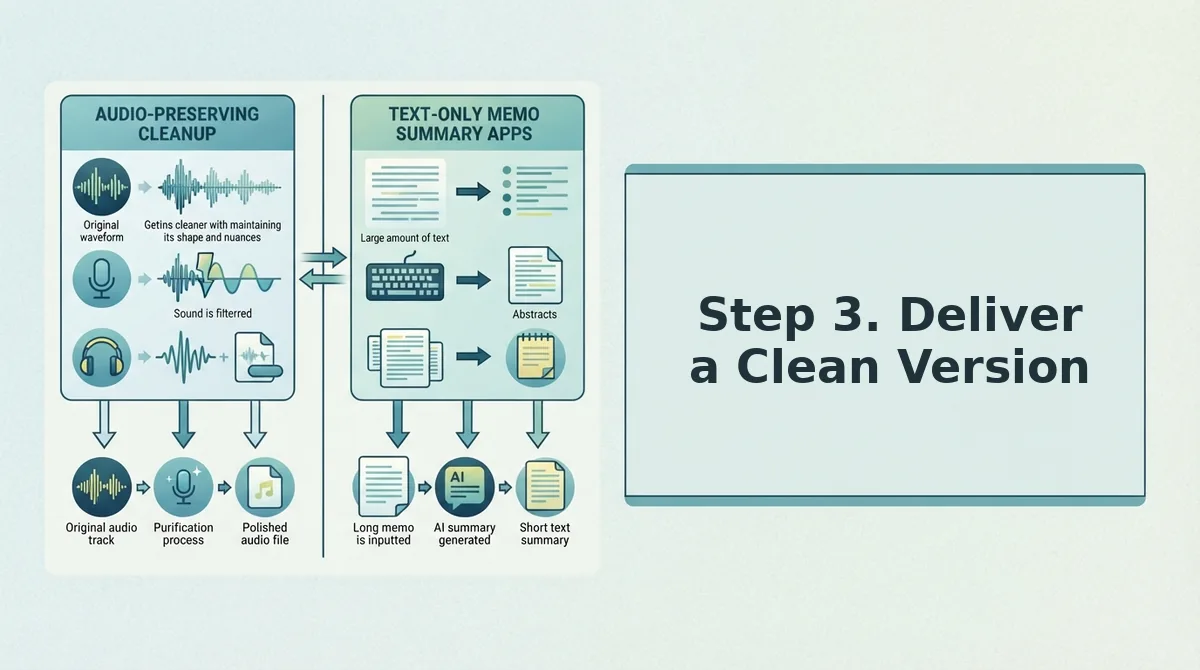
You have three ways to deliver a fixed voice memo. Each trades time, control, and authenticity differently.
- Re-record the message. Record the entire memo again from a scripted, corrected transcript. This gives you full control but costs 5-10 minutes and risks losing the spontaneous energy of the original take.
- Edit the audio manually. Use a waveform editor to splice out dangling phrases and patch gaps. This preserves the original recording but requires 15-30 minutes of precise editing and can leave audible seams.
- Use AI voice cleaning. Upload the memo to VClar and let it remove dangling phrases and repair spoken grammar in one pass. This is the fastest method, under a minute, and preserves your natural tone, accent, and rhythm without manual splicing.
For most voice memos, AI voice cleaning is the practical default. If you also need to fix grammar in voice messages, VClar handles both corrections in the same pass, so you deliver a polished memo without re-recording.
When to Keep a Dangling Phrase
A dangling spoken phrase is an unfinished thought that trails off mid-sentence. Not every one needs fixing.
Think of a dangling phrase like a hand gesture in conversation, sometimes the incomplete motion communicates more than a finished one would. In casual voice memos to close colleagues or friends, a trail-off can signal honesty, hesitation, or shared understanding that a polished sentence would flatten.
But here's the counterintuitive part: removing every imperfection can make you sound less trustworthy, not more. Keep a dangling phrase when:
- The memo is casual or relationship-building, not transactional
- The trail-off softens a critique or bad news ("I'm not sure about the timeline, so…")
- The listener already knows the missing information from context
- The hesitation itself is the message, uncertainty, reluctance, or warmth
For sales pitches, investor updates, or cross-language messages, cut the dangling phrases. For a voice note to a co-founder at midnight, let it trail. The context decides.
Still unsure which phrases to keep? The FAQ below covers the most common cases.
FAQ
Dangling spoken phrases are fixable in post-production, and AI voice cleaning tools handle the repair without requiring a full re-record.
Can you edit a voice memo after recording?
Yes, you can edit a voice memo after recording using audio editing tools or AI voice cleaning. Trim the trail-off, splice in a completed sentence from another take, or run the file through VClar to remove the dangling phrase and tighten the surrounding grammar automatically.
Do translation tools handle dangling spoken phrases?
Most translation tools misrender dangling phrases because the source sentence lacks a grammatical anchor. VClar's translation capability repairs spoken grammar first, then translates the cleaned sentence across 11 languages, so the output reads as a complete thought rather than a fragmented one.
How do dangling phrases damage credibility?
Dangling phrases signal hesitation and unfinished thinking, which listeners associate with low preparation or uncertainty. In sales pitches, investor updates, or client messages, a trail-off undercuts authority. One clean, complete sentence restores the perception of decisiveness without changing your vocal tone.
Why do I trail off when recording voice memos?
Trailing off happens when you think faster than you speak or lose the sentence structure mid-thought. Voice memos are unscripted, so the brain often abandons a clause before the mouth finishes it. Recording with a loose outline or pausing before each sentence reduces the frequency.
What is the fastest way to fix a dangling phrase without re-recording?
Run the memo through an AI voice cleaner that detects incomplete clauses and removes or completes them. VClar identifies the trail-off, cuts the filler, and delivers a polished audio file in one pass, eliminating the re-record loop entirely.
The One-Take Habit
Fixing dangling spoken phrases is not about becoming a scripted speaker. It is about building a repeatable three-step reflex: catch the trail-off, decide whether to cut or complete it, and deliver a clean version. Each pass through that loop makes the next voice memo tighter.
Practice the framework on low-stakes messages first. Record a voice note to a colleague, run it through the identify-decide-deliver sequence, and compare the before and after. The confidence compounds quickly once you hear your own voice without the hesitations.
For a deeper look at how AI cleans spoken grammar, read our guide on the spoken English grammar cleaner. Then try VClar on your next voice memo and hear the difference one clean take makes.