

You hit record, speak with total confidence for twenty seconds, then realize mid-sentence that a thought is dangling, and now you're stuck deciding whether to re-record or send a message that sounds unfinished. If you've ever wanted to fix dangling spoken phrases in voice message recordings without doing five takes, you're not alone: most voice message tutorials on YouTube obsess over playback speed and delivery, while the grammar problem underneath gets ignored.
That gap exists because the root cause is cognitive, not technical. You think at roughly 150 words per minute but speak at roughly 120, so dependent clauses get abandoned when your brain races ahead of your mouth. In this guide, you'll learn what a dangling spoken phrase actually is, how to spot one in your own recordings, and three practical ways to fix it, including a tool that removes the friction without replacing your voice.
Stick around for the surprising reason most people never notice these phrases until they hear themselves played back.
What Is a Dangling Spoken Phrase? (And Why It Happens)
A dangling spoken phrase is a sentence fragment that begins with a dependent clause or connector, like "so," "and," "because," or "which means", but never reaches a complete thought. The speaker starts a grammatical structure and abandons it mid-air, leaving the listener waiting for a resolution that never comes.
Think of it like starting to cross a bridge and stopping halfway because you spotted another bridge you'd rather cross. Your sentence is suspended over the gap, and the listener is left on the far side wondering whether you're coming back.
The cause is a speed mismatch. Your brain generates ideas at roughly 150 words per minute, but your mouth delivers them at roughly 120 words per minute. That 30-word-per-minute surplus creates a queue of unfinished clauses. When a new thought interrupts the current one, the original clause gets dropped, not because you're careless, but because your cognitive pipeline outran your articulation.
Here's the part most people miss: you rarely notice dangling phrases while speaking. They become obvious only on playback, when the transcript reveals a sentence that starts with "so if we just" and then veers into an unrelated topic. That's why voice message senders often sound less polished than they feel in the moment.
How to Identify Dangling Phrases in Your Own Voice Messages
You can spot dangling phrases in under a minute by applying a four-question test to any voice memo before you send it. No special tools required, just your own ears and a willingness to listen once.
- Play back the message once at normal speed. Listen for any sentence that starts with "so," "and," "because," or "which means" and then trails off or pivots to a new topic. You should hear a clear break where the thought never completes.
- Ask: Did I switch topics mid-sentence? If the first half of a sentence is about one subject and the second half jumps to another, you have a dangling phrase. The fix is to split the thought into two complete sentences.
- Check for prepositions without objects. Phrases like "we should circle back on" or "I was thinking about" that end without naming what you're circling back on or thinking about are dangling. You should be able to complete the sentence with one noun.
- Read the auto-transcript if your messaging app generates one. A dangling phrase reads as a fragment that would confuse a reader. If the transcript looks like a broken sentence, the audio will sound like one too.
Once you've identified the pattern, the next step is fixing it, and the three methods ahead range from manual re-recording to automated cleanup that preserves your natural voice.
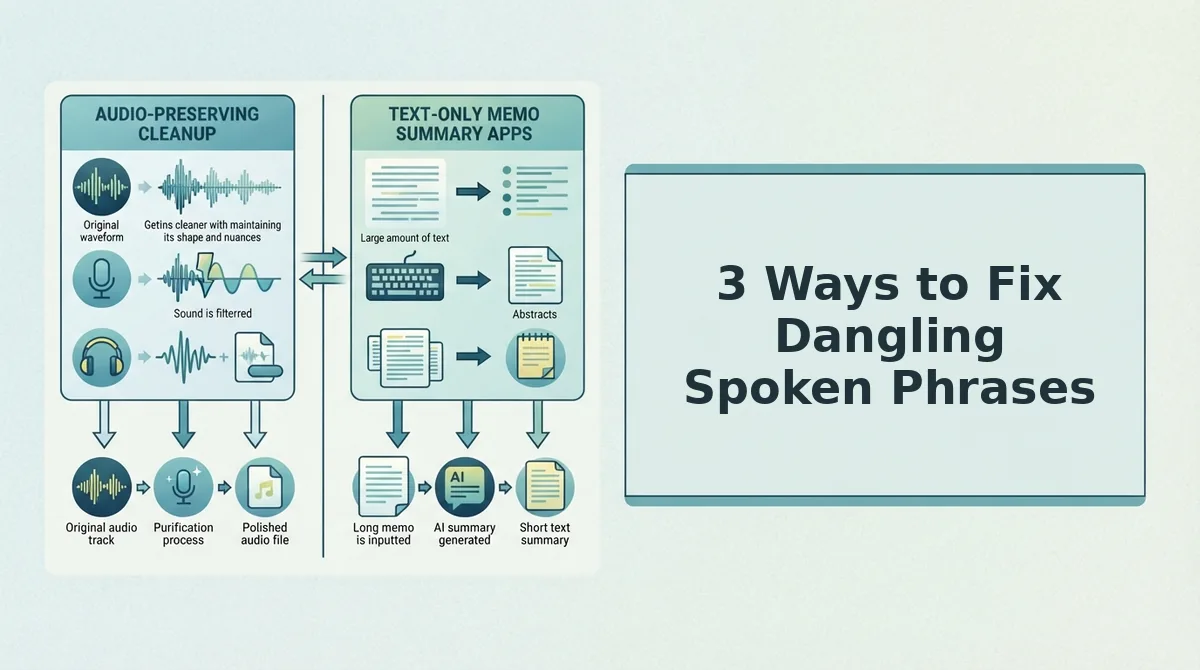
3 Ways to Fix Dangling Spoken Phrases
You can fix dangling spoken phrases at three points in your workflow: while speaking, after recording, or before you hit record. Each method requires only your voice and a smartphone; the post-recording method adds VClar's grammar correction tool.
- Fix while speaking using the Spoken Clause Completion framework. When you catch yourself mid-dangle, pause for one second and apply three moves: (a) identify the abandoned clause you just started, (b) determine the intended completion, (c) re-anchor with a concrete noun or action. For example, if you say "So I was thinking about the Q3 numbers and, like, if we could maybe...", stop, then restart with "I'd like to review the Q3 numbers and propose a revised target." Expected outcome: you finish the thought in one take without re-recording. Time cost: 2-3 seconds per correction.
- Fix after recording with VClar's grammar correction. Upload your voice message to VClar and run the grammar correction feature. The engine detects incomplete clauses and reconstructs them into complete sentences while preserving your voice, tone, and cadence. Worked example: "So I was thinking about the Q3 numbers and, like, if we could maybe..." becomes "I was thinking about the Q3 numbers and whether we could adjust the forecast." You should see the corrected transcript alongside your original audio, with the spoken timeline seamlessly edited. Time cost: under 30 seconds per message. Learn more about how to fix grammar in voice messages without losing your natural delivery.
- Fix before recording with a 10-second mental outline. Before you hit record, name three things in your head: the subject, the action, and the outcome. For example: "Q3 numbers, review, propose target." This primes your brain to complete clauses instead of abandoning them mid-thought. Expected outcome: fewer dangling phrases on the first take, which means less editing time later. Time cost: 10 seconds per message.
If you record a lot of voice messages, the post-recording fix scales best. VClar handles the cleanup so you can stay in flow while speaking.
Why Dangling Phrases Hurt Your Credibility (And What to Do About It)
Dangling phrases signal uncertainty to listeners, and in professional contexts that uncertainty transfers to your ideas. The fix is not studying grammar, it is using a tool that bridges the gap between thought and delivery.
- They make you sound unsure of your own proposal. A message that trails off with "if we could maybe..." leaves the listener guessing what you actually want. Complete sentences project confidence, and confidence drives action from clients and stakeholders.
- They force the listener to do your thinking for you. When you abandon a clause, the recipient has to reconstruct your intent, extra cognitive load that erodes goodwill. A clean, complete message respects the listener's time and attention.
- They compound for non-native speakers. Dangling phrases stack with accent and vocabulary gaps, making messages significantly harder to follow. A grammar-correcting tool removes one layer of friction so your ideas land clearly.
- They cost you follow-ups in sales. A prospect who cannot parse your voice note will not reply with a yes, they will reply with a clarifying question or not at all. Clear voice notes for sales shorten the cycle from message to meeting.
- They dilute founder updates. Investors and teams read hesitation as uncertainty about the business, not the sentence. Polished voice notes for founders keep the focus on the decision, not the delivery.
Dangling phrases are a thinking problem, not a grammar problem. VClar bridges that gap by cleaning up incomplete clauses while keeping your authentic voice intact, so you can speak at the speed of thought and still sound deliberate.
FAQ
What is the difference between dangling phrases and filler words?
Filler words are repeated sounds or words like "um," "ah," or "like" that pad speech without adding meaning. Dangling phrases are incomplete grammatical structures, clauses that start but never finish, such as "if we could maybe..." A message can have zero filler words and still contain dangling phrases, and vice versa. VClar addresses both: use the filler word remover for verbal padding and the grammar correction feature for incomplete clauses.
Can a voice message translator fix grammar too?
Yes, but most voice note translator tools only convert speech to text in another language without correcting grammatical structure. VClar is different: it fixes dangling phrases and other grammar issues in the audio itself while preserving the speaker's authentic voice, tone, and cadence. You get a complete, grammatically sound message that still sounds like you.
How do I stop trailing off in voice messages?
Use the Spoken Clause Completion framework: when you notice a clause going nowhere, pause, identify what you intended to say, and re-anchor with a concrete noun or action. For example, replace "I was wondering if we could maybe..." with "I'd like to propose a new timeline." Practicing this for a week builds the habit of completing thoughts before speaking them.
Why do I dangle phrases more when speaking than when writing?
Speaking happens in real time, so your brain often starts a sentence before it knows how the sentence ends. Writing gives you time to revise before anyone sees the draft. Voice messages sit in the middle: they feel like speaking but are consumed like writing, which is why dangling phrases stand out more to listeners than they do to you while recording.
Does removing dangling phrases make voice messages sound robotic?
No, when the correction preserves your original vocal delivery. VClar edits the audio timeline to remove incomplete clauses and reconstruct complete sentences, but it does not replace your voice with synthetic speech. The result sounds like you on your best day, same tone, same cadence, same accent, just without the unfinished thoughts.
You Don't Need More Grammar Rules, You Need a Bridge
The Spoken Clause Completion framework works because it treats dangling phrases as a thinking-speaking gap, not a grammar failure. Your brain abandons clauses mid-thought because it's already racing ahead. No amount of rule memorization changes that wiring.
What changes it is a tool that repairs the gap after you speak, without flattening your delivery. That's the contrarian payoff: stop rehearsing grammar, start recording with confidence, and let the cleanup happen downstream.
Here's the sequence that actually works:
- Record your message in one take, don't stop to self-correct.
- Run it through VClar's grammar correction for voice messages.
- Send the cleaned version, with your voice and cadence intact.
You'll hear the difference immediately: no dangling clauses, no false starts, no credibility leaks. Just your message, complete.
The fix isn't learning more grammar, it's understanding why your brain abandons clauses and using a tool that repairs them without losing your natural delivery.