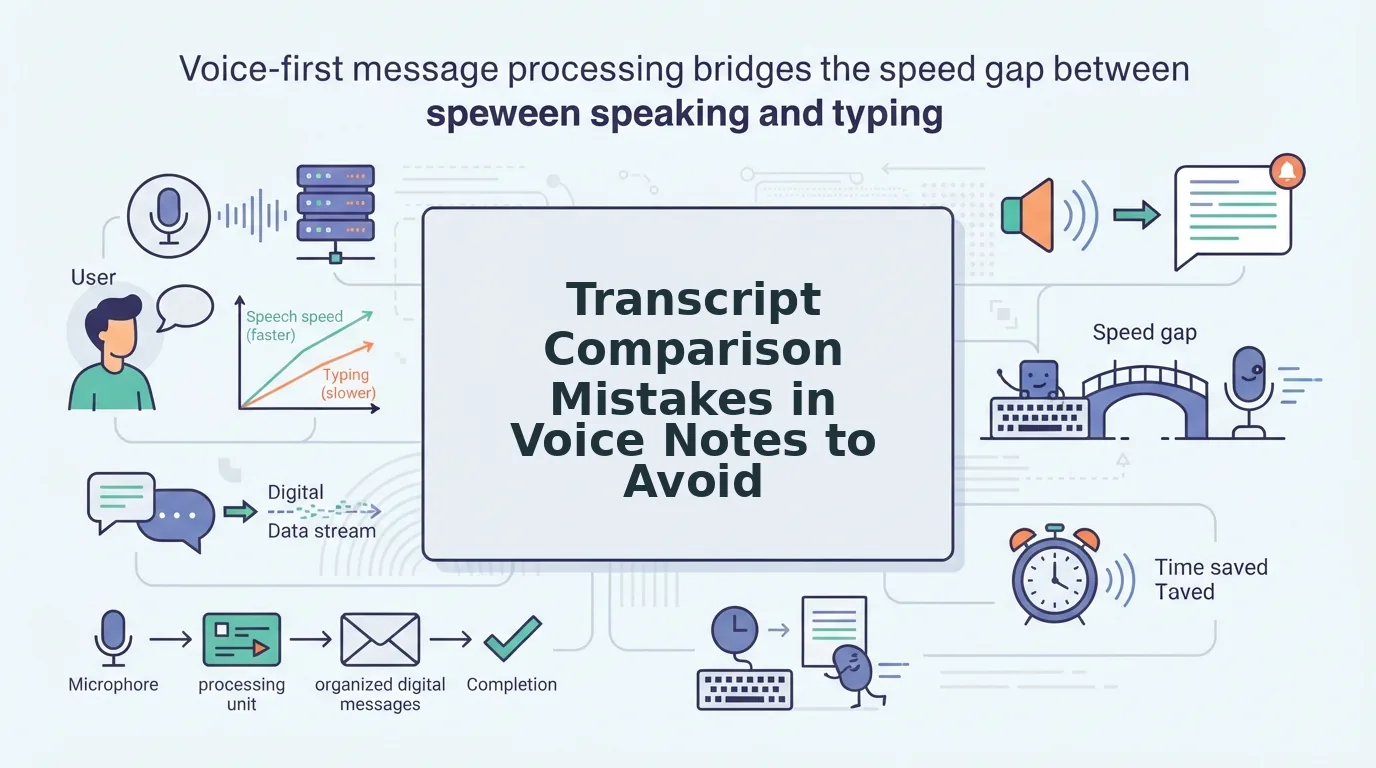


You've sent 500 voice notes this year. Can you name your top three verbal habits? Most founders and sales reps can't, because they never listen back. That's the uncomfortable truth: you're broadcasting patterns you've never once audited.
If that stings, you're not alone. Voice notes are the only free, always-available self-audit tool you own, yet almost nobody replays them. Live conversation gives you no replay button; voice notes give you infinite replays. The friction isn't technical, it's emotional. Listening to yourself is awkward, so you skip it, and the habits stay invisible.
This guide shows you exactly how to spot verbal habits in voice notes using a side-by-side text comparison you can run in minutes. You'll learn the six habit categories that erode authority, the 3-in-5 rule for deciding what counts as a pattern, and a repeatable three-pass audit. Along the way, you'll see how a tool like VClar can remove filler words from audio so you hear the cleaned version next to your raw take. One finding in Section 3 will likely surprise you, and it's the reason most people never fix the habit that costs them the most credibility.
Why Voice Notes Are the Best Self-Audit Tool You're Ignoring
A voice note self-audit is the practice of replaying your own recorded spoken messages and comparing what you intended to say against what you actually said, word for word. It's the cheapest communication feedback loop you'll ever run.
Live conversation gives you one pass. The moment you speak, the words are gone, you can't rewind a meeting, a pitch, or a hallway chat. Voice notes change that equation entirely. Every message you send is a frozen sample of your speech patterns, waiting to be replayed as many times as you need. Think of it like a golfer reviewing swing footage: you can't fix a slice you've never seen on video, and you can't fix a verbal tic you've never heard on playback.
Here's the catch: self-listening is uncomfortable, so most people avoid it. That avoidance is exactly what keeps verbal habits invisible. You don't notice the "um" before every answer because you're busy thinking about the next sentence while speaking. But on replay, the pattern is undeniable.
Start simple. Record a 60-second voice note explaining a recent decision, then transcribe it. Read the transcript out loud and mark every word that isn't essential to the meaning. You'll spot filler words, false starts, and hedge phrases within the first pass. For a faster route, you can remove filler words from audio with VClar and compare the cleaned transcript against your raw one side by side, the gap between the two is your habit map.
At the intermediate level, track frequency: if a habit appears in three of your last five voice notes, it's not a one-off, it's a pattern. Advanced practitioners go further, auditing how habits shift under pressure (pitch calls vs. casual updates) and using the transcript delta to measure improvement week over week.

The 6 Verbal Habits to Listen For
Verbal habits fall into six categories: fillers, false starts, hedge phrases, uptalk, trailing sentences, and qualifier stacking. Use the 3-in-5 rule to identify them, a habit is any pattern that appears in three of your last five voice notes.
- Filler words. "Um," "ah," "like," "basically," and "you know" are the most common. They buy your brain time but cost you perceived decisiveness. Count them per minute in your transcript; anything above three per minute signals a habit worth targeting.
- False starts. These are abandoned sentence openings, "I think we should, wait, actually what I mean is..." They signal uncertainty and force the listener to discard information. Mark every sentence in your transcript that begins twice before completing a thought.
- Hedge phrases. "Sort of," "kind of," "maybe we could," and "I'm not an expert but" soften your message into a suggestion rather than a statement. They're common in voice notes from people who fear overcommitting. Replace one hedge per message with a direct verb and notice how the tone shifts.
- Uptalk. Ending declarative sentences with a rising pitch makes statements sound like questions. Uptalk is invisible in text but obvious on replay, listen for the melody of your final syllables. It's the habit most people never catch because they only read transcripts, never listen back.
- Trailing sentences. These are thoughts that fade out without a clear endpoint: "So yeah, that's kind of the plan, and..." They leave the listener waiting for a conclusion that never arrives. In transcripts, they show up as sentences ending in ellipses or conjunctions.
- Qualifier stacking. Piling multiple qualifiers before a claim, "I think maybe we could possibly consider...", buries your point under layers of caution. It's the verbal equivalent of apologizing before you speak. Strip all qualifiers from one voice note and compare the authority of the result.
To run a quick self-check, transcribe your last five voice notes and scan for these six patterns. If a category shows up in three of the five, you've found a habit. Most people discover at least two they never knew they had, and the one they find most surprising is usually uptalk, because it never appears in text. That's the first habit to tackle in the next step.
The 3-Pass Voice Note Audit Step by Step
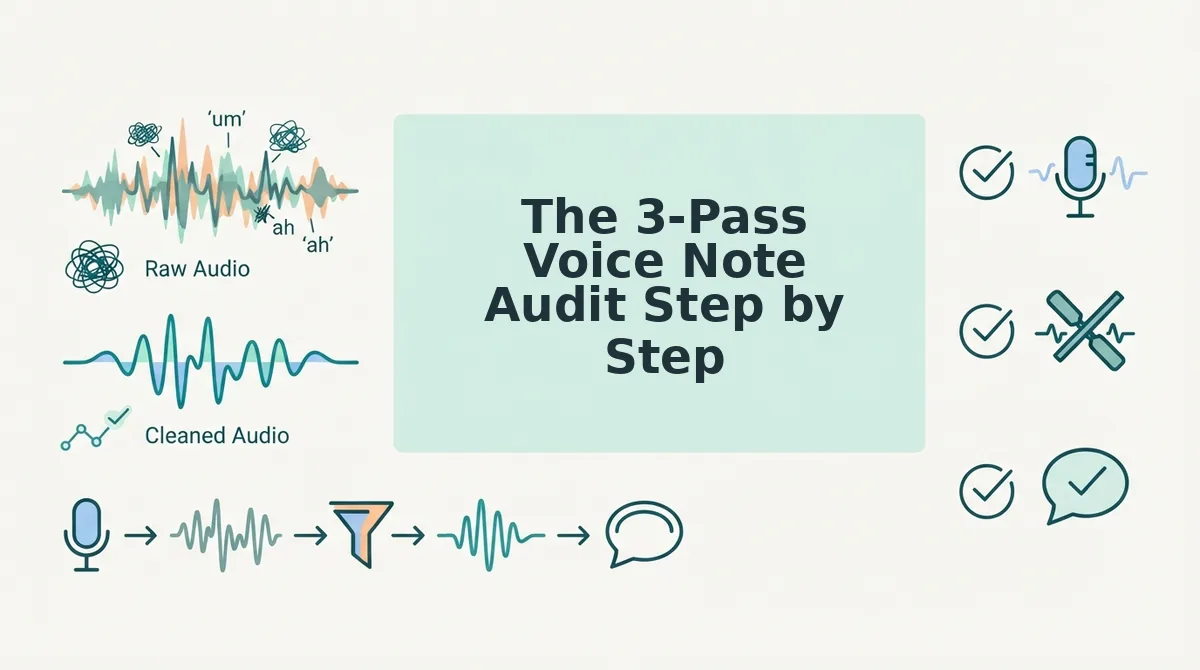
A 3-pass audit separates sound patterns, grammar, and structure so you catch habits you'd otherwise miss. You need a voice note you've sent recently, its transcript, and about 15 minutes total.
- Upload one voice note and listen for sound patterns only. Open your voice note app, select a note you sent in the last 48 hours, and play it back with the transcript hidden. Ignore the content entirely, listen only for ums, ahs, repeated words, and false starts. You should finish this pass in 3-4 minutes with a tally of filler sounds per 30 seconds.
- Read the transcript and flag recurring structural issues. Open the transcript view and read it as text, not speech. Highlight every sentence that starts with "So," "I mean," or "Basically," and circle any sentence you had to reread. You should see patterns emerge, typically 2-3 recurring openers per note.
- Check whether the message has a point or circles. Read the transcript once more and write a one-line summary of the message's core ask or update. If you can't write that line, or if the note repeats the same idea twice before landing it, mark the note as "circling." You should finish with a clear verdict: direct or circling.
A founder sending daily voice updates to a cross-border team ran this audit and discovered "basically" appeared 4 times in every note, a habit invisible until the transcript made it countable. Once you've spotted grammar issues in your transcripts, you can fix grammar in voice messages without re-recording from scratch.
From Spotted to Fixed: Turning Awareness into Habit Change
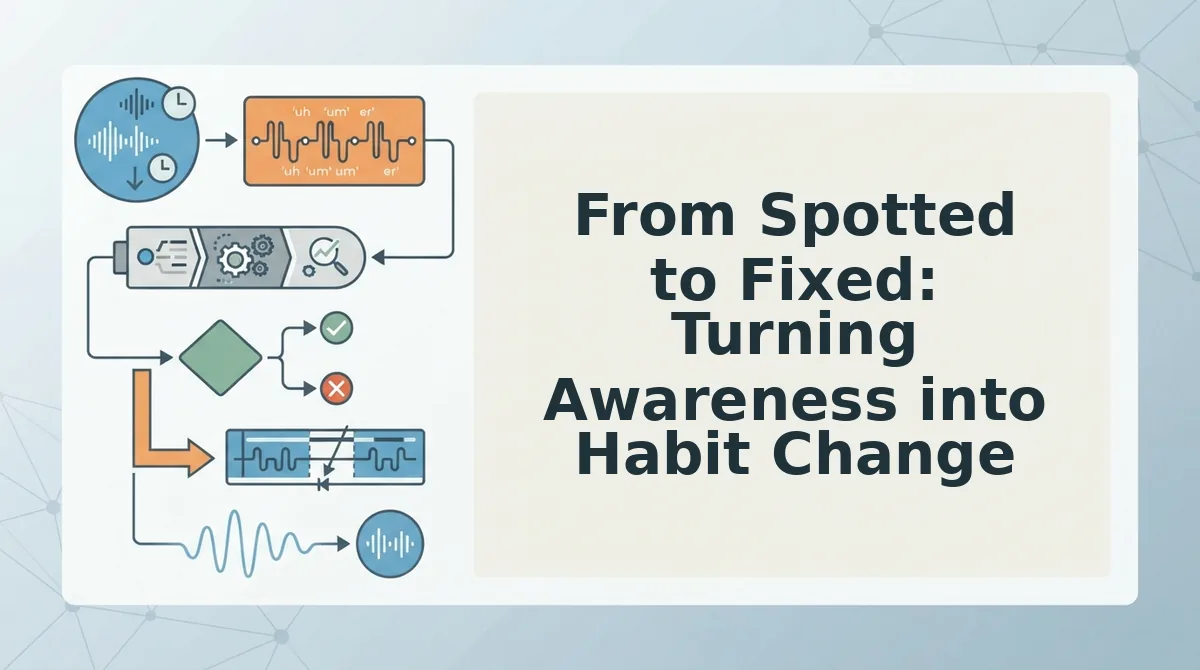
Awareness alone doesn't change speech habits, you need a replacement behavior and a fast feedback loop. You'll need one voice note, a timer, and 10 minutes.
- Apply the Replacement Rule to your top habit. Pick the one filler or opener you use most. Don't try to delete it, replace it with a deliberate pause. Every time you feel "basically" coming, stop, breathe for one second, then continue. You should feel the pause become automatic within 3-5 practice notes.
- Run the 30-Second Re-Record Test. Record a 30-second voice note on any topic, audit it using the 3-pass method, then re-record the same message once. Compare the two versions side by side. You should see fewer fillers and a clearer point in the second take, usually a 50% reduction after one deliberate re-record.
- Use a cleaner for notes you can't re-record. For messages sent in real time, upload the audio to a tool that can remove filler words from audio automatically. You should get a clean version that still sounds like you, without the ums and false starts.
Run this loop once a week for three weeks and the pause replaces the filler permanently. The goal isn't perfect speech, it's one-take confidence on messages that matter.
Frequently Asked Questions About Spotting Verbal Habits in Voice Notes
How can I spot verbal habits in voice notes to speak more concisely?
Record a 30-second voice note, transcribe it, and read the text without listening. Count filler words, repeated openers, and sentences that don't advance your point. Compare three notes to find patterns you can't hear in real time.
What are the most common verbal habits in voice messages?
The most common habits are filler words (um, ah, like), false starts ("I think, what I mean is"), repeated openers ("So," "Basically"), and circling, restating the same idea twice before landing the point. Most speakers have 2-3 dominant habits.
How many voice notes do I need to review to find my habits?
Three to five voice notes from different contexts are enough to identify recurring patterns. A single note can reveal frequency, but habits only become clear when the same filler or opener appears across multiple recordings.
Can AI help me identify verbal habits automatically?
Yes. AI voice tools can transcribe audio, count filler word frequency, flag repeated openers, and remove fillers from the audio timeline while preserving your natural voice, tone, and cadence.
Audit Your Next Five Voice Notes This Week
Verbal habits are recurring patterns, not one-off slips. The 3-in-5 rule makes them visible: if a filler or false start appears in three of your last five voice notes, it's a habit worth fixing. The 3-pass audit gives you the method to find it.
Here's the challenge that ties both together:
- Pick your next five voice notes, not curated ones, the real ones you send this week.
- Run each through the 3-pass audit: listen for flow, read the side-by-side text, mark the patterns.
- Apply the 3-in-5 rule. Three appearances across five notes means it's systemic, not situational.
One week of this produces a concrete habit map you can act on. You'll know exactly which verbal tic costs you clarity, and you'll have the side-by-side text evidence to track improvement. That's the payoff: awareness with a paper trail.
Verbal habits don't survive being seen. The side-by-side text makes them impossible to ignore, and the 3-in-5 rule turns vague self-criticism into a measurable audit. For more voice communication guides, explore our blog.
You can't fix what you can't see, but once you see it in text, the fix is already underway.