


You can type a flawless email in 90 seconds, but the moment you hit record on a voice note, your grammar falls apart. That gap isn't a knowledge problem, it's a processing problem. Spoken errors are automatic, not ignorance, which means memorizing more rules won't fix them. You need a way to track spoken grammar mistakes visually, the same way you'd review a marked-up document.
You're not alone. Founders, sales leads, and freelancers think at roughly 150 words per minute but stumble when speaking because there's no backspace in real time. The good news: you can build a repeatable tracking system that turns every voice note into a visible record of your error patterns. In this guide, you'll learn why spoken grammar breaks down even when your writing is clean, which six mistakes appear most often in spontaneous speech, and a step-by-step visual diff method for spotting them in transcripts. One finding in particular, why your brain defaults to fragments under time pressure, will change how you approach every recording. And if you want to clean up the "ums" and "likes" first, VClar's filler word removal handles that automatically so you can focus on grammar patterns.
Why Spoken Grammar Breaks Down Even When Your Writing Is Fine
Spoken grammar errors are automatic deviations from standard sentence structure that occur because speech has no editing layer, once a word leaves your mouth, it cannot be revised. Writing lets you pause, reread, and rewrite; speaking forces you to produce language in real time under cognitive load.
Think of speaking like driving a car while someone asks you directions. You can drive competently, but the added demand of navigating, watching traffic, and answering questions means you occasionally miss a turn or drift in your lane. Your grammar does the same thing: the more mental bandwidth you spend on what to say next, the less you have for how you're saying it.
Three specific pressures cause the breakdown. First, cognitive load, you're simultaneously planning content, monitoring the listener, and managing your tone, which leaves fewer resources for grammatical accuracy. Second, no editing ability, unlike writing, you cannot delete a sentence fragment or fix a tense shift after it's spoken. Third, time pressure, the need to keep speaking without awkward pauses forces your brain to fall back on automatic patterns, even when those patterns are grammatically sloppy.
In spontaneous speech, three error types dominate. A sentence fragment is an incomplete thought that lacks a subject or verb, for example, "The client meeting. Totally forgot about it." A tense shift is when you switch verb tenses mid-thought without reason, "She said she will send the report, but then she didn't." A subject-verb disagreement happens when the verb doesn't match the subject's number, "The list of action items are on the shared drive" instead of "The list of action items is on the shared drive."
Here's the key insight most grammar guides miss: these errors are not knowledge gaps. You already know the rules when you write. The problem is that speaking strips away your editing buffer, so tracking your spoken patterns, not studying more grammar, is the only fix that works.
The Most Common Spoken Grammar Mistakes to Track
Six error patterns account for the vast majority of grammar breakdowns in spontaneous voice notes. Track each one as a recurring pattern in your transcripts rather than a rule to memorize.
- Sentence fragments. A fragment is an incomplete thought missing a subject or verb, like "The proposal. Sent it yesterday." It matters because fragments make you sound uncertain and force listeners to fill in gaps. Track how often your voice notes contain standalone phrases that would be marked incomplete in writing.
- Subject-verb disagreement. This happens when the verb doesn't match the subject's number, such as "The details in the report needs updating" instead of "The details in the report need updating." It matters because it signals carelessness to detail-oriented listeners. Track mismatches between singular and plural subjects and their verbs in your transcripts.
- Tense shifts. A tense shift is switching verb tenses without a logical reason, like "I talked to the client and he says he's interested." It matters because inconsistent timelines confuse your listener about what happened when. Track every instance where you move between past and present tense within a single thought.
- Pronoun confusion. This occurs when it's unclear who or what a pronoun refers to, such as "Mark told James he needed to fix the deck", who is "he"? It matters because ambiguous references force listeners to guess, and they often guess wrong. Track sentences where "he," "she," "it," or "they" could point to more than one person or thing.
- Run-on sentences. A run-on is two or more complete thoughts jammed together without proper separation, like "I finished the deck then I called the client then I realized I forgot the attachment." It matters because run-ons bury your key points under a stream of undifferentiated information. Track where you string three or more clauses together without pausing or restructuring.
- Dropped articles. This is omitting "a," "an," or "the" where standard English requires them, such as "I sent email to team" instead of "I sent the email to the team." It matters because missing articles make speech sound rushed and non-native, even for fluent speakers. Track every noun that appears without its expected article in your transcripts.
Before you can track grammar patterns, you need a clean transcript, and that starts with removing the verbal noise that obscures them. VClar's filler word removal strips out "ums," "likes," and false starts automatically, so your transcript shows only the actual sentence structure worth analyzing. Once the fillers are gone, you're ready for the visual diff method.
The Visual Diff Method to Track Your Spoken Grammar Mistakes Step by Step
To track spoken grammar mistakes using visual transcripts, record a 60-second voice note, generate a raw transcript, compare it against a corrected transcript side by side, and log every recurring pattern you spot. This four-step loop takes under 15 minutes per session and turns vague self-criticism into a measurable dataset.
Prerequisites: a voice recorder app on your phone, a transcript tool that can fix grammar in voice messages, and a simple spreadsheet or markdown file for your pattern log.
- Record a 60-second voice note on one topic. Open your phone's voice recorder, press record, and speak for exactly 60 seconds about a real work topic, a product update, a client recap, or a meeting summary. Do not script it. Stop at 60 seconds. You should have one raw, unedited audio file that captures your natural speaking patterns, including every fragment and false start.
- Generate the raw transcript. Upload the audio to your transcript tool and export the verbatim text without any cleanup applied. Read it once. You should see your spoken grammar exactly as it happened, sentence fragments, tense shifts, and filler words all visible on the page.
- Generate the corrected transcript and compare side by side. Run the same audio through a grammar-correction pass, then place the raw and corrected transcripts next to each other. Highlight every difference between the two. You should see a clear visual diff where each correction maps to a specific spoken mistake.
- Log recurring patterns, not one-off slips. Open your pattern log and create one entry per mistake type that appeared two or more times in the diff. For each entry, note the mistake type, the raw phrase, the corrected phrase, and the date. You should end with a short list of your highest-frequency spoken grammar weaknesses, ready for targeted practice.
Worked example: A founder records a 60-second product update. The raw transcript shows three sentence fragments ("Shipping the new dashboard. Finally."), one tense shift ("We shipped last week and now we test the fix"), and four filler words. The corrected transcript resolves each issue. The pattern log entry reads: "Fragments, 3 occurrences, combine with next sentence." That single entry now guides the next week of practice.
This method works because you are not relying on memory or how you think you sound. You are reading your spoken grammar as data. VClar's transcript and correction workflow makes the diff step automatic, so the only manual work left is the pattern log itself.
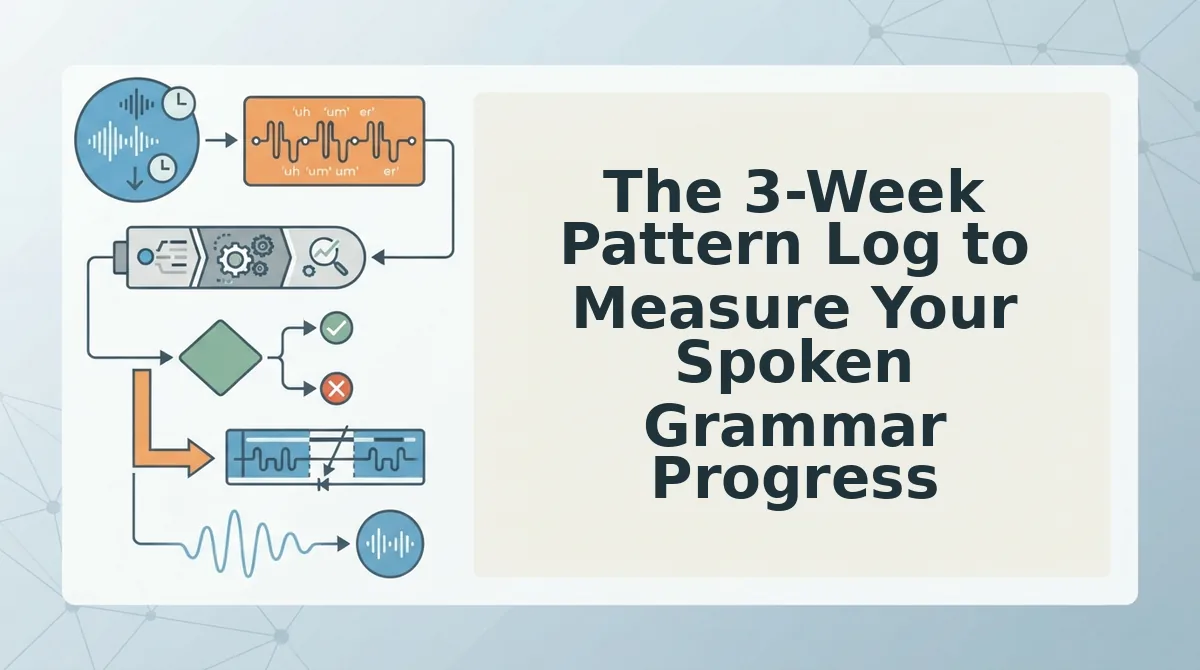
The 3-Week Pattern Log to Measure Your Spoken Grammar Progress
A pattern log turns sporadic self-observation into measurable progress: track mistake type, weekly frequency, and the correction you applied, then compare week-over-week frequency rather than total errors. Tracking without a log is just noticing; a log is how you prove improvement.
Prerequisites: the visual diff output from the previous section and a markdown file or spreadsheet with four columns.
- Create the log table. Open a markdown file or spreadsheet and copy the table template below. You should see four columns ready for your first entry.
- Fill in Week 1 after your first diff session. Type each mistake type you logged, the number of occurrences, and the specific correction you plan to apply. You should see your baseline frequency for every recurring pattern.
- Repeat the diff session weekly for three weeks. Record a new 60-second note on a similar topic, run the diff, and update the table. You should see frequency numbers shift week over week for each mistake type.
- Compare frequencies, not totals. Look at each row across the three weeks. A mistake type dropping from 5 to 2 to 0 is progress; a flat 3-3-3 means that correction is not sticking and needs a different approach. You should be able to name exactly which patterns improved and which did not.
| Week | Mistake Type | Frequency | Correction Applied |
|---|---|---|---|
| 1 | Sentence fragments | 3 | Combine fragment with following sentence |
| 1 | Tense shifts | 1 | Pause before verbs, confirm timeline |
| 2 | Sentence fragments | 2 | Same correction, continued practice |
| 2 | Tense shifts | 0 | , |
| 3 | Sentence fragments | 1 | Same correction, continued practice |
| 3 | Tense shifts | 0 | , |
If filling this log manually feels like friction, run your weekly voice note through VClar's grammar correction pass first, the corrected transcript gives you the exact diff you need to populate each row in under five minutes.
How to Know You're Improving at Spoken Grammar
You are improving when three signals show up in your pattern log: fewer logged errors per minute of speech, faster self-correction mid-sentence, and cleaner first-take recordings that need fewer transcript corrections. These signals only become visible because the visual diff method gives you a before-and-after transcript comparison protocol, raw on one side, corrected on the other, week after week.
The loop is simple: record, diff, log, repeat. Each cycle tightens the gap between how you speak and how you want to sound. The founder who logged three fragments in week one and one in week three is not guessing, they have a dataset.
Your next step is to run one 60-second voice note through the visual diff method this week. Start with a single recording, generate the raw and corrected transcripts, and make your first pattern log entry. For more on building a spoken English grammar cleaner habit, explore the VClar blog. One diff session is enough to show you exactly where your spoken grammar breaks, and exactly what to fix next.