
You've recorded the same voice memo four times, and every version still sounds like you lost your train of thought halfway through. That re-record loop is the hidden tax of spoken communication, and it's almost always caused by sentence fragments you can hear but can't see. A sentence fragment checklist for voice memos turns that invisible grammar problem into a send/no-send decision you can make in under 60 seconds.
You're not alone if your spoken notes come out disjointed. Raw voice memos are full of verbal fillers, awkward pauses, and half-finished thoughts that quietly undermine your authority, especially when you're pitching an investor or closing a client. No competitor teaches fragment detection by ear; every existing guide assumes you're staring at written text. This article gives you an audio-first method instead.
Here's the roadmap: you'll learn what a fragment actually sounds like in spoken audio, then walk through a 5-point checklist you can run while listening back. Along the way, you'll discover why one specific failure mode, the trailing thought, is responsible for most re-records, and how tools like VClar can strip those fragments without forcing another take.
What a Sentence Fragment Sounds Like in a Voice Memo
A sentence fragment is a group of words that cannot stand alone as a complete sentence because it's missing a subject, a verb, or a complete thought. In written text, you spot fragments by reading. In voice memos, you have to spot them by listening, and they have a distinct audio signature.
Think of a spoken fragment like a staircase that stops three steps from the landing. Your listener climbs with you, expecting a conclusion, then steps into empty air. The result is a subtle but real drop in perceived competence, the listener registers the incompleteness even if they can't name it.
Kevin Spaans, an English instructor, distinguishes fragments from run-ons by whether the group of words can stand alone. A run-on crams too many complete thoughts together; a fragment delivers none. Khan Academy defines the fragment as an incomplete sentence missing a subject, verb, or complete thought, a definition that maps cleanly onto spoken audio when you know what to listen for.
In practice, spoken fragments fall into four failure modes. Trailing thoughts start with a clear subject and verb, then drift off: "The Q3 numbers are looking strong because we finally..." False starts begin, stop, and restart: "I wanted to, so the thing is, we should..." Dependent-clause orphans set up a condition or time frame and never deliver the main clause: "If we can get the contract signed by Friday." Missing-verb statements name a subject and pile on description but never state an action: "The new pricing page, which we've been working on for weeks."
Each mode has a distinct rhythm: trailing thoughts fade out, false starts stutter, dependent-clause orphans end on a rising pitch, and missing-verb statements feel like a drumroll with no crash. Once you can name these four patterns, you can hear them in your own recordings, and that's the foundation of the checklist in the next section.
The 5-Point Sentence Fragment Checklist for Voice Memos
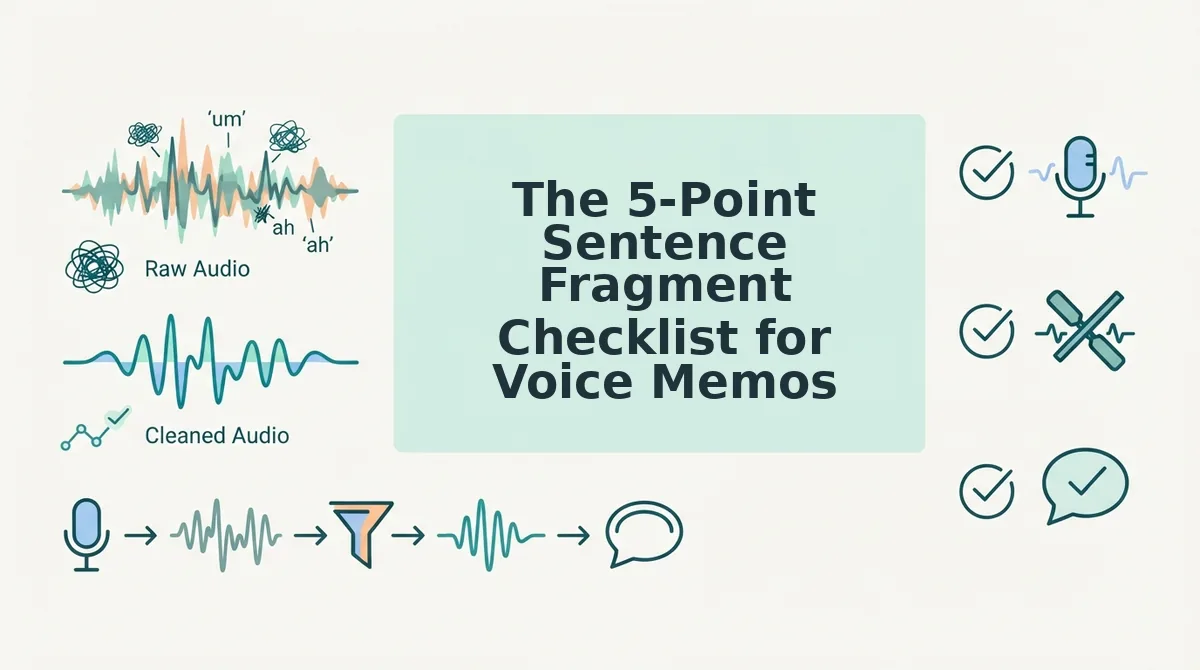
A sentence fragment checklist for voice memos is a five-question audio review you run before sending any spoken message. Each check takes 10-15 seconds, and the full pass takes under a minute. You'll need your recording device, headphones, and a willingness to listen for what's missing rather than what's there.
- Play back the memo and mark every pause longer than two seconds. Long pauses often signal a trailing thought, the speaker started a sentence, lost the thread, and abandoned it. Each marked pause is a candidate fragment. Expected outcome: you'll identify 2-5 pause points in a typical 60-second memo.
- At each pause, ask: "Did the sentence before this pause finish its thought?" If the sentence ended on a rising pitch or a connector like "because," "if," or "so," it's likely a dependent-clause orphan. Expected outcome: you'll flag every sentence that leaves the listener waiting for a conclusion that never arrives.
- Listen for restarts, places where you begin a phrase, stop, and begin again. False starts are the easiest fragments to hear because they sound like a stutter at the sentence level. Expected outcome: you'll catch phrases like "I wanted to, so the thing is" and mark them for removal.
- Run the standalone test on every sentence. Say the sentence alone, out loud, with no surrounding context. If it doesn't make sense by itself, it's a fragment. This test catches missing-verb statements and dependent-clause orphans that hide behind neighboring sentences. Expected outcome: you'll isolate 1-3 sentences that only seemed complete because adjacent sentences propped them up.
- Apply the delivery-confidence gate. Ask yourself: "Would I say this exact sentence to the recipient's face, in this exact wording?" If the answer is no, the sentence is either a fragment or too weak to send. Expected outcome: a final send/no-send decision on every flagged sentence.
Here's how the checklist works in practice. A founder records an investor update: "The beta launch went well, we hit 400 signups in the first week, which is great because we were hoping to..." The founder runs the checklist, hears the trailing thought at the end, and catches it before sending. The standalone test confirms the final clause can't survive alone. The delivery-confidence gate seals it: no founder would trail off mid-sentence to an investor's face.
Running this checklist manually takes discipline, but tools like VClar can automate the detection, cleaning filler words, tightening phrasing, and removing fragment patterns from the audio timeline without changing your voice. That matters because the goal isn't just to spot fragments; it's to fix them without burning another take. The next section covers exactly how to do that.
How to Fix Fragments Without Re-Recording
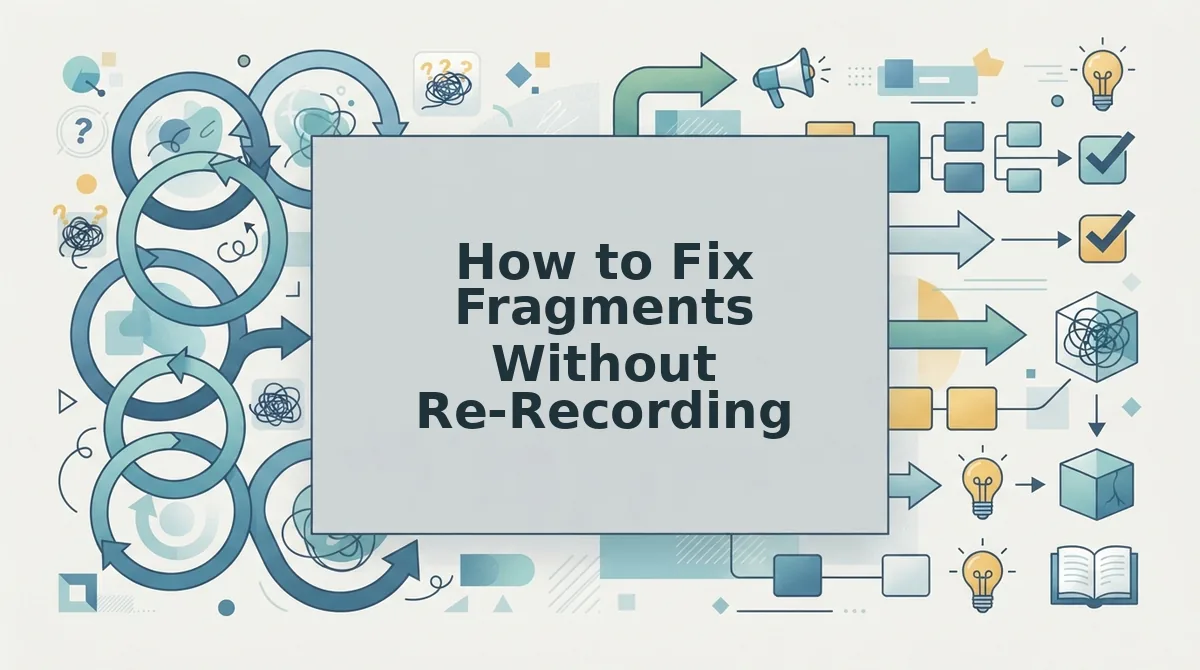
You have three practical paths for fixing sentence fragments in a voice memo: re-record the message, manually edit a transcript, or let AI correct the spoken grammar in the audio itself. Each method works, but they differ sharply in time cost and how much of your natural delivery survives.
| Method | How It Works | Time Cost | Preserves Natural Tone | Best For |
|---|---|---|---|---|
| Re-Recording | You listen back, note the fragment, and speak the message again from scratch or from the mistake point. | High, often 3-5 takes per message | Yes, but only if you can reproduce the same energy and phrasing | Perfectionists with unlimited time and no deadline pressure |
| Manual Transcript Editing | You transcribe the audio, fix fragments in text, then either send the text or re-read the corrected script aloud. | Medium, transcription plus editing plus optional re-read | No, the re-read becomes a scripted performance, not your original voice | Writers and editors who prefer text-first workflows |
| AI Spoken Grammar Correction | AI detects and repairs fragments directly in the audio timeline, joining incomplete thoughts into complete sentences without changing your voice, accent, or rhythm. | Low, one cleanup pass after recording | Yes, the original vocal identity stays intact | Founders, sales reps, and creators who need one-take confidence |
Re-recording is the most common advice, and it does work when you have the time and patience for multiple takes. Manual transcript editing gives you precise control over wording, which is why many professionals still prefer it for formal communications. The limitation of both is that they pull you out of the moment, re-recording forces you to recreate a spontaneous thought, and transcript editing turns your spoken voice into a written artifact.
AI spoken grammar correction removes the re-record loop entirely. Instead of re-speaking the message, you record once, and the engine repairs fragments in the audio itself. VClar's grammar correction feature fixes fragments automatically without re-recording, so you can fix grammar in voice messages automatically while keeping your natural cadence and accent intact.
The Pre-Send Voice Memo Workflow
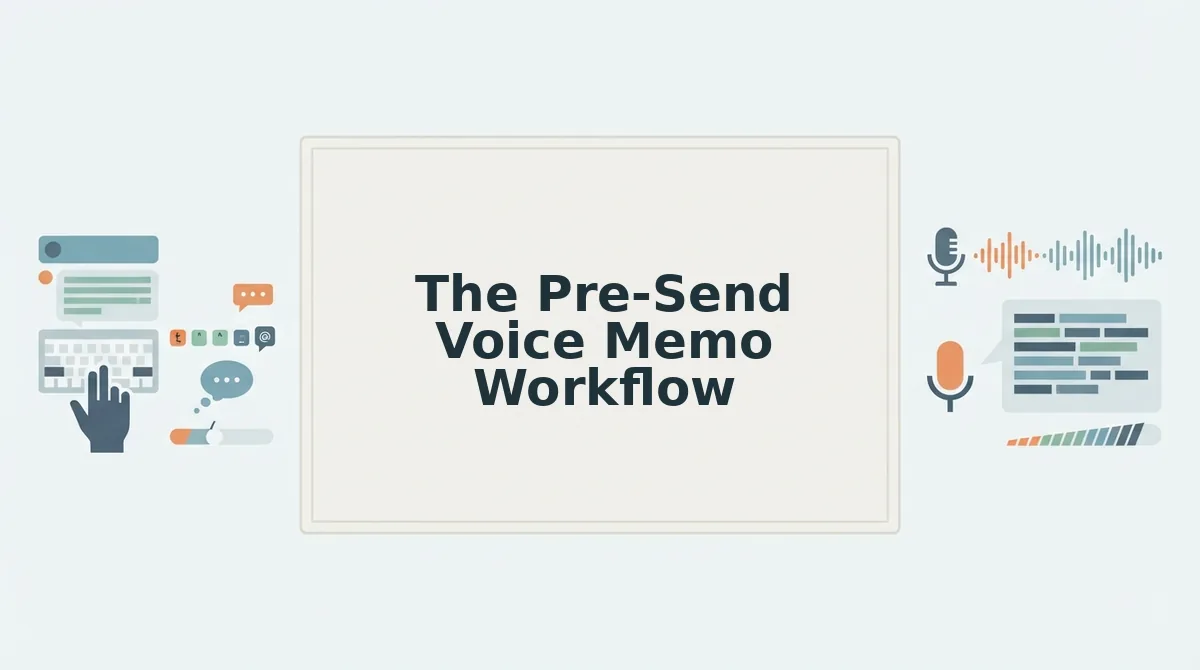
A repeatable four-step habit turns the fragment checklist from a one-time exercise into a daily workflow. Record freely first, then clean once, listen once, and send.
- Record freely without self-editing. Speak the full thought as it comes, fragments and all. Stopping mid-sentence to fix yourself breaks your rhythm and makes fragments more likely, not less. MacSparky's voice memo transcription workflow supports this approach: capture first, refine later.
- Run the 5-point fragment checklist. Listen once and check for incomplete thoughts, missing subjects, missing verbs, orphaned dependent clauses, and false starts. Mark the spots that need repair, but do not re-record yet.
- Clean with VClar in a single pass. Upload the memo and let VClar remove filler words from audio and correct spoken grammar in the same cleanup pass. The engine joins fragments into complete sentences while preserving your tone, accent, and pacing.
- Listen once and send. Play back the cleaned memo to confirm the message still sounds like you and the meaning is intact. If it passes, send it. If not, run one more cleanup pass rather than starting over.
This workflow eliminates the re-record loop entirely. You record once, clean once, and send with confidence that the message is grammatically complete and authentically yours.
Sentence Fragment Checklist for Voice Memos FAQ
What should I check to fix sentence fragments in a voice memo?
Check for five things: incomplete thoughts that trail off, missing subjects, missing verbs, dependent clauses left standing alone, and false starts where you begin a sentence and restart. Each of these creates a fragment that sounds unfinished to the listener and weakens your message.
Can AI fix sentence fragments in audio?
Yes. AI grammar correction tools can detect incomplete sentences in spoken audio and repair them directly in the audio timeline. The repair happens without re-recording, and the speaker's original voice, accent, and rhythm remain intact.
What's the difference between a fragment and a run-on in speech?
A fragment is an incomplete thought missing a subject or verb, like "When we finish the call." A run-on is two or more complete thoughts jammed together without a pause or connector, like "I'll send the file then we can review it tomorrow."
Do voice memo apps transcribe fragments accurately?
Most transcription engines transcribe fragments literally, preserving the incomplete sentence exactly as spoken. They do not flag or repair the fragment, which means the written transcript carries the same unfinished thought as the audio.
How do I stop using sentence fragments when I speak?
Practice recording without self-editing, then run a fragment checklist on playback. Over time, you will start noticing fragments in real time. AI cleanup tools accelerate the habit by showing you what a corrected version of your own speech sounds like.
The five checks close the loop on one-take voice memos
Subject, verb, complete thought, standalone test, delivery confidence. Run all five, and a fragment stops being a gamble, it becomes a caught mistake before anyone hears it. That is the payoff the intro promised: you do not need a second take to sound composed.
Here is the synthesis that ties the whole article together: fragments in voice memos are not a writing problem. They are a delivery problem. Spoken grammar breaks down when your mouth outruns your thought, not when your language skills fail. That is why re-recording feels so punishing, you are fixing the symptom, not the cause.
VClar's AI spoken grammar correction targets the cause directly. It reconstructs incomplete clauses, attaches orphaned phrases to their subjects, and smooths false starts, all while preserving your natural tone, accent, and cadence. You keep the one-take energy. The fragment disappears.
Your next step is one action: Try VClar free on your next voice memo. Record once, run the five checks mentally, then let the engine handle what you missed. Expect a message that lands as decisive and complete, no re-recording loop, no apology follow-up.
A voice memo with zero fragments is not a polished script, it is a speaker who never had to stop being themselves.