

You record a 90-second voice note to your team, hit send, and only later realize you said "I think we should, actually, no, let's, what I mean is…" three separate times. The worst part? You didn't hear any of it while speaking. That's why the most effective way to audit false starts in spoken transcripts is to read your own words back, not just listen to them.
You're not alone if your voice notes feel scattered. Founders and sales reps think at roughly 150 words per minute but speak at half that speed, leaving the brain constantly rewriting mid-sentence. The result is abandoned fragments that never make it into polished audio, and you don't notice them until you see the transcript.
Here's what this guide will walk you through: a precise definition of false starts and how they differ from filler words, the three types you'll encounter in your own transcripts, and a repeatable 4-pass audit system to eliminate them. You'll also learn why a benchmark of roughly 1 false start per 100 spoken words is a useful starting target, and why one specific type of false start is far more damaging to your credibility than the other two. Tools like VClar's AI voice message translator can detect and remove these restarts automatically, but understanding the mechanics first is what makes the fix stick.
What Is a False Start in Spoken Transcripts?
A false start is an abandoned or restarted sentence fragment in spoken language, a phrase you begin, stop, and either rephrase or drop entirely before completing the thought. It is distinct from filler words like "um" or "like," which pad silence without changing sentence direction.
Think of a false start like a driver who pulls into an intersection, brakes suddenly, then takes a different turn than the one they signaled. The car never crashed, but everyone behind them had to adjust. In conversation, your listener's brain does the same mental braking every time you restart a sentence.
Here's the distinction competitors blur: filler words are insertions that don't alter meaning, while false starts are structural, they leave a grammatical dead end in the transcript. "Um, I think the budget works" still parses as one sentence. "I think the budget, actually, the timeline is the issue" leaves the word "budget" hanging with no verb to complete it.
| Feature | False Start | Filler Word |
|---|---|---|
| Definition | Abandoned or restarted sentence fragment | Inserted sound or word that pads silence |
| Example | "We should move the, let's circle back on pricing." | "We should, um, move the meeting." |
| Impact on clarity | High, breaks sentence structure, forces listener to discard partial meaning | Low, adds noise but preserves the sentence's grammatical core |
| Detection method | Visible in transcripts as incomplete clauses before a dash or restart | Audible in audio; visible in transcripts as isolated words |
In a transcript, a false start appears as a clause that never reaches a predicate, a subject introduced and then orphaned. For example: "The Q3 numbers show we, " followed by a completely new sentence. The reader must mentally delete the first fragment to follow the second. Over a 5-minute voice note, five or six of these force the listener to constantly re-anchor, which is why a single false start can undermine more trust than three "ums" combined.
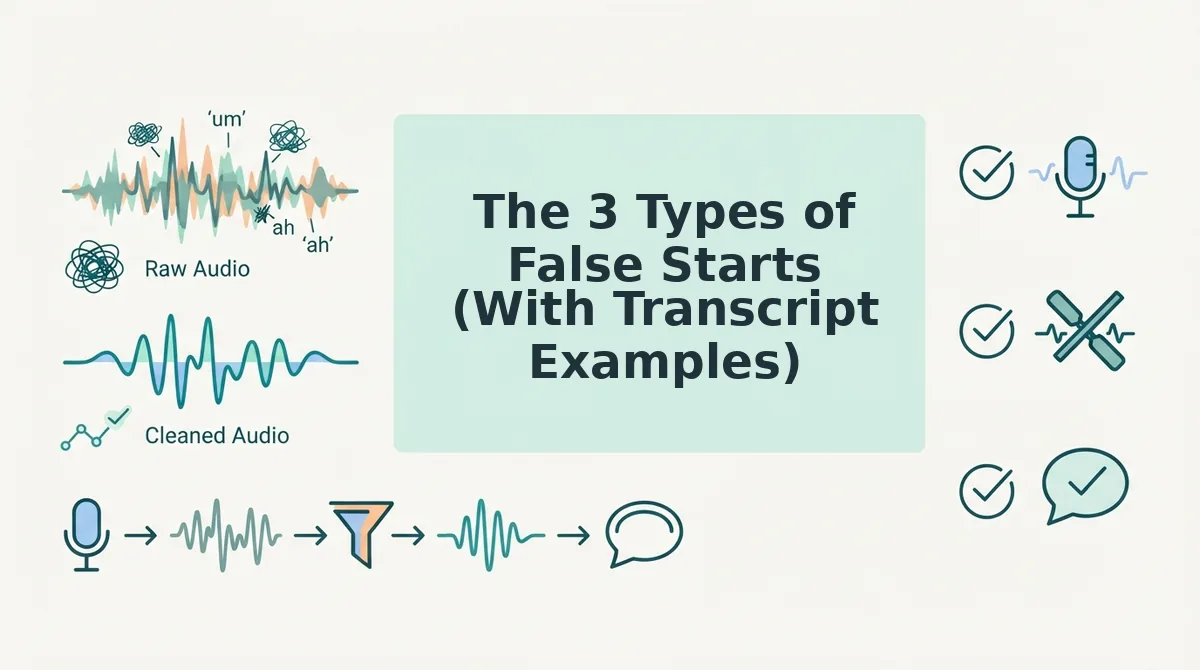
The 3 Types of False Starts (With Transcript Examples)
False starts fall into three distinct patterns, each with a different root cause and fix. Recognizing which type dominates your speech is the first step in any audit.
- Abandoned sentence restarts. You begin a sentence, stop mid-clause, and start a new sentence on a different subject. This is the most common type and the most damaging to clarity because the listener must discard an entire partial thought. Example: "I think we should, actually, let's try the other approach." The fix is to pause silently instead of speaking the restart, giving your brain time to finish the thought before vocalizing it.
- Repeated word stumbles. You repeat a word or short phrase two or more times before continuing, usually while your brain searches for the next word. Example: "The the the report is ready." This type signals processing lag rather than indecision, and it's the easiest to catch in a transcript because the repetition is visually obvious. The fix is to slow your speaking pace by roughly 10% when transitioning between ideas.
- Mid-thought pivots. You complete a clause but then reverse or qualify it with a pivot phrase like "I mean" or "actually." Example: "We need to move faster, I mean, focus on quality first." This type is the most subtle because the sentence is grammatically complete, but the pivot forces the listener to re-evaluate what they just processed. The fix is to decide on your priority before speaking and lead with it.
Save these three examples as a reference sheet while you audit your own transcripts, and if you want to skip the manual work, VClar removes filler words from audio and cleans up false starts automatically without changing your vocal delivery. Next, let's put this taxonomy to work with a systematic audit method.
How to Audit False Starts With the 4-Pass System
The 4-Pass System is a repeatable framework for auditing your own spoken transcripts: mark every false start, classify each by type, count frequency against a benchmark, then rewrite a clean version. You need only a raw transcript of one voice note, a highlighter or annotation tool, and 15 minutes.
- Open your transcript and mark every false start. Upload or paste your raw voice note transcript into any text editor. Read it aloud exactly as written. Highlight every place where you abandoned a phrase mid-sentence and restarted, such as "I think we should, what I mean is we need to ship this week." You should see 3-8 highlights in a typical 60-second voice note.
- Classify each mark by the 3 types. Label every highlight as a repetition (same word repeated), abandonment (phrase dropped mid-thought), or repair (self-correction with a transition like "I mean" or "actually"). Write the type next to each mark. You should see a clear distribution emerge, usually dominated by one type.
- Count frequency against the 1-per-100-words benchmark. Divide your total word count by 100, then compare that number to your total false starts. If a 300-word transcript contains 6 false starts, you are at 2 per 100 words, double the estimated conversational norm of 1 per 100 words. You should now know whether false starts are a real problem or within normal spoken range.
- Rewrite a clean version without re-recording. Type out the transcript again, deleting every marked false start and stitching the sentence together. Keep your exact word choices and phrasing. You should end with a transcript that reads as decisive and direct, ready to send as text or use as a script for your next take.
Worked example: A founder records: "So I was thinking we could, um, we could push the launch to, actually, let's keep the launch date and cut scope instead." Pass 1 marks two false starts: "we could, um, we could" (repetition) and "push the launch to, actually" (repair). Pass 2 classifies them. Pass 3 counts 2 false starts in a 28-word note, roughly 7 per 100 words, well above benchmark. Pass 4 rewrites: "Let's keep the launch date and cut scope instead."
If your audit reveals frequent abandoned phrases, you may also want to fix sentence fragments in voice memos using the same rewrite pass. The manual audit trains your ear; the tool handles cleanup at scale.
How to Fix False Starts in Voice Notes Without Re-Recording
You can remove false starts from an existing voice note in under a minute using VClar's false start cleaner. Automated tools catch most but not all false starts, so run a manual audit first for high-stakes messages like investor updates or client proposals.
- Upload your voice note to VClar. Open the VClar dashboard and drag your audio file into the upload area. You should see a processing indicator within seconds.
- Select the false start cleaner. Click the Clean Audio control, then toggle Remove False Starts to on. You should see a preview of detected false starts highlighted in the transcript.
- Review and export. Compare the cleaned transcript against your manual audit marks. You should see the filler-free audio timeline and a polished transcript ready to send. For a fully automated pass, remove false starts from audio automatically with VClar's dedicated cleaner.
FAQ About Auditing False Starts in Spoken Transcripts
Can software catch false starts automatically?
Yes. VClar's false start cleaner detects abandoned phrases, repetitions, and self-corrections in audio and removes them from both the transcript and the audio timeline. Automated tools catch most false starts, but a manual audit remains the gold standard for high-stakes messages where nuance matters.
How many false starts are normal in a voice note?
Roughly 1 false start per 100 spoken words is within normal conversational range. A 60-second voice note averages 130-150 words, so 1-2 false starts is typical. More than 3 per 100 words signals that your message will sound hesitant or unclear to listeners.
What is the difference between a false start and a stutter?
A false start is abandoning a phrase and restarting with a new sentence structure, such as "I think we, let's try this instead." A stutter is repeating a sound or syllable within a word, like "p-p-please." False starts are structural; stutters are phonological.
Do false starts matter in casual voice messages?
Less than in professional messages, but they still add cognitive load. Listeners must mentally discard abandoned phrases to follow your point. In casual chats, 1-2 false starts go unnoticed. In sales pitches or founder updates, they undermine perceived confidence and clarity.
Audit Your Next Voice Note Before You Send It
False starts are not a speaking flaw. They are a compression artifact, your brain drafting faster than your mouth can deliver. The fix is not to slow down. The fix is to audit, clean, and send with confidence.
The 4-pass system gives you a repeatable method: scan the transcript, mark the restarts, classify the pattern, and decide what stays. If your false starts exceed 1 per 100 words, run the audio through VClar's cleaner. The AI voice message translator removes the restarts without flattening your cadence, so the message sounds like you, just the version of you that got it right on the first take.
Here is the payoff from the intro: speakers who audit false starts do not just sound cleaner. They start drafting tighter in real time, because the audit trains the same mental loop that causes the restart in the first place.
Your next step is one voice note. Record it, pull the transcript, and run the 4-pass audit tonight. One pass. One pattern. One cleaner message.
False starts are not the problem, sending them unedited is.