

You think at roughly 150 words per minute, yet you've lost entire afternoons re-recording a single 40-second voice note to an investor. Founders who sound decisive in async channels aren't naturally better speakers, they audit differently. If you've ever deleted and re-recorded the same update three times, you already know the friction is real.
Here's the agreement: your spoken ideas are sharp, but the delivery carries fillers, grammar breaks, and trailing sentences that undercut your authority. The promise: by the end of this article, you'll have a repeatable framework to audit spoken habits in founder voice notes in under five minutes per message, without re-recording a single take.
Here's the preview: first, why a voice note audit habit matters for leadership perception. Second, the exact 3-pass method to spot fillers, fragments, and weak endings. Third, how to fix what you find without losing your authentic cadence. Along the way, you'll see why the most decisive founders treat voice notes for founders as a skill to measure, not a talent you either have or don't. The surprising part? Most founders skip the one pass that actually changes how their team hears them.
Why Founders Need a Voice Note Audit Habit
A voice note audit is a structured review of your recorded speech to identify filler words, grammar breaks, and weak sentence endings before you send. Think of it like reviewing a code diff before merging, you're catching small defects that compound into a messy product.
Async communication is now the default for distributed teams, which means your voice notes carry more leadership weight than a hallway conversation ever did. When your spoken updates are riddled with "um," "basically," and sentences that trail off, your team hears hesitation, not vision. The fix isn't becoming a polished speaker overnight. It's building a lightweight review habit that takes minutes per message.
Start simple: record one voice note, then listen back once and count every filler word you hear. That's your baseline. Intermediate founders add a second pass for grammar breaks, places where a sentence starts one way and ends another, or where a fragment stands in for a complete thought. Advanced practitioners run a third pass focused purely on decisiveness: does each sentence land with a clear point, or does it fade into "so yeah, let me know"?
The stakes are higher than most founders realize. A voice note audit is not about perfectionism, it's about removing the friction between your thinking speed and your team's comprehension speed. When you send a clean, direct voice note, you save every listener the mental work of decoding around your fillers. That's the difference between a founder who sounds like they're figuring it out and one who sounds like they've already decided.
For a deeper look at how voice notes for founders shape leadership perception, start with the use case guide.
The 3-Pass Audit Method for Founder Voice Notes
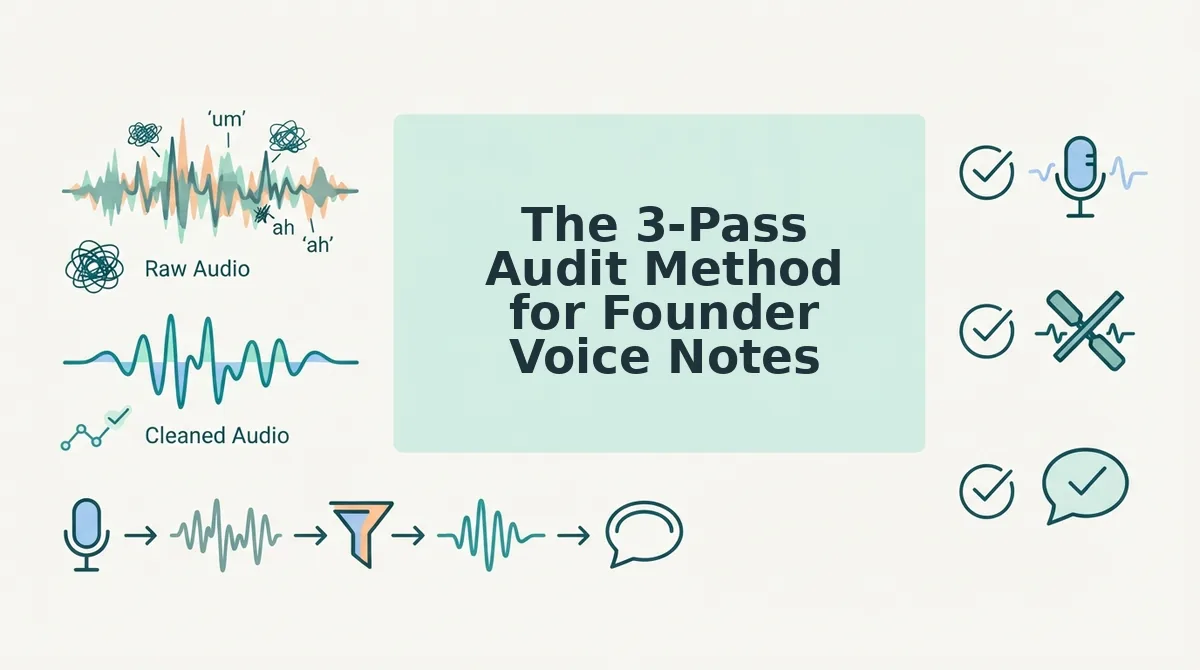
The 3-Pass Audit Method is a repeatable framework for reviewing founder voice notes in three focused sweeps: filler counting, grammar flagging, and decisiveness scoring. Each pass takes under two minutes, and together they replace the re-recording loop with a targeted fix list.
Prerequisites: one raw voice note recording (30 - 90 seconds works best), a timer, and either a notepad or a tool that can remove filler words from audio after you've identified them.
- Pass 1: Count every filler word. Play the recording at normal speed and tally every "um," "ah," "like," "you know," and "basically." Set a 60-second timer and count only the first minute. If you hit more than 3 fillers in that window, you've found a habit worth fixing. Write down the exact fillers and their rough timestamps. Success looks like a short list, not a perfect zero.
- Pass 2: Flag grammar breaks and sentence fragments. Replay the note and listen for places where a sentence starts one direction and pivots mid-thought, or where a fragment stands alone as if it were complete. Mark each one with a one-word note like "pivot" or "fragment." Don't fix anything yet, just flag. You should end with a handful of marks, not a rewrite.
- Pass 3: Assess decisiveness. Listen a third time and ask one question per sentence: does this land, or does it trail off? Mark any sentence that ends with "so yeah," "anyway," "let me know what you think," or a fading intonation. These are the moments where your authority leaks. Success is a note where most sentences end on a clear point.
Here's a worked example. A 45-second investor update contains 7 fillers, 2 grammar fragments, and 3 trailing sentences. Pass 1 takes 60 seconds, Pass 2 takes 90 seconds, Pass 3 takes 90 seconds. Total audit time: 4 minutes. You now have a concrete fix list instead of a vague feeling that the note "sounded off."
Once you've completed all three passes, you have two options: re-record with the fix list in front of you, or run the original audio through a tool that cleans fillers and grammar breaks while preserving your voice. The second option is faster, and it's exactly what the next section covers.
From Audit to Fix Without Re-Recording
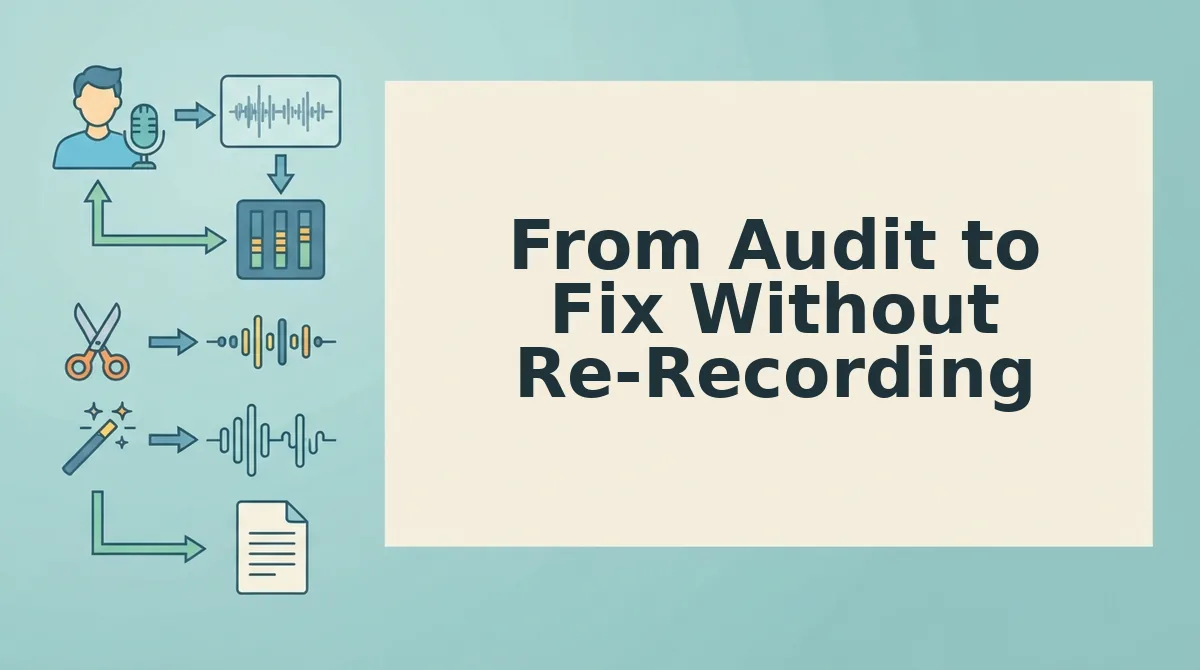
Once you have identified your spoken patterns, the fastest path to a clean message is not re-recording, it is applying a targeted fix to the audio you already have. Re-recording is a hidden time sink: founders often do 3 - 5 takes for a single note, losing 10 - 15 minutes per message. A side-by-side transcript comparison shows exactly what changed, so you learn your patterns instead of just patching them.
Three practical workflows dominate for founders today. Manual re-recording is the default but costs the most time. Third-party editing tools like Descript or Audacity give you waveform-level control but require manual cutting and can leave audible seams. VClar automates the cleanup while preserving your original voice, tone, and cadence.
| Option | What it does | Time cost per note | Preserves natural voice | Best for |
|---|---|---|---|---|
| Manual re-recording | Delete and re-record the entire note until it sounds right | 10 - 15 minutes (3 - 5 takes) | Yes, but inconsistent across takes | Founders with unlimited time and zero backlog |
| Waveform editor (e.g., Descript, Audacity) | Manually cut fillers and pauses from the audio timeline | 5 - 10 minutes per note | Yes, but risk of audible seams | Podcasters and video editors who need frame-level control |
| VClar | Automatically removes fillers, corrects grammar, and cleans audio in one pass | Under 1 minute | Yes, voice, accent, and cadence stay intact | Founders and operators who send voice notes daily and cannot afford re-takes |
Manual editing tools are genuinely powerful for long-form content, but they solve a different problem than a founder sending a 45-second update between meetings. If your goal is to remove filler words from audio and fix grammar in a voice message without losing your delivery, an automated pass beats a manual one on both speed and consistency. The contrarian one-take audit loop works because you stop treating every note as a performance and start treating it as raw material you refine once.
Building a Weekly Voice Note Audit Routine
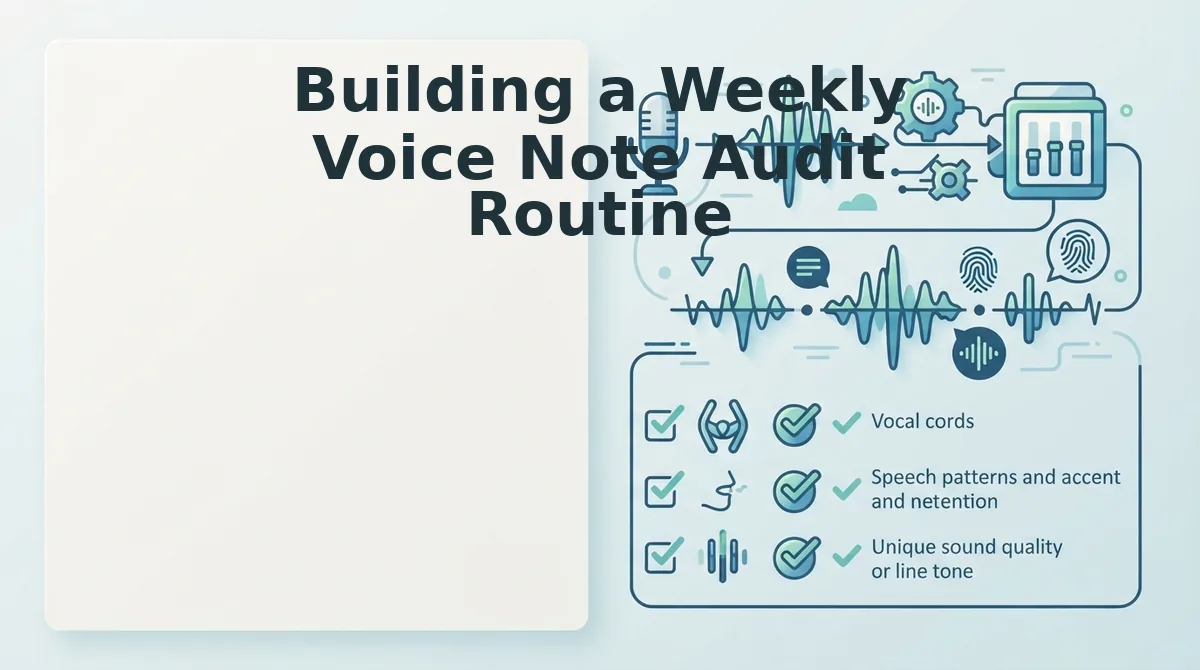
A weekly audit routine turns sporadic self-correction into a measurable habit. Audit 3 voice notes per week, not all of them, to avoid audit fatigue. Track your filler count over 30 days to see measurable improvement.
- Pick 3 voice notes from the past week. Choose a mix of high-stakes messages (investor updates, client replies) and casual ones. Variety reveals whether you slip more under pressure or when relaxed.
- Run the 3-pass listening method on each note. First pass listens for fillers only, second pass for grammar breaks, third pass for weak sentence endings. Separating the passes prevents you from missing patterns you are not looking for.
- Log results in a simple tracking table. Use columns for Date | Note Length | Fillers | Grammar Breaks | Decisiveness Score (1 - 5). A written log makes improvement visible and keeps you honest.
- Fix the note with a cleanup pass instead of re-recording. Apply a tool like VClar to remove fillers and correct grammar in one pass. The side-by-side transcript shows exactly what changed, reinforcing the pattern you need to stop.
- Review your 30-day trend on the last Friday of each month. Compare your filler count and decisiveness score against the previous month. A downward filler trend is the clearest signal the habit is working.
Consistency beats intensity here. Three notes a week is enough to spot patterns without turning self-review into a second job.
Frequently Asked Questions About Auditing Founder Voice Notes
Auditing your spoken habits in voice notes means listening back to your own recordings with a structured ear, checking for filler words, grammar breaks, and weak endings, so you can fix patterns instead of repeating them. It takes about 10 minutes per week when you focus on just 3 notes.
How do I hear my own filler words in voice notes?
Use the 3-pass listening method: first pass for fillers only, second for grammar, third for sentence endings. Isolating one category per pass prevents your brain from auto-correcting what it expects to hear.
What's a normal number of filler words in a 60-second voice note?
More than 3 fillers per 60 seconds is a working benchmark worth fixing. Most founders average 5 - 8 fillers per minute in spontaneous notes, which is why a cleanup pass matters more than trying to speak perfectly.
Should I script my voice notes before recording?
No, scripting kills authenticity. Your tone flattens and you sound like you are reading. Audit after recording instead, and let a cleanup tool handle the rough edges while your natural delivery stays intact.
Can I fix grammar in a voice note without re-recording?
Yes, use a tool like VClar to correct grammar while preserving your voice. The audio timeline is cleaned seamlessly, so you keep your tone and cadence without doing another take. For more on this, see our guide to spoken English grammar cleaner.
Start auditing your next voice note today.
Start Auditing Your Next Voice Note Today
The 3-pass method takes five minutes per note and eliminates the re-recording loop entirely. That's the real payoff: you stop burning twenty minutes on take seven and start shipping the first take.
Here's the sequence that turns auditing into a habit:
- Record one voice note as you normally would, no prep, no script.
- Run the 3-pass audit: filler scan, grammar check, structure review.
- Compare against VClar's free transcript to see your patterns in 60 seconds.
VClar's free transcript comparison surfaces your verbal tics immediately, the "basically" you lean on, the false starts you repeat, the grammar slips you never hear in real time. Once you see the pattern, you can either fix it manually or let VClar remove filler words from audio without touching your tone or cadence.
The founders who sound sharpest on voice notes aren't the ones with perfect diction. They're the ones who audit five minutes a week and ship every message in one take.
Your voice is already the asset, the audit just removes what's covering it.