

You record a voice note, hit send, and then listen back, only to hear a sentence that starts strong and dies mid-air. If you're a founder or sales rep who thinks faster than you type, you've probably asked yourself how to fix dangling spoken phrases in audio messages without doing ten takes. You're not alone, and the fix isn't speaking more carefully, it's knowing what to listen for.
Dangling spoken phrases are incomplete thoughts that quietly undermine authority in voice messages. They make a confident pitch sound hesitant and a clear instruction sound vague. The good news: you can repair them systematically, not by rehearsing endlessly but by recognizing the patterns and applying targeted fixes.
In this guide, you'll learn what a dangling spoken phrase actually is, the five patterns that cause most of them, and three practical methods to fix them, including an AI-assisted cleanup that preserves your natural voice. One of these patterns is so common that you've probably used it in your last three voice notes without noticing.
What Is a Dangling Spoken Phrase? (And Why It Happens)
A dangling spoken phrase is an incomplete or grammatically disconnected thought that leaves the listener waiting for a resolution that never arrives. In voice messages, these phrases typically surface as abandoned subjects, orphaned modifiers, false starts, trailing conjunctions, or pronoun ghosts, each a distinct pattern with its own fix.
Think of a dangling phrase like a bridge that stops halfway across a river. The speaker starts building toward a destination, but the structure never reaches the other side. The listener is left standing on the edge, reconstructing what the speaker probably meant.
Speech produces more dangling phrases than writing because thinking speed outpaces speaking speed and there is no backspace key. When you type, you can delete and restructure before anyone sees the draft. When you speak, every false start and abandoned clause ships immediately.
The Dangling Phrase Taxonomy categorizes the five most common spoken dangling patterns:
- Abandoned subject: "The thing about the Q3 numbers is, anyway, let's talk about the demo." The subject is introduced but never resolved.
- Orphaned modifier: "After reviewing the proposal, the timeline needs to shift." The modifier "after reviewing" has no clear subject doing the reviewing.
- False start: "I think we should, what I mean is, the pricing page needs a refresh." The first clause is abandoned mid-stream.
- Trailing conjunction: "We can launch next week, but…" The sentence ends on a conjunction, leaving the contrast unresolved.
- Pronoun ghost: "They said it would be ready, but it wasn't clear who they meant." The pronoun "they" has no identifiable antecedent.
Each pattern has a specific repair strategy. The abandoned subject needs a completed predicate. The orphaned modifier needs its implied subject named explicitly. The false start needs the first clause deleted entirely. The trailing conjunction needs the contrasting clause spoken aloud. The pronoun ghost needs a concrete noun substituted for the vague reference.
Recognizing these five patterns is the prerequisite for fixing them. Without a taxonomy, you only hear that something sounds "off", with it, you can name the problem and apply the right repair in seconds.
How to Fix Dangling Spoken Phrases in a Voice Note (3 Methods)
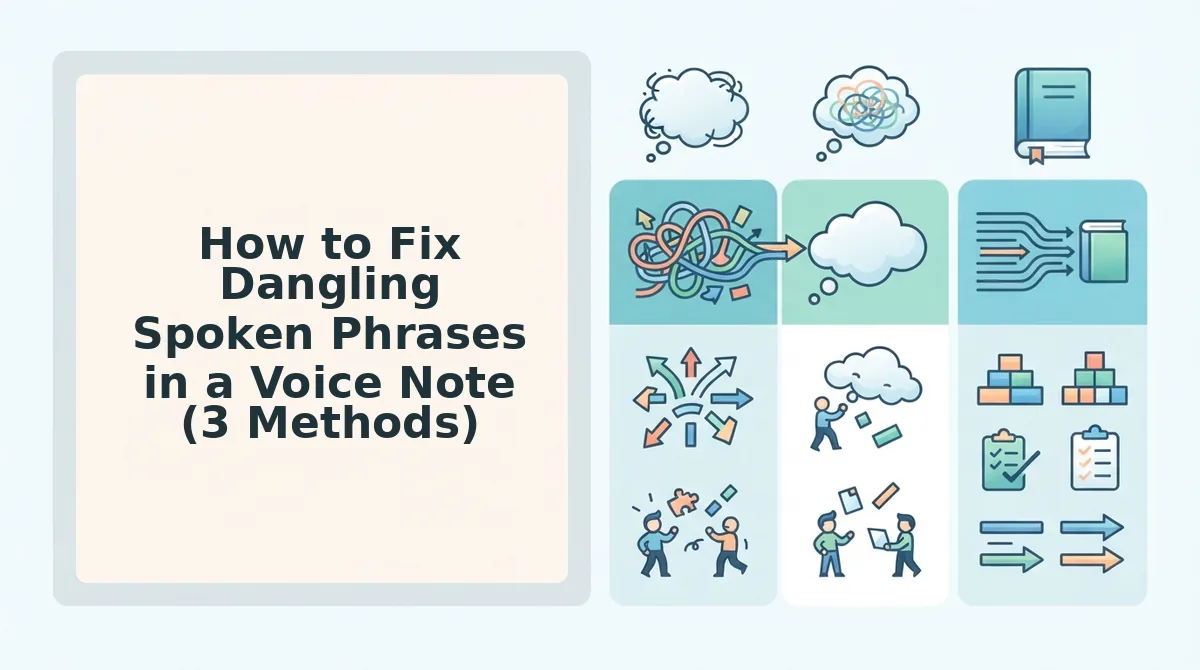
You can repair dangling spoken phrases in a voice note using three methods: a pre-recording mental checklist, manual timeline editing, or AI-assisted cleanup that detects and fixes the patterns automatically. Each method works independently, and the third eliminates the need for re-recording entirely.
Prerequisites: a voice note you've already recorded (for methods 2 and 3), an audio editing tool with a visible waveform (for method 2), or access to an AI voice cleanup tool like VClar (for method 3).
- Run the mental checklist before you record. Before hitting record, commit to three rules: finish every subject with a verb, place modifiers next to the word they modify, and never end a sentence on a conjunction. Say the first sentence out loud in your head. If it trails off, restart it with a complete subject-verb pair. You should feel the sentence land with a period, not a question mark. This takes 10-15 seconds and prevents most dangling phrases before they happen.
- Edit the audio timeline manually. Open your voice note in an audio editor with a visible waveform. Locate the dangling phrase by listening for the moment your sentence loses momentum. Select the incomplete clause, the false start, the trailing "but," the orphaned modifier, and delete it from the timeline. If the remaining audio sounds abrupt, record a short replacement clause and splice it into the gap. You should hear a clean, complete sentence with no audible seam. This method takes 3-5 minutes per voice note and requires basic audio editing comfort.
- Run AI-assisted cleanup. Upload your voice note to a tool that detects and repairs dangling spoken phrases while preserving your vocal timbre, tone, and cadence. The engine identifies abandoned subjects, orphaned modifiers, false starts, trailing conjunctions, and pronoun ghosts, then reconstructs the sentence structure without making you sound synthetic. You should hear your own voice delivering a complete, grammatically sound message in one pass. This method takes under a minute and removes the need to re-record anything. VClar performs this cleanup automatically, and you can also use it to fix grammar in a voice message beyond dangling phrases.
Method 3 is the fastest path to a polished voice note because it handles all five dangling patterns at once without requiring you to identify them manually. The output sounds like you on your best take, not like a text-to-speech clone.
Next, see what a real voice note sounds like before and after these repairs are applied.
Before and After: A Real Voice Note, Repaired
A dangling phrase is easiest to spot when you see it side by side with its repaired version. The example below shows a founder leaving an investor update voice note, first with the dangling construction intact, then with the sentence completed.
| Version | Transcript | What Changed |
|---|---|---|
| Before | "So when we looked at the numbers... anyway, the meeting started without me running late." | The phrase "when we looked at the numbers" never resolves. The speaker abandons it mid-thought, then jumps to an unrelated clause that also dangles because "running late" lacks a subject. |
| After | "When we looked at the numbers, we saw a 20% increase. The meeting started without me because I was running late." | The subordinate clause now connects to a main clause. The second sentence gains a causal link ("because") and a clear subject ("I"). |
Manual editing works when you have time to review a transcript. AI repair is faster when you need to send the note in one take. Best for founders and sales leads: an automated pass that catches dangling phrases before the message goes out. Best for editors and content reviewers: a manual checklist applied to transcripts before publishing.
Why Dangling Phrases Hurt Your Credibility (And What to Do Instead)
A dangling spoken phrase is a sentence fragment that starts with a dependent clause but never connects it to a complete thought, leaving the listener waiting for a resolution that never arrives. Dangling phrases make voice messages sound unprofessional even when the speaker knows exactly what they want to say.
Think of a dangling phrase like a handshake that stops halfway: the other person is left holding an incomplete gesture, unsure whether to commit or pull back. At the simple level, you can catch these by asking after every sentence, "Did I finish the thought I started?" At the intermediate level, you can run a mental checklist: subject, verb, and a clear connection between clauses. At the advanced level, you can automate the fix entirely.
The common advice to "practice more" fails busy professionals because it assumes you have time to rehearse every voice note. The One-Take Confidence mental model inverts that assumption: you don't need to become a grammar expert; you need a workflow that catches dangling phrases automatically. A tool that can remove filler words from audio while also repairing incomplete sentence structures gives you that workflow without adding a second take to your day.
Speak Once, Sound Polished
You can fix dangling spoken phrases by recognizing the five patterns, using a mental checklist, or letting AI repair them automatically before you hit send. The goal is not to speak perfectly but to sound polished without losing your natural voice.
The next step is to run your next voice note through VClar and see how the repair engine handles your dangling phrases in one pass. Once your spoken notes are clean, you can translate voice notes across languages without losing the cadence you worked to preserve. One take is enough when the cleanup happens for you.