

You've spent 30 minutes re-recording a 45-second voice note to your lead investor, deleting, restarting, deleting again, because every take sounds either rambling or robotic. Founders think at roughly 150 words per minute, but raw voice memos full of verbal fillers, awkward pauses, and disjointed grammar can quietly undermine the authority you've spent months building.
If that re-record loop sounds familiar, you're not alone. Most founders default to voice notes because they're faster than typing, then lose the time savings trying to sound polished. The good news: you can translate founder voice note for investors into a clear, confident update in one take, without losing your natural tone, accent, or cadence.
In this guide, you'll learn when a voice note actually beats a written update, a repeatable 45-second formula that structures your message for investor attention, and how to clean out the rambling so your voice sounds decisive, not rehearsed. Along the way, you'll see why one common assumption about investor communication is exactly backwards, and how tools like VClar's filler word removal and speech enhancement can make a single take your final take.
When a Voice Note Beats a Written Update for Investors
A founder voice note is a short, spoken update sent directly to an investor to convey progress, flag a decision, or ask for help, and it outperforms written updates when the message is narrative-driven and the relationship is already established. Voice notes win when tone matters more than tables.
Think of a voice note like a phone call you don't have to schedule. It carries urgency, warmth, and conviction that a bulleted email strips away. But not every update deserves one. The Investor Voice Note Decision Matrix, a simple 2x2 framework, helps you decide in under ten seconds.
Start simple: if your update is metrics-heavy (revenue, churn, burn rate) and your investor relationship is new, send a written update. Numbers need to be scanned, not heard. If your update is narrative-heavy (a key hire, a strategic pivot, a customer story) and the relationship is established, record a voice note. Your investor already trusts the numbers; they need to hear the conviction behind the story.
The intermediate layer: mixed updates, one metric, one story, work best as a voice note with the single number stated clearly up front, then the narrative wrapped around it. Advanced founders use voice notes strategically as a relationship signal: sending one at all tells an investor "you're close enough to hear the unfiltered version."
For a deeper breakdown of how to use voice notes for founders across fundraising stages, team updates, and board prep, see the full use-case guide. And when you do record, VClar's speech enhancement removes the ums, false starts, and background noise that make a spontaneous message sound unpolished, so the authenticity stays and the friction goes.
The 45-Second Investor Update Formula
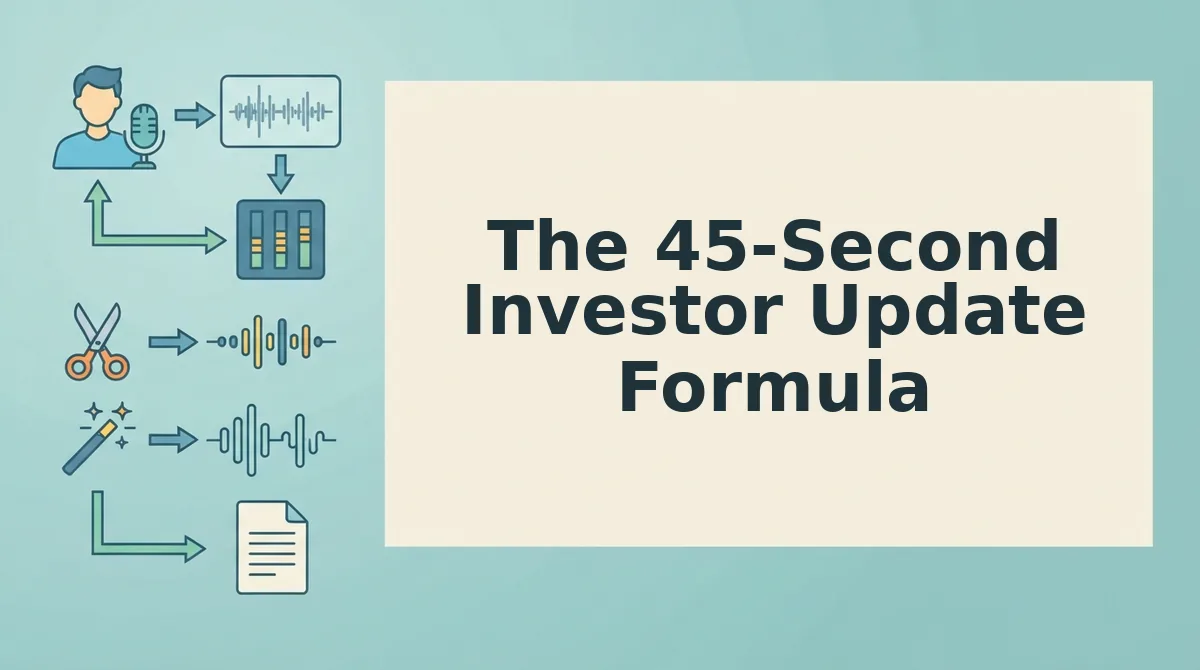
A 45-second investor update follows a four-part structure, context to number to implication to ask, that gives your investor everything they need to respond without a follow-up email. You need only your phone, a quiet-ish space, and a voice note app or VClar to record and clean the message.
- Open your voice note app and state the context in one sentence. Say what changed since your last update and why it matters now. Example: "We closed the enterprise pilot we mentioned last month." You should hear a clear, single-thread opening with no throat-clearing.
- Record the single most important number. Pick one metric, revenue, active users, pipeline value, and state it plainly. Example: "The pilot converted to a $48,000 annual contract." You should be able to point to exactly one number in your message.
- Explain the implication in plain language. Tell your investor what that number means for the business. Example: "That puts us at 62% of our Q4 revenue target with six weeks left." You should sound confident, not hedging, no "basically" or "kind of."
- Make the ask specific and time-bound. End with exactly what you need and by when. Example: "Can you intro us to the VP of Sales at Acme by Thursday? We're pitching them next Monday." You should hear a clear action your investor can take immediately.
Here's the formula in action: a founder records a metrics update from her car between meetings, voice note full of road noise and three false starts. She uploads it to VClar, which removes the fillers and background noise while keeping her voice and cadence intact. The cleaned 45-second message, context, number, implication, ask, goes to her lead investor, who replies with the intro within the hour. One take, no re-recording loop.
Next: cleaning the rambling out of your voice note so the formula above lands with full impact.
Cleaning the Rambling Out of Your Voice Note
Investors judge founder credibility in the first 15 seconds of audio. A clean, filler-free voice note signals decisiveness; a rambling one signals uncertainty before you finish your first sentence.
Here are the seven highest-impact cleanups, ordered by how much they move an investor's perception of you.
- Remove filler words first, they map directly to credibility gaps. Every "um" an investor hears reads as uncertainty, every "like" as imprecision, every "basically" as over-simplification, and every "you know" as a need for validation. Run your recording through a filler word remover that deletes these from the audio timeline seamlessly, so the message sounds decisive without re-recording.
- Cut false starts and repeated openings. Founders often begin a voice note three times before landing on the real sentence. Investors hear the hesitation, not the recovery. Delete the abandoned attempts and keep only the clean take, the audio should start with your strongest point.
- Fix spoken grammar errors that undercut authority. Subject-verb mismatches and tense slips in speech read as sloppiness to an investor evaluating operational rigor. Use a grammar correction pass that adjusts the transcript and audio without flattening your natural cadence.
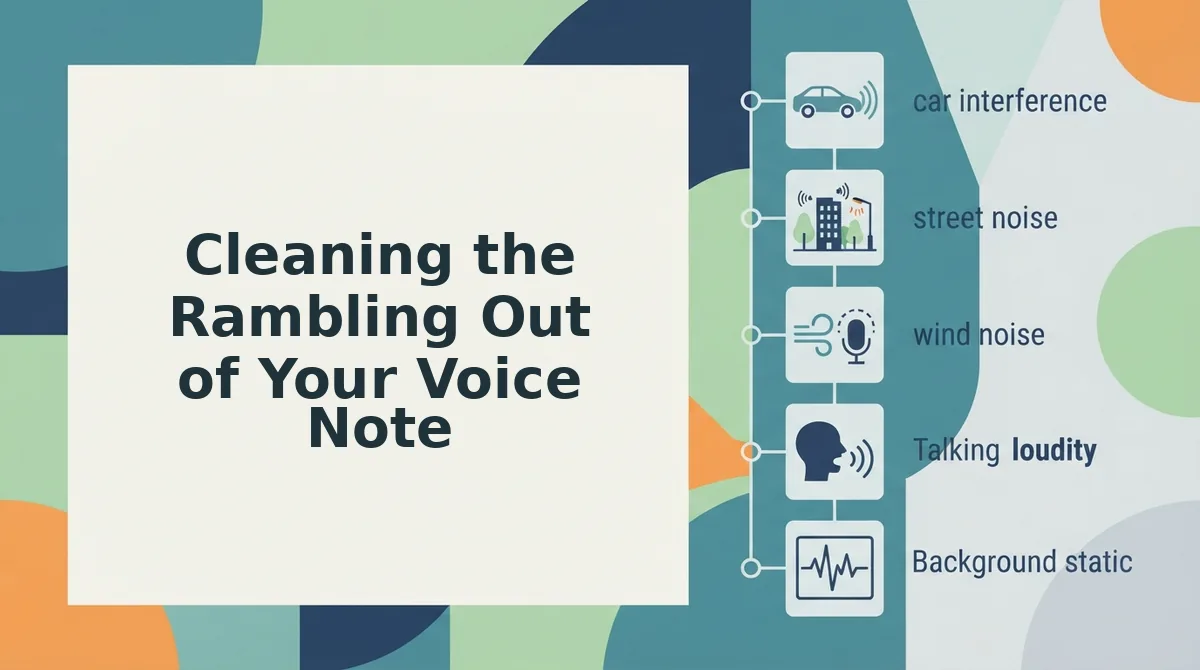
- Reduce background noise, breath sounds, and mouth clicks. Acoustic distractions force investors to work to hear you, and effort lowers trust. Clean the audio bed so your voice sits front and center, with your accent and rhythm fully intact.
- Tighten long-winded phrasing. A 90-second ramble can usually become a 45-second update with zero information loss. Cut redundant clauses and circular explanations before sending, investors reward density, not duration.
- Preserve your natural tone, accent, and rhythm while cleaning. The goal is polish, not performance. Any cleanup that makes you sound like a different person destroys the authenticity that made the voice note worth sending in the first place.
- Listen once before sending, with investor ears. Play the cleaned version and ask: would I fund this person based on this audio alone? If any sentence still sounds hesitant, cut it or re-record that segment only.
Cleaning filler words, fixing grammar, and reducing background noise, done right, preserves your natural tone, accent, and rhythm. The result is the same founder, just sharper. Run your next investor update through VClar's cleanup workflow before it leaves your phone.

Translating Your Voice Note for Cross-Border Investors
You can translate a founder voice note into any of 11 languages. Hindi, English, French, Japanese, Korean, German, Russian, Portuguese, Spanish, Italian, and Chinese, without losing your vocal identity. Translation preserves your natural tone, accent, and rhythm rather than replacing you with a synthetic clone.
Prerequisites: a recorded voice note (cleaned of fillers and background noise), the VClar app or web dashboard, and the target language for your investor.
- Upload your cleaned voice note. Open VClar and select Upload Audio. Choose the file from your device. You should see a waveform preview with a green confirmation checkmark once the upload completes.
- Select the target language. Click the Language dropdown and choose from the 11 supported languages, for example, Japanese for a Tokyo-based investor or German for a Berlin fund. The interface confirms your selection immediately.
- Run the translation. Click Translate. VClar processes the audio in under a minute for a typical 45-second note. You should see a progress indicator followed by a "Translation complete" status.
- Review the translated transcript. Open the Transcript tab to verify key terms, especially metrics, product names, and round details, translated correctly. Edit any term inline if your investor uses a specific regional variant.
- Listen to the translated audio. Play the output to confirm your tone, cadence, and emphasis survived the translation. The voice should still sound like you, not a text-to-speech engine.
- Send or export. Click Share to send the translated voice note directly, or Export to download the audio and transcript for your investor update email.
For founders raising across borders, a voice note translator turns one recording into 11 investor-ready versions. You record once in your native language, and each investor hears the update in theirs, with your authentic voice carrying the pitch, not a synthetic stand-in.
FAQ: Founder Voice Notes for Investors
Quick answers to the questions founders ask most before sending voice updates to investors.
How do I translate a founder voice note for an investor who speaks another language?
Upload your cleaned voice note to VClar, select the investor's language from the 11 supported options, including Hindi, Japanese, German, and Portuguese, and run the translation. The output preserves your natural tone, accent, and rhythm, so the investor hears your authentic voice speaking their language, not a synthetic clone.
What makes a voice note sound unprofessional to investors?
Filler words like "um" and "like," false starts, background noise, and rambling phrasing are the top credibility killers. Each filler maps to a specific doubt: "um" signals uncertainty, "basically" signals over-simplification, and "you know" signals a need for validation. Clean audio signals operational discipline.
Should I send a voice note or a written update to investors?
Send a voice note when tone matters, good news, bad news, or a pivot, and a written update for routine metrics. A 45-second voice note conveys conviction that text cannot, but only if it is clean, tight, and free of fillers. Use both: voice for the narrative, text for the numbers.
How long should a founder voice note to investors be?
Aim for 45 seconds or less. Investors process audio faster than text but tune out after a minute of rambling. Lead with the headline, give one supporting detail, and end with the ask. Anything longer belongs in a written update.
The One-Take Founder Voice Note Is Now a Repeatable Workflow
You no longer need to choose between speed and polish when updating investors. The 45-second formula gives you structure, cleaning removes the hesitation that erodes confidence, and translation opens doors across 110 language directions without flattening your voice. The open loop from the start resolves here: the bottleneck was never your speaking ability. It was the absence of a cleanup layer between your raw thought and the investor's ear.
Here is the workflow in one breath:
- Record once, using the 45-second update formula.
- Run the audio through VClar to strip fillers, fix spoken grammar, and reduce noise.
- Translate if needed, then send the cleaned voice note or transcript.
Founders who adopt this loop stop re-recording and start shipping updates. The expected outcome is a voice note that sounds like you on your best day, in any of the 11 supported languages, ready for a cross-border investor's inbox in under two minutes.
Your voice is the asset. The cleanup is the leverage.