

You send ten voice notes a day to your team, your cofounder, your clients, and every single one contains the same three verbal tics you've had since your first pitch. The notes get the job done, but you never actually get better at speaking. That's the gap between capturing your thoughts and improving how you deliver them, and it's exactly where a voice note learning loop for founders changes the game.
Most productivity advice stops at capture: record the idea, transcribe it, move on. Thomas Frank's popular video on voice notes, with over 200K views, focuses almost entirely on capture and summarization, not on reviewing how you actually sound. That's the missing half of the loop.
Here's what you'll learn: how to turn your existing voice note habit into a self-correcting feedback system, why comparing your raw ramble against a cleaned version reveals patterns you can't hear in real time, and the exact transcript diff method that surfaces your worst speaking habits in under ten minutes. If you already use voice notes for founders as a daily tool, you're sitting on a training dataset most people pay coaches to access.
You'll see it in Section 4. For now, start by understanding the loop itself, and consider running your next voice note through a tool that strips filler words and fixes grammar automatically, so you have a clean baseline to compare against.
What Is a Voice Note Learning Loop (and Why Founders Need It)?
A voice note learning loop is a feedback system where you record, review, compare, and adjust your spoken communication using your own voice notes as the raw material. It turns every message you send into a deliberate practice session instead of a one-way broadcast.
Think of it like watching game film as an athlete. A basketball player doesn't improve by playing more games, they improve by reviewing footage, spotting the moment they dropped their guard, and drilling that specific fix. Your voice notes are your game film. The loop is the review session.
At the simplest level, the loop has three stages: record a voice note as you normally would, review a cleaned or transcribed version of it, and adjust one specific behavior in your next note. You don't need to fix everything at once. You need to fix one thing repeatedly until it sticks.
At an intermediate level, you add a comparison step. Run your raw audio through a tool that removes filler words and fixes grammar in voice messages, then place the raw transcript and the cleaned transcript side by side. The differences between the two are your personal speaking patterns, made visible. You'll start noticing that you say "basically" before every recommendation, or that you restart sentences when you're uncertain about a number.
At an advanced level, you track these patterns over time. Keep a running list of your top three verbal habits and check each new voice note against that list. Founders who do this consistently report that their messages get shorter, their asks get clearer, and their teams stop asking follow-up questions that the original note should have answered.
Here's the contrast that matters: tools like Voicenotes, whose product walkthrough has drawn thousands of views, excel at capture and organization. They store your thoughts, tag them, and resurface them. But they don't close the loop. A capture-only workflow is like writing in a journal and never rereading a page. The learning loop is what turns storage into skill.
For founders specifically, the stakes are higher than for most professionals. You speak to investors, customers, and hires in rapid succession, often with no script and no second take. Every voice note you send is a live audition for clarity. A learning loop gives you a way to improve that audition without hiring a speaking coach or blocking out hours for practice.
The Transcript Diff Method: How to Compare Raw vs Cleaned Voice Notes
The transcript diff method is a five-step process for comparing your raw voice note transcript against a cleaned version to identify your specific speaking patterns. You'll need a voice note you've already sent or recorded, a tool that removes filler words and fixes grammar in voice messages, and a simple three-column table.
This method works because your ear filters out your own verbal habits in real time. You literally cannot hear your own "ums" while speaking, your brain edits them out. The side-by-side transcript comparison makes those invisible patterns visible, which is the first step to changing them.
- Record or select a voice note you sent in the last 48 hours. Pick one that felt rushed or rambling when you sent it. The discomfort you felt is a signal that there's something to learn. You should have the audio file or the original transcript ready in under two minutes.
- Upload the audio to a voice enhancement tool. Use a platform that removes filler words, false starts, and grammatical errors while preserving your natural voice and cadence. After processing, you should see a cleaned transcript that reads noticeably tighter than your original.
- Open a three-column table. Label the columns: What I said, What changed, and Why it matters. This table is the core of the diff method, it forces you to name the pattern, not just notice it.
- Fill in the first five differences you spot. For each row, copy the raw sentence into column one, the cleaned version into column two, and write one sentence in column three explaining what the change reveals. For example: raw says "I think we should basically like move forward with the proposal," cleaned says "We should move forward with the proposal." The change reveals you hedge before committing to a recommendation, a pattern that weakens your authority with teams and clients.
- Pick one pattern to fix in your next three voice notes. Don't try to fix all five. Choose the one that appears most often or does the most damage. Before your next voice note, write that pattern on a sticky note and keep it visible while you record. After three notes, run the diff again and check whether the pattern's frequency dropped.
Here's what the table looks like in practice:
| What I said | What changed | Why it matters |
|---|---|---|
| "I just wanted to like quickly check in about the, um, the deadline thing." | "I wanted to check in about the deadline." | You use "just" and "like" to soften requests, which makes deadlines sound negotiable. |
| "Basically the idea is we could maybe try to launch in Q1." | "The idea is we could launch in Q1." | You hedge with "basically" and "maybe" before stating a plan, signaling uncertainty to your team. |
| "So yeah, I mean, if that makes sense, let me know what you think." | "Let me know what you think." | You append validation-seeking phrases that undercut a confident close. |
The entire diff takes under ten minutes once you've done it twice. The goal isn't to become a polished speaker overnight, it's to make your speaking patterns visible so you can change them deliberately. Next, we'll name the five rambling patterns every founder should recognize in their own transcripts.
The 5 Rambling Patterns Every Founder Should Name
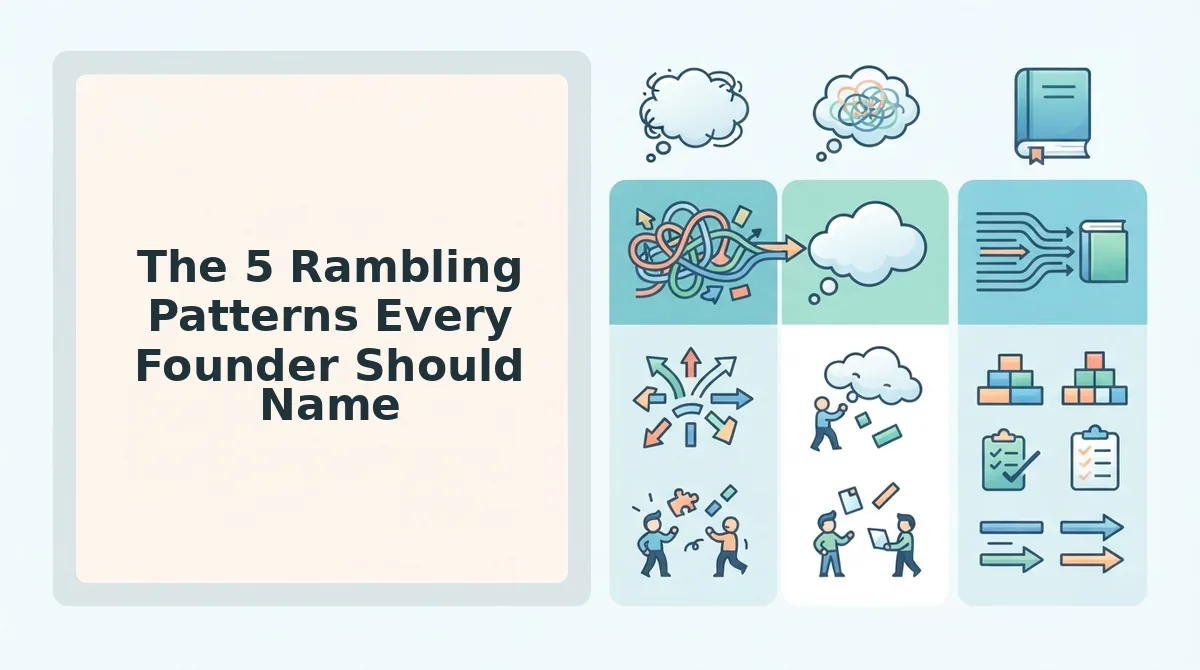
Naming a rambling pattern is the first step to fixing it. These five patterns show up in nearly every founder's voice notes, and each has a specific counter-move you can apply in your next recording.
- The False Start Cascade. You begin a sentence, abandon it three words in, and restart with a slightly different angle. This pattern signals you're composing in real time instead of delivering a decision, and it forces listeners to track multiple abandoned threads. To use it, flag every restart in your transcript diff and count them; if you exceed two in a 60-second note, script your opening sentence before you hit record.
- The Qualifier Spiral. You stack softening phrases like "I think," "sort of," "maybe," and "to be honest" before every substantive point. This pattern erodes authority and makes even confident recommendations sound provisional. To use it, highlight every qualifier in your cleaned transcript and rewrite the sentence without it; the goal is one qualifier per note, not one per sentence.
- The Context Dump. You spend the first 40 seconds explaining background the listener already has before reaching the actual ask or update. This pattern buries your point and trains recipients to skip ahead. To use it, mark the exact second your message shifts from context to content in the diff; if it's past the 15-second mark, cut the preamble and start with the decision or question.
- The Tangent Loop. You drift into a related but non-essential story, realize you've drifted, and verbally course-correct with "anyway" or "so back to the point." This pattern fragments your message and forces the listener to mentally discard dead-end material. To use it, identify every "anyway" in your raw transcript and delete the preceding clause; if a tangent doesn't survive that cut, it never belonged in the note.
- The Filler Thicket. You pepper the message with "um," "like," "basically," and "you know" to buy thinking time between ideas. This pattern is the most common and the most mechanically fixable; remove filler words from audio with VClar's engine and the timeline tightens without touching your cadence. To use it, run a filler count on every note and track the per-minute rate; founders who audit this number weekly typically cut it in half within a month.
These five names give you a diagnostic vocabulary no generic "speak clearly" advice provides. Once you can name the pattern, you can measure it, and once you can measure it, you can fix it.
The 5-Minute Weekly Voice Audit: A Founder's Review Ritual
A weekly voice audit is a five-minute review where you compare one raw voice note against its cleaned version, count your rambling patterns, and set one measurable goal for the next week. You need one recent voice note, its transcript, and a VClar account to run the side-by-side comparison.
- Pick one voice note from the past week. Choose the message you sent to the highest-stakes recipient, an investor, a key customer, or a co-founder. Open it in your voice notes app and export the raw audio file. You should have one file ready to upload in under 30 seconds.
- Upload the raw audio to VClar and generate the cleaned version. Open the VClar dashboard, click Upload, and select your file. Wait for the processing to complete, you should see a cleaned audio player and a side-by-side transcript appear on screen.
- Run the diff and count your patterns. Compare the raw transcript against the cleaned transcript line by line. Count false starts, qualifiers, tangents, and filler words. One founder sent a 90-second investor update, ran the diff, and found 14 filler words and three false starts; the cleaned version cut it to 3 fillers and zero restarts. You should end this step with a written count for each pattern.
- Set one measurable goal for next week. Pick the single pattern with the highest count and commit to a specific target, for example, "under 5 fillers per minute" or "zero false starts in my next investor note." Write the goal in your notes app where you'll see it before your next recording. You should finish the audit in under five minutes with a clear, trackable target.
This ritual works because it's time-boxed and diagnostic rather than aspirational. You're not "working on your communication" in the abstract; you're measuring one named pattern against a number. For a deeper walkthrough of how this fits into a founder's weekly workflow, see voice notes for founders and start your first audit this week.
Start the Loop, Keep Your Voice
The voice note learning loop works because it separates signal from delivery without asking you to become a different speaker. You don't need to eliminate your accent, flatten your cadence, or sound like a polished podcast host, you need to name your patterns, measure them weekly, and let the diff show you what's already working.
Your next step is one diff. Take the last voice note you sent to an investor or customer, run it through VClar's side-by-side comparison, and count your patterns. Then commit to four weeks of the five-minute audit. The founder who cuts 14 fillers to 3 in one week doesn't have a new voice, they have a cleaner version of the one their team already trusts.