

Guides
Voice Message Etiquette and Clarity: Top Tips
Plan the point, speak calmly in a quiet place, keep a routine work note under about two minutes, listen once, and polish the wording after the take. Add a text line when someone must copy a fact. VClar is the polish step, after you already know what the note has to say.
A voice message is a small speech with one listener and no slide deck. The habits that make a short talk usable are the same habits that make a work note usable: you know the point, you speak so the words can be heard, you stop before you have used up the other person’s patience, and you check the result before it leaves your hands. Polish comes after those habits. It cannot supply a point you never chose.
This page is the etiquette and the clarity, written for someone sending notes at work, to a client, or across a family chat that still has to carry a decision. Role-specific pages on the use-case hub say who is speaking. The voice versus text guide says when to speak at all. Here the choice is already made, and the question is how to record so the listener can use what you sent.
The ten practices
The title is a list, so here is the list. The sections after it are the reasons, the research behind the reasons, and what to do when a take is almost right.
- Know the decision before you press record.
- Jot three beats, not an essay you will read aloud.
- Record in a quiet place, with the phone a short distance from your mouth.
- Speak at a moderate pace and finish your consonants.
- Keep a routine work note under about two minutes.
- Lead with the decision, then the reason, then the ask.
- Listen once before you send.
- Polish the wording after the take when the meaning is already right.
- Add one text sentence when a fact has to be copied or forwarded.
- Leave voice alone when the person needs text, secrecy, or a calmer you.
Prepare your script
Preparation is the difference between a note and a search. If you press record in order to discover what you think, the listener hears the search: the false start, the repaired noun, the “um” while you pick a date. Those sounds are honest. They are also the part of the message that is about your planning, not about their work.
A National Library of Medicine paper on disfluency and cognitive load describes the direction of that effect carefully. As a speaker’s cognitive load goes up, speech becomes more disfluent. Listeners, in turn, treat filled pauses and repairs as a sign that the speaker is having trouble planning the next words. The practical reading for a status note is simple. Do the hard planning before the red light. Three beats on a scrap of paper, or in the notes app, move the load off the recording. The listener then spends their attention on the decision. VClar can lift leftover fillers out of a take. It should not be the first time anyone, including you, hears what the note was for.
There is a speed finding that makes the same point from the other side. A Stanford, University of Washington, and Baidu study of entering short phrases found English speech at a mean of 161.20 words per minute and phone-keyboard entry at 53.46, with a lower error rate for speech on that copying task. The same paper cites earlier composition research in which speech, after people corrected it, was slower than keyboard-and-mouse composition: 7.8 corrected words per minute for speech against 32.5 for the keyboard. Copying a phrase you already know is fast by voice. Inventing and then repairing a message by voice can be the slow path. Plan, then speak. The microphone is a delivery tool once the point exists.

Three beats, built for the ear
Purdue OWL’s conference-presentation guidance warns that a paper written to be read silently is the wrong script for a talk. Seminar prose runs long, and it lacks the repetition and simple sentence shape that help a listener. A voice note is a much smaller talk, and the warning scales down rather than disappearing. Do not paste the email you almost sent into your head and recite it. Write three lines you can say:
- The decision, in one sentence, with the verb you mean. “We are moving the review to Thursday” is a decision. “So I was thinking about the review” is a warm-up.
- The reason, in one sentence. Why Thursday, why this vendor, why the change. One reason. The second reason can live in the thread if someone asks.
- The ask, in one sentence. What the listener should do, or the explicit news that they need do nothing. Silence on the ask makes people replay the note to find a task that was never there.
Say the name of the thing once, clearly, near the start. “The Q3 renewal” beats “that thing we discussed.” If you must mention two options, name the one you are choosing and then the one you are leaving, in that order. Listeners hold the first concrete noun more easily than a contrast buried in the middle of a repair.
Read the three beats to yourself before you record. This is the mindfulness step. If a beat is cruel, vague, or still undecided, the recording will not negotiate it into kindness. Fix the sentence on the page. A voice note carries pace and emphasis, which means a sharp sentence arrives sharper than it looked in type. If you would not send the three lines as a text to that person, do not say them into a microphone and hope the smile in your voice will sand them down. Sometimes it will. Sometimes the smile will not survive the commute, the speakerphone, or a listener who is already having a bad day.
What the script is allowed to leave out
Leave out the apology for sending a voice note, unless you know this person dislikes audio and you are making a one-time exception. A five-second apology is a tax on every future note. Leave out the recap of the entire thread. They have the thread. Leave out a second topic. Two topics in one waveform become one muddy topic, and the listener has no heading to jump to. Send a second note, or put the second topic in the text line.
Leave in one human sentence if the relationship needs it. “The draft is strong, and Thursday gives us time to use Maya’s notes” carries a different stance from “Thursday.” You do not need a paragraph of praise. You need the adjective you actually mean, said once, where the pitch can land on it. That is the part text often flattens, and it is the reason this note is audio.
Speak clearly and calmly
Clarity is physical. The room, the distance to the microphone, and the pace do more for a voice note than a dramatic performance. Purdue’s same talk guidance says to speak slowly and clearly. For a note recorded on a phone, that means you are not racing a meeting that has already started in your head.
The University of Minnesota’s open chapter on vocal delivery treats a conversational rate of about 125 to 150 words per minute as a usable speaking pace. Faster than that, consonants smear and a listener who is walking, driving, or using a second language starts to lose words. Slower than that, a short note can feel like you are stalling. You do not need a metronome. You need the feeling that you could write the sentence down as you say it. If you cannot, you are rushing the ending of words, which is where names and numbers hide. The speech speed test can time a practice sentence if you want the number. The note itself still only needs to feel writable as you say it.
The room and the phone
Record where the air is quiet. A kitchen fan, a street, an open office, and a car window each add a noise floor that a later listener cannot turn off. Close the door. If you are outside, face away from the wind so the gust does not sit on the microphone. Hold the phone a small, steady distance from your mouth, close enough to be present and far enough that plosives, the “p” and “b” sounds, do not thump. Earbuds with a mic often beat a phone lying on a table, because the table picks up the room and the mic picks up a ceiling.
One test takes five seconds. Record “Thursday, three options, I recommend the second” and play it back at arm’s length. If “Thursday” and “second” are both intact, the setup is good enough. If either word blurs, move, turn, or step indoors. Do not discover the blur after the real note is two minutes long.
Enunciation is not a new accent. Finish the word you chose. “Going to” can be “gonna” if that is how you speak and the listener knows you. It should not become a swallow in which the verb disappears. Names get a full vowel. Numbers get a pause on either side: “three,” then the unit, then the date. A string of digits said as a blur is how invoices go to the wrong amount. If the number matters, it also goes in the text line, which is practice nine. Saying it cleanly is still practice four, because some people will only listen.
Calm is a pace, not a personality
Calm means you are not stacking three repairs on one noun. It does not mean you sound like a presenter. Your accent, your pitch, and your usual rhythm are the voice the other person recognizes. VClar’s polish keeps that recognizable delivery. The habit on your side is to stop smiling through a sentence you have not finished, and to stop speeding up because you are embarrassed to be recording. Embarrassment is what produces the “sorry, this is easier than typing” opening that eats the first ten seconds. Start on the decision.
If you are angry, wait. A voice note stores emphasis. The sentence “I need the file” said with heat arrives as heat, even after filler words are gone. Polish does not launder a mood. Type the request when the mood is the part you do not want to send. Come back to audio when the three beats are something you could say in the same room without raising the temperature.
Non-native speech is not a reason to abandon the note. Pace and a quiet room help every listener, including a listener who shares your first language. If the wording is the fragile part, that is what the grammar step is for, after the take. Do not slow down into a monotone that hides the point. Keep the pitch that marks the decision, and give the consonants enough time to exist.
Keep it concise
Purdue’s talk advice includes a courtesy that maps cleanly onto a chat: aim to take less time than you were given. A voice note has no formal slot, so you borrow one. For a routine update, two minutes is a generous slot. At 125 to 150 words per minute, two minutes is roughly 250 to 300 words. That is a short memo, not a meeting. It fits a decision, a reason, and an ask, with a little air around the names.
Two minutes is a practice, not a result from a single experiment that crowned that number. A teacher who was asked for a spoken explanation, or a founder recording context a board member asked to hear, can run longer because the listener opted in. A status note nobody asked to sit through should not. If your three beats take forty seconds, send forty seconds. Padding to sound thorough is how notes grow a second topic.
Concise also means one job. A note that approves a draft, assigns a new owner, and changes a date is three notes, or it is one note plus a text line that lists the three facts. The waveform can carry the stance: “I am comfortable with Maya’s draft.” The text line can carry the logistics: “Maya owns the next pass. Review moves to Thursday.” Listeners who are in a hallway can take the stance from the audio later. Listeners who are in a meeting can take the logistics from the line now.
Harvard Business Review’s piece on asynchronous communication is about work that has to travel across hours and time zones. A voice note is one of the tools for that pattern, because you can record when you are free and they can listen when they are free. The etiquette follows from the pattern. You are leaving an object in their queue, not pulling them into a live conversation. A queue respects length. A live conversation can wander, because both people can interrupt. A note cannot be interrupted, so you do the interrupting yourself, by stopping.

A useful self-check is the first sentence. Play the opening five seconds. If they contain the decision, the length of the rest is easier to forgive. If they contain weather, apology, and “quick question,” you have spent the scarce part of their attention on the lobby. Move the decision to the front even if the rest of the take stays. You can do that by re-recording twenty seconds, or by letting the cleaned version lead with the sentence you already said later in the file, once you have confirmed the words are the ones you meant.
Listen and edit
Listening once is the cheapest edit. Play the note from start to finish without doing anything else. You are checking four things: the decision is actually in the audio, the name is the right name, the number survived, and the tone is one you would use in the room. If any of the four fails, do not send it and hope the text line will rescue a contradictory audio. People believe the voice when the voice and the text split, because the voice sounds like a person and the text looks like a caption.
Edit in this order. First, cut a second topic if one snuck in. Second, fix a wrong fact by recording that sentence again or by deleting the note and keeping the text. Third, only then worry about “um,” a repeated “so,” or a grammar tangle. The third category is what polish is good at. The first two are yours, because an automated cleanup that removes a filler will not know that you named the wrong client.
Headphones change what you hear. A note that sounded fine from the phone speaker can reveal a thump on every “p,” or a buzz from a charger. If you send audio often, one playback on the same kind of speaker your listener is likely to use is worth more than three playbacks in studio headphones. Most work listeners are on a laptop speaker or a phone in a kitchen. Mix for that room.
The text line
Research on how people read web pages is not a study of WhatsApp, and it should not be cited as one. It is still the right analogy for a chat preview. The Nielsen Norman Group’s article “How Users Read on the Web” reported that 79 percent of their test users scanned a new page and 16 percent read word by word. A waveform cannot be scanned. A sentence can. When the note carries a date, an amount, a name, or a yes-or-no, put that token in a line under the audio.
Write the line as the decision, not as a teaser. “Thoughts?” forces a full listen for no reason. “Thursday review, Maya owns the next pass” lets a person in a meeting act, and lets them listen later for the tone. Keep the line and the audio in agreement. If you change the date after listening, change it in both places. The voice versus text guide walks through when the line should exist at all. On this page the rule is narrower: if you bothered to speak a fact someone might forward, give them the fact in type as well.
Some people prefer the line and will never press play. That preference is legitimate. Sending both respects it without giving up the stance that audio carries. Forcing audio on a person who has said they cannot listen, or who is in a culture of the team where voice notes have become a way to dodge writing, is the etiquette failure. Ask once if you do not know. Remember the answer.
Use AI polish
Polish is what you do after the meaning is right. VClar removes filler, repairs spoken grammar, and shows the original wording next to the improved wording. You hear a delivery that stays recognizable: your tone, accent, rhythm, and speaking style, with the clutter lifted. You do not get a different person. You do not get a new opinion. If the improved line changes a “not,” a name, or a day, you reject that line. The diff is the point of the step.
This is why the filler-word page and the spoken-grammar page sit next to a best-practices guide. Fillers and tangled grammar are what remain when a human has already done the planning and the room was good enough. They are also what a listener uses, often without meaning to, as a cue that the speaker was unsure. Cleaning them keeps the cue from attaching to a decision you had already made on paper. Leaving them in is reasonable when the note is a friend, the mess is the charm, and nobody has to act. Work notes usually have to act.
A before and after, written as an illustration
This is not a customer recording and not a measured result. It is the shape of the edit.
| What the listener gets | |
|---|---|
| Unplanned take | Um, hey, so I looked at the, uh, the draft, and I think, I mean if Maya’s notes land, Thursday is better, or Wednesday, no, Thursday, sorry. |
| After you know the point, and after polish | I read the draft. Thursday is the better review, so Maya’s notes can land first. Please move the meeting to Thursday. |
| Text line under the audio | Review moves to Thursday. Maya’s notes come first. |
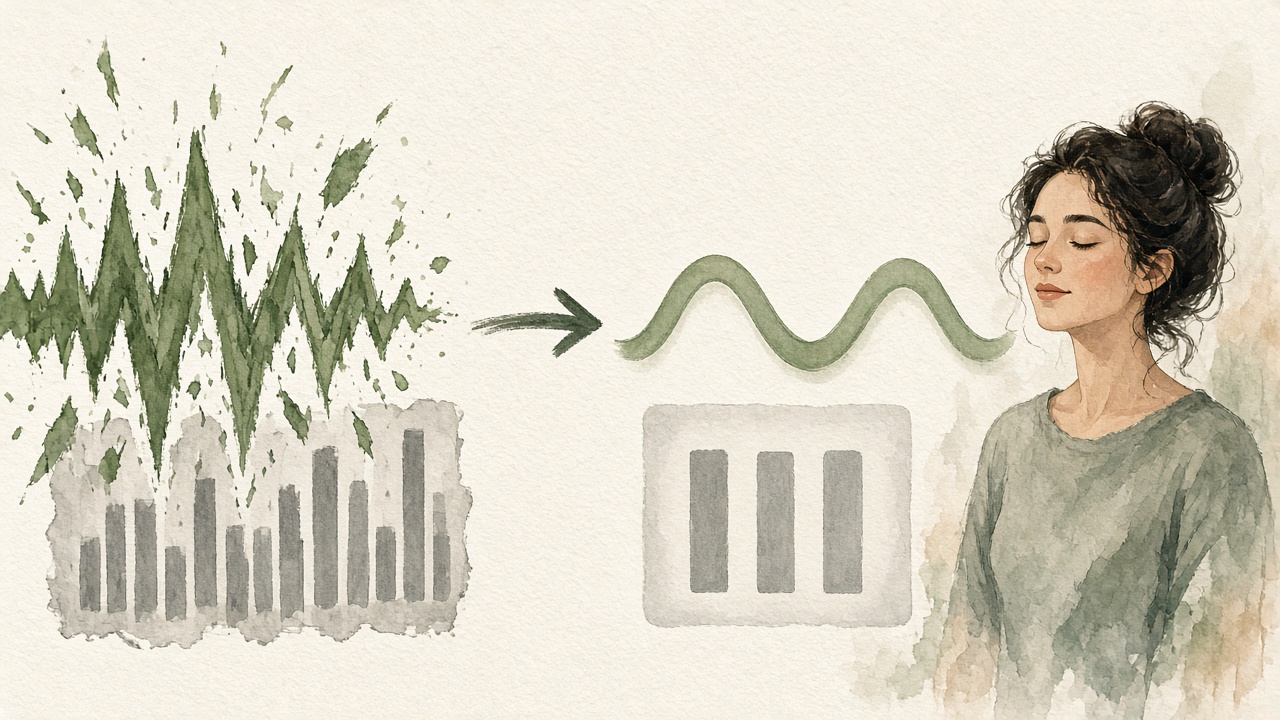
The dangerous moment in the raw take is “or Wednesday, no, Thursday.” A listener who catches only the first day will show up on the wrong morning. Planning removes the scramble. Polish removes the leftover “um” and the false start if any remain. The text line makes the day scannable. All three are the practice. None of them is a promise that a model will guess Thursday when you never decided.
Translation is a separate practice, used when the listener needs another language. The order stays the same: clean the meaning, then translate that cleaned meaning, among Hindi, English, French, Japanese, Korean, German, Russian, Portuguese, Spanish, Italian, and Chinese, 110 directions. The translation guide is that order for any file. The multilingual teams guide is the same order when the listeners work in another supported language. A WhatsApp file has its own export steps on the WhatsApp voice-note guide. Etiquette does not change because a language changed. The decision still leads. The number still sits in text. The voice that comes back should still be recognizable as the person who recorded it.
What polish will not do
It will not invent the third beat you skipped. It will not make a two-topic ramble into a crisp approval. It will not remove street noise that ate the client’s name, and it will not turn a shout into a neutral request. It will not publish an accuracy percentage, because VClar has not published one. You still listen, and you still read the diff. It is not a video editor, a meeting recorder, or a help-desk connector. It is a pass over the voice message you already decided to send.
Retention is ordinary product fact, useful if the note mentions a client or a student. New accounts keep the recording, the transcript, and the outputs until you delete them. You can turn on automatic deletion after 14 days or after 30 days. You can delete the data without closing the account. The privacy policy is the full document. Etiquette includes not uploading a recording you were told not to keep.
Do this, skip that
| Do | Skip |
|---|---|
| Open on the decision. | Open on an apology for using audio. |
| One topic, under about two minutes, unless they asked for more. | A second topic hiding after the one o’clock mark. |
| Quiet room, finished consonants, numbers with air around them. | A sidewalk, a fan, and a blur of digits. |
| Listen once. Read the diff if you polish. | Send the first take because re-recording feels slow. |
| A text line for any fact that must be copied. | A waveform as the only place a date exists. |
| Your own tone, after the clutter is gone. | A performance, or a note sent while you are still angry. |
Work, clients, and everyone else
Professional does not mean stiff. It means the other person can tell what changed and what they should do, without replaying you twice, and without feeling ambushed by tone. A client update from an agency, a founder’s note to a small team, and a support follow-up after a call all pass that test in different words. The agency version sounds like the account lead. The founder version sounds like the person who owns the decision. The support version sounds like the agent who was on the call, with the empathy still in the pace and the facts still checkable. Those roles have their own pages. The recording habits on this page are the shared floor.
Inside a company, match the channel the team already trusts. If the agreement is that decisions live in the issue tracker, the voice note can carry the stance and the tracker still gets the sentence. If the agreement is that voice is welcome for status and not for approvals, follow that. Etiquette is local. A guide can tell you how to be clear. It cannot overrule a teammate who has said, in plain text, “please don’t send me audio.” Believe them. Send the three beats as sentences.
Across time zones, send the note when it is done, not when you guess they are awake, and do not expect a listen in the same hour. That is the async bargain, and the remote teams guide is the handoff. Label the urgency in the text line if there is real urgency: “Need a yes by 16:00 your time.” A voice note with no label sits fairly in a queue. A voice note that hides a deadline inside minute two is how deadlines get missed and how people start to resent audio.
Families and friends can ignore half of this and still be kind. A rambling voice note to a sibling is a visit. A rambling voice note to a colleague about a renewal is a task you handed them without a subject line. Know which one you are recording. If both are true, because the client is also a friend, use the work rules. The friendship survives a clear note. The work may not survive a visit disguised as an approval.
A two-minute rehearsal
Use this the next time you record, before you worry about tools.
- Write the decision, the reason, and the ask. Read them silently. If one line is still a maybe, stop and decide, or send a question in text instead of a performance of uncertainty.
- Check the room. Five-second test: a day, a number, and a name. Play it back.
- Record the three beats. Start on the decision. Stop when the ask is out.
- Listen once. Confirm the day, the name, and the tone.
- If the wording is tangled and the facts are right, polish in VClar and read what changed.
- Paste one text sentence if a fact has to travel. Send.
That sequence is the whole guide in miniature. The workflow guide is the same order once the file is in VClar. The pages around it go deeper on one slice: fillers, grammar, the choice between voice and text, a specific job, a WhatsApp file. You do not need all of them to send one clear note. You need the point, the room, the length, the listen, and a polish step that you are willing to overrule.
Questions people ask before they hit record
The short answers are here so the feature pages can stay on the feature. If a question is really about whether to speak at all, the voice-versus-text guide is the next read. If it is about a language, the translator pages are the next read.
How do I record a clear voice message?
Know the decision before you press record. Record in a quiet room, hold the phone a short distance from your mouth, and speak at a conversational pace rather than a rush. Purdue OWL’s guidance for talks is to speak slowly and clearly. Listen once. If the point is right and the wording is messy, polish the take in VClar instead of chasing a perfect retake. Add a one-line text summary when the listener must copy a fact.
What should I say in a voice note?
Say who it is for, the decision or the ask, and the one detail they cannot afford to miss. Three beats are enough for a routine work note: the point, the reason, and what you need from them. Leave the literature review, the side stories, and the apology for the microphone out. If a number, a date, or a name has to travel, put that token in text beside the audio.
Are voice notes professional for work?
They are professional when the listener can play audio, the note has a point, the pace is calm, and any fact they must forward is also in text. They are a poor fit for a password, a payment number, a contract clause, or a person who has asked for writing. Tone is the reason to speak. A scannable line is the reason to type the fact next to it.
How long should a voice message be?
For a routine work update, stay under about two minutes. At a conversational rate of roughly 125 to 150 words per minute, that is on the order of 250 to 300 words: a decision, a reason, and an ask. A lesson or a story can run longer when the listener asked to hear it. Length is a courtesy, not a lab law. If you need more than two minutes to explain a status, the note is carrying a document’s job.
Should I use voice or text for work?
Use voice when the listener needs your stance and you already know the point. Use text when they must scan, search, copy, or forward a fact. Many updates need both: a short voice note for the tone and a sentence for the number. The voice-versus-text guide is the longer version of that choice. This page is how to record well once you have chosen voice.
Should I summarize a voice message in text?
Yes, whenever the note contains a fact someone may need without headphones. One sentence is enough: the decision and the digit. People can scan a line. They cannot scan a waveform. The audio remains for tone. The line remains for the copy-paste moment. If the sentence and the audio disagree, fix them until they say the same thing.
When should I not use a voice note?
Skip voice when the other person asked for text, when they cannot listen, when the content is a secret or a code, or when you are still angry and the tone would carry the anger. Skip it for view-once material you were not meant to keep, and skip it when the language pair you need is outside VClar’s 11 languages and the whole point is translation. Type the sentence instead.
Record the note you already understand
Pick one real update. Write the three beats. Record them in a quiet place, under two minutes, and listen once. If the facts are right and the wording is messy, open VClar and read the diff before you send anything. If the facts are not right, no polish step will make them right. If you want to hear a polished sample before your own file, open the live demo. The button below is for the take that already says what you mean.