
You recorded a nine-minute walk-through for a client, hit send, and then spent the next hour wondering whether anyone actually pressed play. The voice note or written summary decision is really about who absorbs the cost: you at recording time, or your listener at playback time.
Your instinct that speaking is faster is correct. Capture friction has collapsed to almost nothing â Tekky Tutor's hidden-recorder demo inside Apple Notes shows a memo is one tap away â so raw notes now pile up faster than anyone can play them back. The scarce resource moved to the other side of the send: attention.
This guide hands you three things: a format choice you can make in under a minute, the send order to use when you decide on both, and a length band tied to your listener's task rather than a hard cap. Bring two inputs. One real message you have already sent, so the judgment stays concrete, and an honest guess at whether your listener skims or absorbs.
Later you will find the one box in the decision matrix that most people get backwards â and why the written summary often goes first even when the audio is the thing that carries your point.
What does each format actually give a busy listener?
Audio delivers stance; text delivers structure. A voice note carries tone, warmth, urgency and accent into a few seconds of listening, but it can only be consumed front to back, in real time. A written summary is scannable, searchable, quotable and forwardable to someone who was never on the call. Send audio when how you say it matters; send text when what was decided matters.
Compare the costs instead of the benefits. Every format charges the listener something, and the one that charges least for the job at hand wins.
| What it costs | Voice note | Written summary |
|---|---|---|
| Listener's time | Full playback, front to back | A single scan, seconds not minutes |
| Your effort to produce | One take, no editing | Typing, or a summary tool |
| Finding one detail later | Replay and scrub | Search the text |
| Passing it to a third party | Re-send, then re-explain context | Forward as-is |
| Carrying accent, hesitation, warmth | Native and immediate | Lost unless quoted |
| Best for | Founders and sellers delivering a stance, a nudge, an apology | Operators and project leads logging decisions for a team |
An unedited note also spends the listener's attention on filler and false starts before any content arrives â a structural cost of the format, not a measured one. Research Ralph's recorder roundup covers lectures, meetings and calls, and every tool it lists outputs a text summary of the recording, which is a quiet admission that the artifact people keep is the text. Audionotes' WhatsApp demo points the same way: summary-on-messaging-app is already the dominant pattern.
Run the worked example the roundups imply but never state. After a recorded meeting or call, the deliverable is a short summary of decisions and owners, not the raw file â the audio is evidence, the summary is the product. For the sequencing that resolves this, read the voice message workflow guide, and see voice vs text compared for the format trade-offs in detail. Then send audio that survives a scan: VClar strips filler words, false starts and breath noise while keeping your accent and cadence intact.
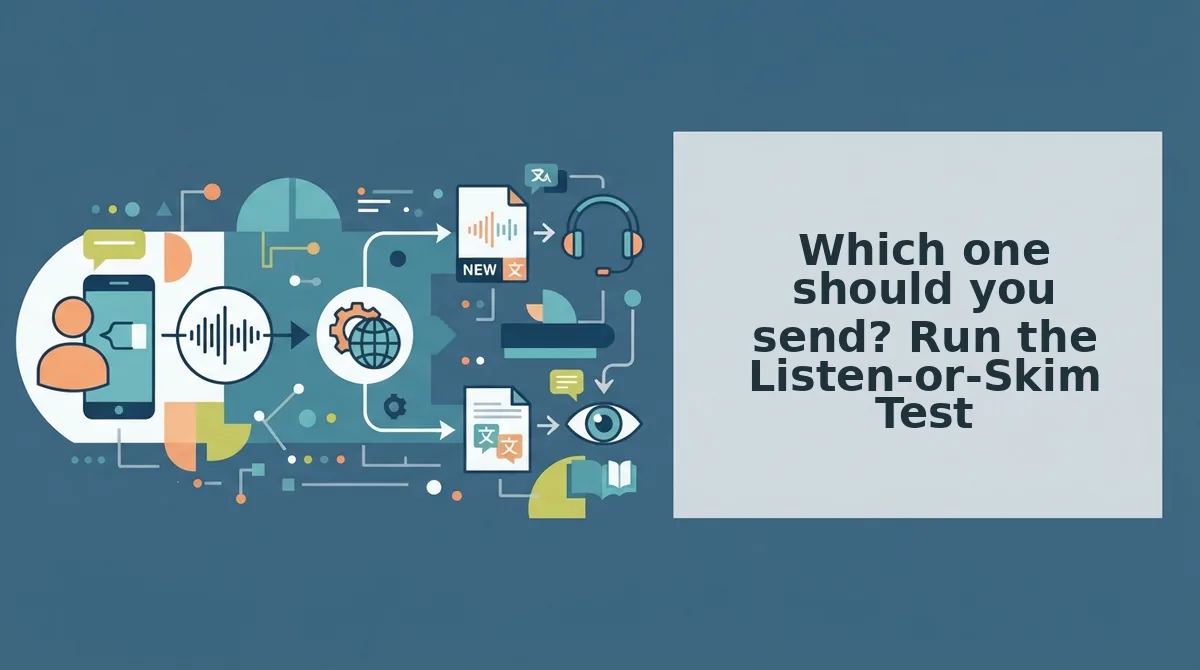
Which one should you send? Run the Listen-or-Skim Test
The Listen-or-Skim Test is a two-question check that picks a format from how your listener will handle the message and from what actually carries it. Ask first whether they will skim or absorb, then whether the payload is tone and stance or facts and decisions. Where the two answers cross is your format.
Think of packaging a parcel for a courier: identical contents ship differently depending on how the box will be handled on arrival. A listener skimming between meetings handles your message roughly; a listener absorbing it one to one has both hands free.
| Listener mode + payload | Send this | Why | Caveat |
|---|---|---|---|
| Skim + facts | Written summary | Scannable, forwardable, searchable later | Cut the pleasantries; lead with the decision |
| Skim + tone | Text with one quoted line, or a note under 45 seconds | Tone still lands, but costs almost no time | Expect it to be deferred, so nothing urgent rides on it |
| Absorb + facts | Written summary with the recording attached | Detail stays available without forcing playback | Never bury the decision inside a long file |
| Absorb + tone | Cleaned voice note | Stance, warmth and accent are the message | Past 90 seconds, lead with a summary |
Length is a rule of thumb, not a measured threshold: roughly 20 to 45 seconds when stance is the payload, because that is about how long a listener holds one emotional beat before wondering when it ends. Past 90 seconds, lead with a summary. These bands sit alongside the recording habits in the voice message best practices guide.
How long should a voice note be? Aim for 20 to 45 seconds when the point is tone â a nudge, an apology, good news â since that is roughly how long one emotional beat survives before the listener starts clock-watching. For anything past 90 seconds, put the conclusion first in text and attach the audio underneath. These bands come from listener attention, not a measured threshold, and they shift with context: a colleague who asked for a detailed walkthrough will tolerate minutes that a client skimming between meetings will not.
With a format chosen, the only open question is order â which of the two arrives first.
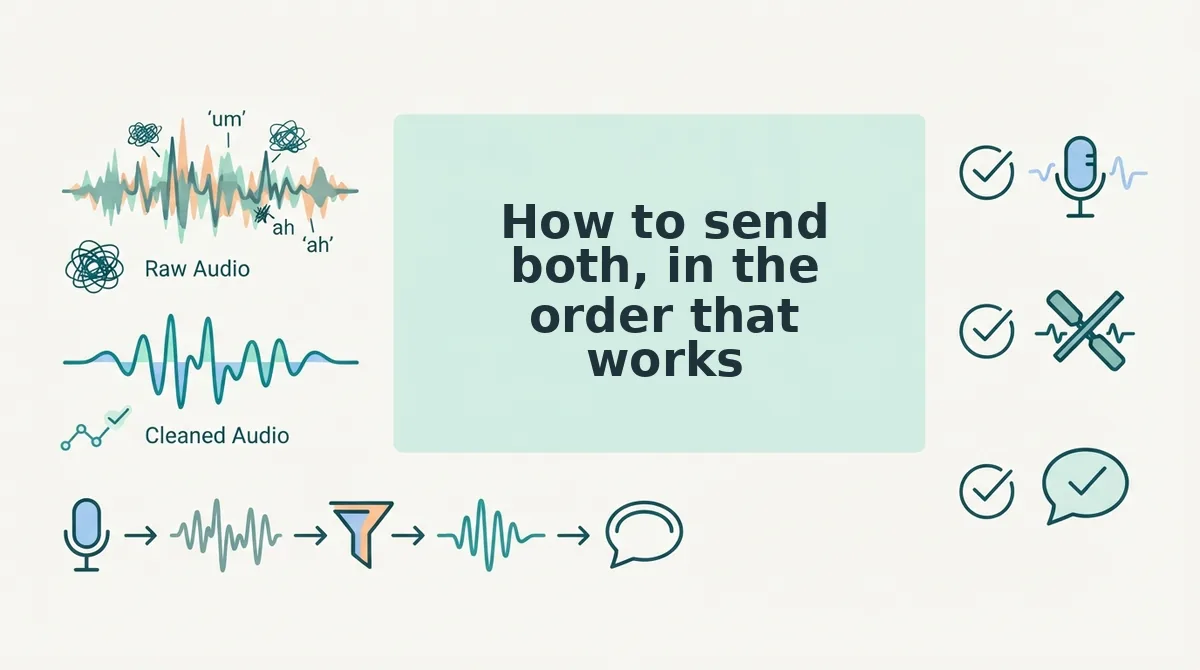
How to send both, in the order that works
Send the written recap first, then the cleaned audio, in the same thread and within ten minutes. The text takes about 20 seconds to scan and frames the decision; the audio fills in stance. Reversed, the listener spends the opening minute decoding instead of reading.
Before you start: you need the raw recording and somewhere to type. Cleaning happens before either message goes out, not between them. A full audio editor carries more timeline than this job needs; see the VClar vs Descript comparison.
- Type the recap in four lines (3 minutes): decision, owner, date, one next action. You should end with a summary that has no adjectives in it.
- Check every name and date against the source (60 seconds). DoraeCAT's clean-summary framing puts verification before sending, because a misnamed stakeholder costs more trust than a late message. You should be able to point to where each fact came from.
- Upload the recording to the filler-words remover and let it cut the ums, false starts, and repeated "like." You should hear a note that plays in one pass, no rewind.
- Send the text under the subject line "Recap â [topic] â [date]," and check its read time with the reading-length tool if it runs past one screen.
- Send the audio right behind it, 60 to 90 seconds long. AnyToSpeech names replay cost as the core pain of voice, which is why the audio goes second and stays short: it is heard once, not studied.
- Label the audio "Audio â [topic] â [date]" so both messages stay findable six weeks later.
- Name the reply you want in the closing line: "Reply go or no-go by Thursday." You should get a decision back, not a thank-you.
Why does the text go first?
Because working memory holds a frame better than it holds a stream. A listener who has read four lines already knows the purpose, the owner, and the deadline, so the audio lands as confirmation of stance instead of raw material to be organized. Play the audio first and that same listener spends the opening 30 seconds working out what the message is even about. The text sets the frame; the audio fills it. That sequencing claim, not the format choice, is the part that changes the outcome.
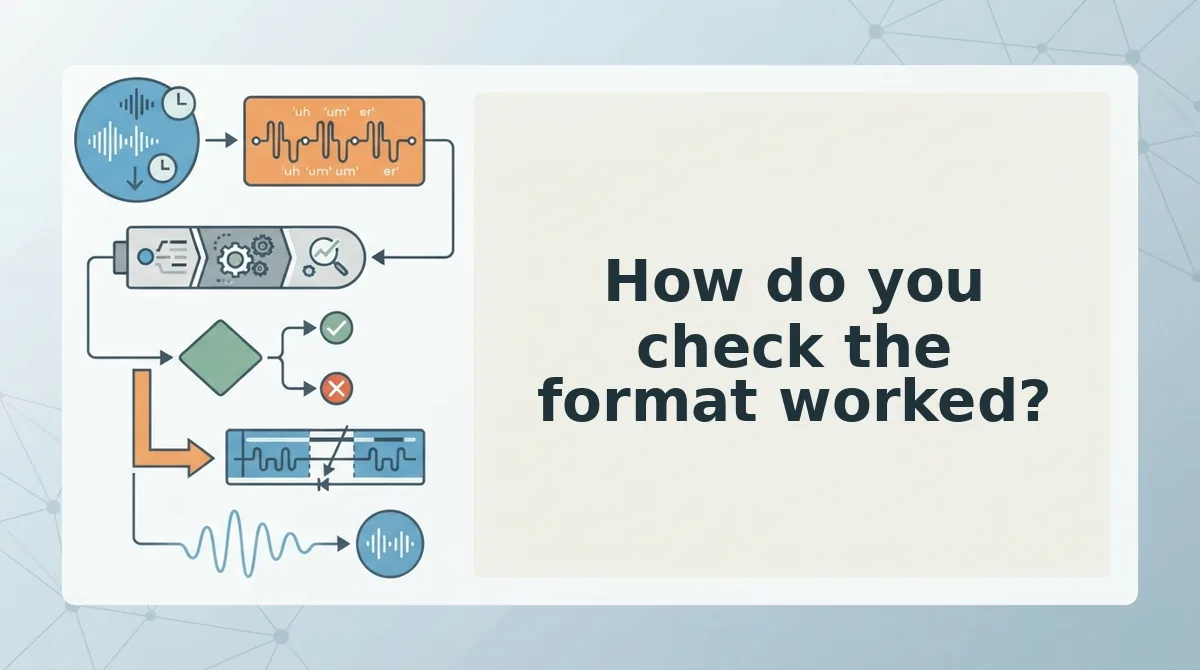
How do you check the format worked?
Three reply-behaviour signals tell you the send landed, and all three show up in the response rather than in read receipts.
- The reply carries the decision, not a request to resend. You get "approved," "I'll own the pricing page," or "Thursday works" back. That means the recap named the decision clearly enough to act on from the text alone, which is the only test the format has to pass.
- Nobody asks you to repeat a name or a date. No "sorry, who?" and no "which Friday?" â the four-line recap held the facts and the audio confirmed them. If a name still comes back wrong, the verification step failed, not the audio.
- The message gets forwarded without being rewritten. Your recap appears in a colleague's inbox verbatim, or the audio is passed on as-is. Both formats stood on their own for a reader who was never on the call.
One caveat worth stating plainly: none of these signals survive a rough recording. If the note is carrying fillers, false starts, and broken sentences, no send order rescues it. Cleaning comes before choosing a format, not after â run it through the filler words remover and fix the grammar in the voice message first.
What to do with your next message
Run the two-touch send on your next follow-up: four-line recap first, cleaned audio second, ten minutes start to finish. That order was the payoff hiding behind the format question, and it is the part worth keeping.
Take the one-minute step first â decide whether your listener is skimming or absorbing, and whether the message is facts or stance. Then the medium step: clean a single note and play it against the raw file, so you hear for yourself what a listener was losing. The strong step is a cross-language recipient, where cleaned audio plus a translated recap stops being optional; the voice note translator handles that recap.
If your calls are investor or client conversations, start with the voice notes for founders workflow and send the pair before your next call ends. Ten minutes on your side buys back the listener's first minute.
You can also edit and share a voice note.