

You recorded a four-minute voice note, ran it through AudioPen, and got back six clean sentences. For a note you keep for yourself, that trade is a straight win â AudioPen's own site frames the product as a way to "go from fuzzy thought to clear text, fast," and for private notes it delivers exactly that. The same trade gets expensive the moment the memo is outbound: a founder's investor update, a sales rep's follow-up, a consultant's scope change. That is where what AudioPen leaves out of a voice note stops being an academic question.
The coverage around this tool is demo-and-review â AudioPen's own walkthroughs and the MacAutomationTips review show the workflow working, and none of them asks what the workflow removes. Below is a four-part audit built for outbound notes: what gets dropped, how to check for it in five steps, and the one category of deleted language that was quietly doing more work than everything else in the memo. It is also the category most people strip first.
What does AudioPen leave out of a rambling voice note?
AudioPen leaves out four things: compression, register, evidence, and delivery. A rambling note carries conditions, tone, and specifics that a cleaned summary flattens, and text output cannot hand back the audio a recipient needed to hear.
A voice note summary is a condensed rewrite of what you said; a transcript is the full spoken record, hesitations included. That gap is where the losses live. Compression drops the conditional clauses that set limits. Register drops how you sounded saying it. Evidence drops a number, a name, or the order events happened in. Delivery drops the audio itself, which is sometimes the entire reason someone sent a voice note instead of typing. Think of it as shrink-wrap: the parcel arrives faster and neater, but whatever did not fit the film is gone, and someone has to ask you to ship it separately.
Two terms worth fixing now. A load-bearing hedge is a qualifier that changes what the reader is allowed to do, not just how confident you sounded â "if legal signs off" is not the same as "probably." And summary debt is the follow-up question a summary forces the recipient to send you afterward; each one costs a round trip.
To audit a summary you need three documents on screen at once, no specific app required:
- The original audio, unedited.
- The cleaned text or summary, side by side with it.
- One line describing what the recipient has to do next, written before you start reading.
A cleaner makes this comparison easier â VClar removes fillers and fixes spoken grammar while keeping your tone and cadence intact, so fixing grammar in a voice message stops masking the four losses behind verbal noise.
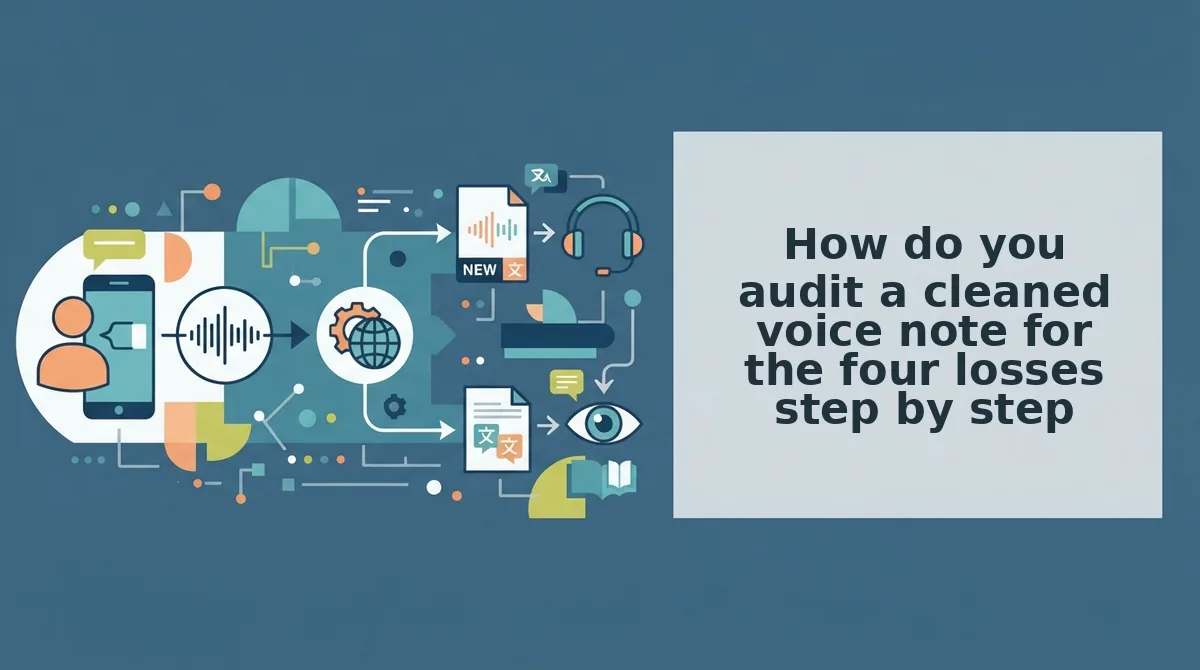
How do you audit a cleaned voice note for the four losses step by step?
Run five checks with the source audio, the cleaned text, and one line about the recipient's next action all visible. The full pass takes roughly six minutes on a two-minute memo, and it is the difference between a summary that saves a round trip and one that creates two.
Before you start, line up the three documents above and open the raw recording in whatever player your dictation app uses. No special tooling required.
- Play the source audio and run the if / probably / unless test (about 90 seconds). Highlight every conditional clause as you hear it. Worked example: an engineer records "we can ship Friday if the vendor confirms the certificate by Thursday, otherwise we slip a week." The cleaned text reads "We can ship Friday." The condition was the entire message. You should end step 1 with a highlighted list of clauses that must be restored verbatim.
- Read the cleaned summary aloud and check the register (about 45 seconds). Ask one question: does this sound like me on a good day, or like a stranger who read my notes? If the second, a phrase got smoothed past your intent and needs rewriting in your own words.
- Cross-check every number, name, and date against the audio (about 90 seconds). Also confirm sequence â "Tuesday, then Friday" surviving as "next week" is a lost instruction. Non-native speakers should check hardest here: phrasing gets smoothed toward someone else's voice, and a corrected word can quietly become a corrected commitment.
- Mark each phrase strip or keep using the table below (about 60 seconds). This is the same logic VClar applies when you remove filler words from audio â the goal is deleting noise, not deleting meaning.
- Decide whether this should be a summary at all (about 30 seconds). Past roughly 90 seconds of raw speech, a memo usually needs pruning rather than condensing: cut whole branches of thought, then summarize the branch that mattered. Under 90 seconds, send it close to verbatim with the fillers removed.
| What you hear | Action | Why |
|---|---|---|
| Sound or false start ("um," "so basically," "waitâ") | Strip | Carries no instruction |
| Hedge that gates an action ("if legal signs," "unless they object") | Keep | Sets what the reader may do |
| Number, name, date | Keep and verify | Wrong specifics cost more than vague ones |
| Conditional clause | Keep verbatim | Rewording changes the condition |
Here is the uncomfortable part: the caveat you strip is often the one protecting you. A summary that deletes "pending approval" reads more confident and commits you to a date you never promised.
If the recipient genuinely needs your voice â a delicate client note, a cross-border handoff where tone carries the apology â keep the audio and clean it rather than converting it. VClar does this in 11 languages while preserving your accent and cadence, which is also the practical argument in a VClar vs AudioPen comparison: one tool answers with text, the other returns the message.
Before you send the cleaned version, one more check is worth running.
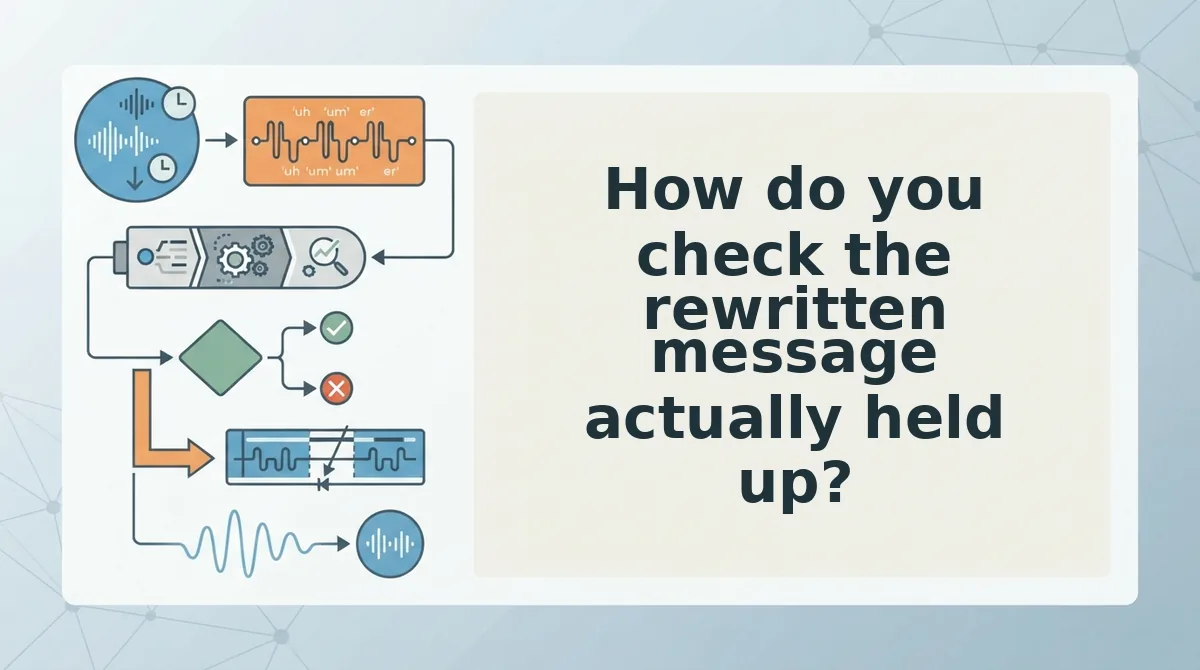
How do you check the rewritten message actually held up?
Run three tests under two minutes each: count the follow-up questions the text forces the recipient to send back, read it cold to see whether the next action is obvious, then translate it out and back. Zero follow-up questions is the pass condition.
You need the original audio, the cleaned text, and your usual translator. About six minutes total.
- Play the original next to the cleaned text (2 minutes). Mark every hedge, number, name, and condition the rewrite dropped. You should see a short list, not a blank page.
- Count the summary debt (2 minutes). List every question the recipient would have to send back: which Tuesday, how much, who owns this. Anything above zero means a hedge or a figure went missing.
- Read only the cleaned text (60 seconds). Cover the original. If you cannot state the next action in one sentence, the ask was trimmed or the register flattened.
- Run the round-trip test (2 minutes). Paste the memo into a voice note translator, translate it into the recipient's language and back. Fragments survive this badly: with no subject to attach to, the engine guesses one. Re-check numbers and proper nouns first â they drift first.
Does AI voice translation keep the meaning of a messy memo? Clean first, translate second. A rambling memo is mostly false starts, hedges, and clauses with no subject, so a translation engine has to invent what the speaker never said and the output drifts. A tightened memo hands the engine complete clauses and one stated ask, which it carries across languages intact. Same words, different order of operations, different result â the variable is the cleanup pass, not the language pair.
Voice note summary questions people still ask
Four questions the steps above do not settle.
Does a summary keep the meaning of a messy memo once it is translated?
Only if you clean before you translate. Fragments have no subject for the target language to attach to, so the engine supplies one, and a rambling memo is mostly fragments. Tighten it first; meaning then survives the language change.
How long should a voice note be before you translate it?
Under 60 seconds, translate it whole. One to five minutes, clean it first and split at natural breaks. Past five minutes, send a written brief with the audio as backup â drift compounds with length.
Should you ever keep the fillers?
Yes, when the hedge is doing work. "I think," "probably," and "unless" carry real uncertainty, and the filler around them is the delivery cue signalling it. Strip the ums, keep the qualifiers that change what you promise.
Is a transcript better than a summary?
A transcript is a record; a summary is a decision. Send the transcript when someone needs exact wording â a quote, a commitment, a number â and the summary when they need to act. Most rambling memos need both.
Run the audit once and you will hear the caveat yourself
The finding sits in the hedges, not the ums. A rambling memo usually holds one real condition â the "if the budget clears," the "unless legal pushes back" â and that is the clause a confident rewrite deletes first.
Three things change after one audit: read the source before you polish it, keep hedges while dropping fillers, and choose the deliverable by what the recipient has to do next. A note you keep stays raw; a message you send gets tightened.
Do it once: record one rambling memo this week, run it through VClar twice, and compare both outputs side by side against the original. That comparison teaches you your own verbal habits faster than any setting does. Voice notes for founders are where it pays off most, because those are the memos that get forwarded upward.
You can also edit and share a voice note.