

Your follow-up to a promising lead ends with "so if you could maybeâ¦" and then nothing. The message now has to reach a German-speaking buyer, and you need to translate a voice note that trails off without losing the ask.
Everyone trails off when they think out loud. It is how spoken ideas form, not a flaw in how you communicate.
Your meaning survives translation if you complete the sentence before you translate it. Clean the fillers, finish the fragment, review the transcript, and only then translate.
Most WhatsApp translation tutorials show you where the translate button is. They rarely explain what to do when the message itself is incomplete.
This guide explains why unfinished sentences break translation, walks through four steps that fix them, and ends with a check that your meaning held. Along the way, you will see which language group gets hit hardest when a sentence trails off.
You need three things: the original voice note, your target language, and a few seconds to review the transcript.
Why Do Unfinished Sentences Break Translation?
Unfinished sentences break translation because machine translation needs a complete clause to decide where the verb and object belong in the target language. A fragment forces the engine to either guess the missing piece or cut the sentence short.
A trail-off is a spoken sentence that stops before its verb, object, or conclusion arrives. In live conversation, listeners fill the gap from context, but a translation engine only sees the words you actually said.
Think of a moving box labeled "kitchen, maybeâ¦" The movers can carry it, but they cannot tell which room it belongs in. A translator holding half a clause has the same problem: it knows the words but not where they land.
| Trail-off type | Example fragment | What breaks | Fix |
|---|---|---|---|
| Dropped verb | "For next quarter we're planning toâ¦" | No action to place in the sentence | Add the intended verb |
| Dangling connector | "So we couldâ¦" | The consequence is missing | Finish the clause or delete the connector |
| Implied object | "I'll send you theâ¦" | The thing being sent is unknown | Name the object |
| Half-finished comparison | "It's faster thanâ¦" | No comparison point | State what it is compared with |
| Trailing hedge | "â¦or whatever" | Vague tone may read as dismissive | Remove it or make it specific |
Verb-final languages carry the highest risk when a spoken sentence trails off, because they place the main verb at the very end of the clause, which is exactly the word that trail-offs most often drop. Hindi, Japanese, and Korean work this way, and German does too in subordinate clauses, so a missing final verb leaves the translation without its core action. Languages built on subject-verb-object (SVO) order, where the verb appears early, tend to tolerate fragments slightly better, although any unfinished sentence still risks a misread meaning.
| Word order | Languages | Trail-off risk |
|---|---|---|
| Verb-final | Hindi, Japanese, Korean, German (subordinate clauses) | Higher |
| SVO or flexible | English, French, Spanish, Portuguese, Italian, Chinese, Russian | Lower |
Here is how the fix looks in practice. A founder records voice notes for investor updates, and one sentence ends with "for next quarter we're planning toâ¦"
Before translating, the founder runs spoken grammar correction to complete the clause. Then they compare the corrected transcript side by side with the original and adjust the verb until it matches their plan.
If you want to fix grammar in your voice message the same way, VClar also removes filler words and reduces background noise in the same pass.
How Do You Translate a Voice Note That Trails Off?
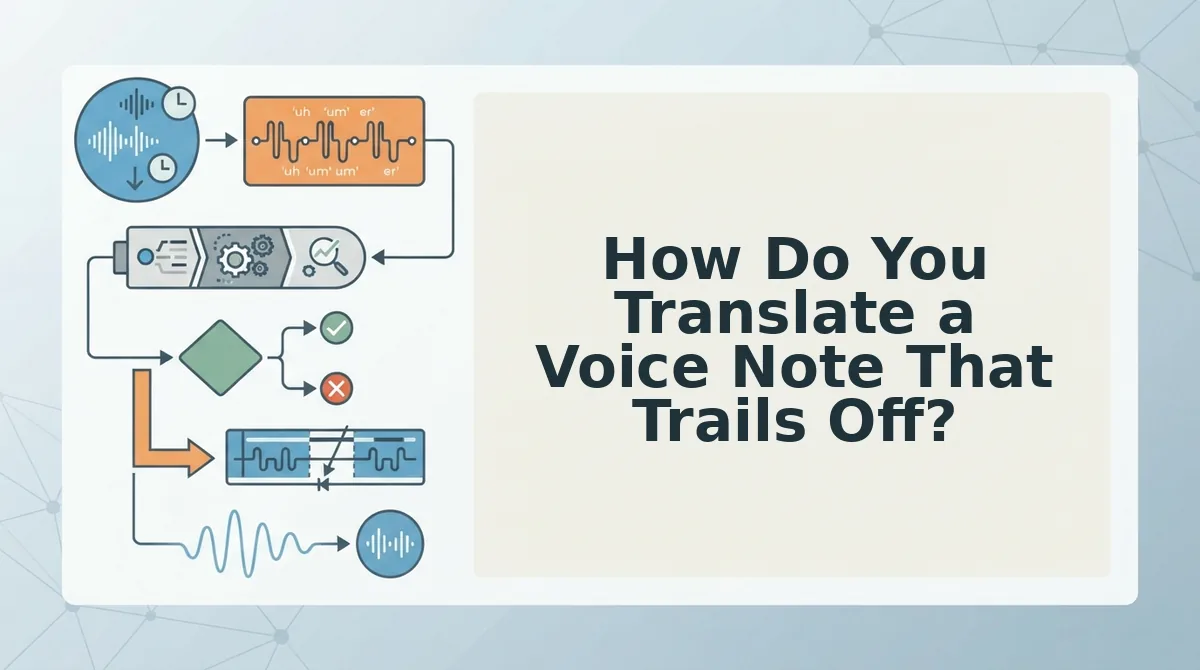
You translate a voice note that trails off by fixing it before you translate it. Remove the filler words first, then complete the unfinished sentences with spoken grammar correction. Next, review the corrected transcript side by side with the original. Only after that should you translate the message into your target language.
Never translate a raw transcript. Before you start, have your original voice note, your target language, and VClar open.
- Remove fillers (about a few seconds of processing)
- Complete trailing sentences (under a minute)
- Review the side-by-side transcript (a few seconds to a minute)
- Translate into the target language (a few seconds)
Step 1: Remove Fillers First
Upload your voice note to VClar, or record it directly, and let it remove filler words from audio. Ums, ahs, "like," "you know," and false starts are cut from the timeline.
When this step works, your transcript shows only meaningful words, so any remaining trail-offs stand out clearly.
Step 2: Complete Trailing Sentences
Apply spoken grammar correction to each fragment, using the fix that matches its trail-off type. Add the missing verb, finish the dangling connector, name the implied object, state the comparison point, and drop vague hedges.
When this step works, every sentence in the transcript has a subject, a verb, and a clear end.
Step 3: Review the Side-by-Side Transcript
Read the corrected transcript next to your original and confirm that each completion says what you meant. Pay closest attention to completed verbs if your target language is Hindi, Japanese, Korean, or German.
When this step works, you can read every corrected line aloud and recognize it as your own intent.
Step 4: Translate into the Target Language
Select your target language and translate the cleaned message. VClar works as a voice note translator for 11 languages, covering 110 translation directions.
When this step works, you have translated audio and a transcript built from complete sentences rather than fragments.
That sales follow-up ending in "so if you could maybeâ¦" can now reach your German-speaking buyer as a clear request. The cleaned, translated audio keeps your own voice, tone, accent, and rhythm, with no synthetic clone replacing you.
The last step is confirming the translation still says what you meant.
How to Check the Translation Kept Your Meaning
Read the cleaned source-language transcript before you trust the translation. If context makes your intent clear, correct the sentence. If a key number, date, or name is missing, re-record only that sentence.
| Situation | Action | Why |
|---|---|---|
| The surrounding sentences make your intent clear | Correct the sentence | Grammar correction completes the thought without changing what you meant |
| A number, date, or name is missing | Re-record only that sentence | Correction cannot invent a fact you never said |
| Several thoughts trail off and the main point is unclear | Re-record the whole note | There is no reliable intent to complete |
Best for: sentence correction suits founders sending quick status updates. Single-sentence re-records suit freelancers who quote deadlines and prices. Full re-records suit long, rambling notes.
- The translation cuts off mid-thought: The source sentence was never finished. Complete it in the transcript, then translate again.
- The verb lands wrong in Japanese or Hindi: Both languages put the verb at the end, so a missing action leaves the sentence hanging. State the action before you translate.
- A hedge is translated literally: Replace "kind of, maybe" with the level of certainty you actually mean.
- The meaning shifted after correction: If the fix guessed wrong, re-record that one line.
Re-recording one sentence is faster than starting over. When only one fact is missing, you replace that line and keep the rest of the message, so you avoid the full re-record loop. VClar handles the fix without timeline editing, so you do not need to scrub waveforms or splice clips by hand. Timeline editors such as Descript are still a strong choice when you want precise, hands-on control over a podcast or video edit. For a one-take voice message that needs cleanup and translation, correcting the sentence or re-recording one line is the shorter path.
For example, a freelancer's client update trails off at "the revised files should be ready byâ¦" The freelancer re-records only that sentence with the actual date and keeps the rest of the note. Then they translate the cleaned message.
Translating Unfinished Voice Notes FAQ
These answers cover the questions people most often ask before translating a voice note that trails off.
Will fixing the grammar change what I meant?
No. Grammar correction completes the sentence your context already implies, so your intent stays the same. It cannot guess a missing fact, such as a date, price, or name. If one of those is absent, re-record that sentence instead.
Does the translated note still sound like me?
Yes. VClar completes and translates the sentence while keeping your natural tone, accent, and cadence. It does not swap your voice for a synthetic one.
Can I translate WhatsApp voice notes this way?
Yes. Upload the raw audio, let VClar clean and complete it, and then translate it into the language you need.
Can I skip cleanup and translate the raw audio?
You can, but fillers and fragments will carry straight into the target language. That makes the trail-off harder to follow, not easier.
Send One Clean Translated Voice Note
A voice note that trails off becomes translatable once you complete it before translating, not after. Translation can only carry the meaning that is already in the sentence.
- Identify how your note trails off.
- Correct the sentence when context shows your intent.
- Re-record only the sentence that is missing a fact.
Record once and let VClar clean and complete your message. Then translate it across 11 languages and 110 directions with your natural tone and accent intact. Your next unfinished thought can still reach any listener as a complete message, in your own voice.