

"So, um, quick one on the quarterâ¦" and the note stalls. You delete it. Take two has a false start mid-clause. Take three catches an inhaled breath right before the ask. By take four, you've read the revenue figure three different ways.
When you need to translate an investor update voice note for a cross-border investor, that loop gets worse. Recording time is not the real cost. The real cost is decision fatigue: trying to sound decisive while improvising, then repeating the whole effort for a reader who speaks another language.
You don't need more talent to fix this. You need the right order of steps. This guide walks you through one clean pass: which step comes first, a 90-second spoken structure that holds up in translation, and why a note that trails off mid-thought can be recovered.
VClar removes fillers, breath sounds, and mouth clicks, then translates across 11 languages while keeping your accent and cadence. For the broader playbook, see voice notes for founder updates.
Clean First or Translate First? The Order Decides the Result
Clean the audio first, then translate. Translation renders whatever is in the waveform, so ums, false starts, and self-corrections come back as literal foreign-language hesitations. If you run a cleanup pass before translating, your investor hears and reads only what you meant to say, in your own voice.
Should you clean a voice note before translating it? Yes. A translation engine cannot tell hesitation from content, so it re-renders disfluencies instead of dropping them. An "um" becomes a filler word in the target language, and a false start becomes a broken half-sentence. Self-corrections cause the most damage. "We closed 400, sorry, 412" turns into two competing numbers, and your investor has to guess which one is real. Cleaning first removes the correction and keeps 412. The cleaning pass is fast enough to run as a single step, so there is no reason to skip it.
Before you start: have your raw recording or phone, a VClar account, and your investor's preferred language ready.
- Record or upload the raw note (1â2 minutes). Speak once without restarting. You should see a draft transcript appear.
- Run the cleanup pass (under a minute). Remove filler words from the audio, along with breath sounds and mouth clicks. The ums and false starts should be gone from the transcript.
- Fix spoken grammar and tighten phrasing. Each metric should now appear once, in a single form.
- Read the cleaned transcript before translating (about 2 minutes). Confirm that your ask is stated clearly and appears only once.
- Select the target language and translate. Choose from the 11 supported languages. The translated audio should still carry your tone and accent.
- Compare the translated transcript with the source, then export. Check that every metric has one number and the ask still closes the note.
What Does the 90-Second Investor Update Structure Look Like in Spoken Form?
A spoken investor update has four blocks: headline, metric, ask, and next step. Deliver them in short clauses within about 90 seconds, or roughly 200 to 230 spoken words. If you plan to translate, treat 120 seconds as a hard stop. Past that point, each translated clause inherits ambiguity from the one before it, and the closing ask stops being quotable.
Short clauses translate more reliably than long ones because they give the engine less room to reorder meaning. The example lines below are illustrative.
| Block | Written investor prose | Spoken line that survives translation | Why it survives |
|---|---|---|---|
| Headline | "Q3 exceeded plan, driven primarily by enterprise expansion." | "Short version: we beat plan this quarter." | One subject and one verb, so nothing gets reordered. |
| Metric | "New accounts rose to 412, outpacing forecast." | "We closed 412 new accounts." | One number, said once. |
| Ask | "We'd welcome introductions to relevant growth-stage funds." | "One ask: two intros to growth funds." | A countable request stays quotable. |
| Next step | "The full deck will follow board review." | "Deck goes out Friday." | A concrete time anchor, with no subordinate clause. |
Written prose still has the edge on dense, skimmable detail. Best for: board packs and formal quarterly letters.
The spoken four-block format trades depth for clarity. Best for: founders sending quick voice notes for founder updates to investors abroad.
But what if your note trails off mid-thought anyway?
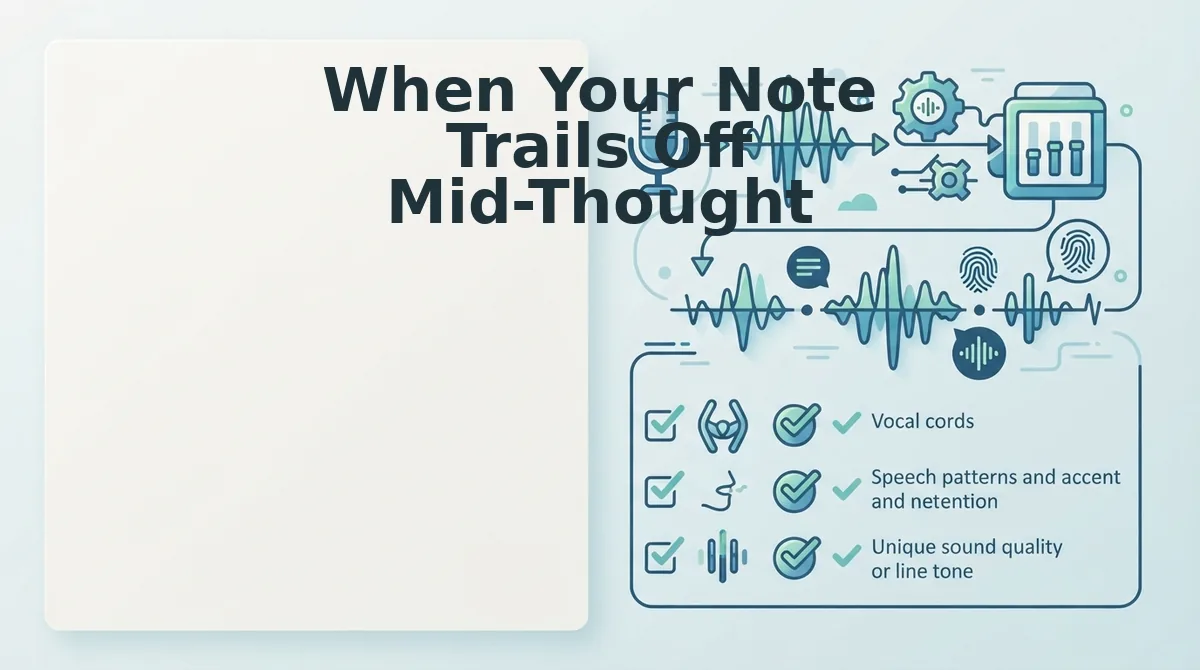
When Your Note Trails Off Mid-Thought
Rewind to the last clause that can stand on its own grammatically, cut everything after it, and rebuild forward from that clause. The rule beats re-recording because it costs one sentence instead of a second take.
Before: "â¦and so the runway conversation, which is, we're working through itâ"
After: "â¦the runway conversation is in progress, and the note continues."
- Find the last complete clause. Scan backward to the final unit with a subject and a working verb. The cut lands there, not at the last audible word â "the runway conversation is in progress" survives; "which is, we're working through it" does not.
- Cut in one block, not word by word. Delete the whole tail from the clause boundary forward. Trimming individual words preserves the shape of the stumble and leaves the investor hearing hesitation.
- Rebuild forward from the clause. Restate the surviving clause and keep speaking into the next sentence. One complete sentence after the cut makes the note sound deliberate again.
- Fix the spoken grammar on the rebuilt section. Tense drift and agreement errors cluster where the thought broke. You can fix spoken grammar without re-recording on that segment alone.
- Strip the filler that survived the cut. Remove "which is," "basically," and "I mean" around the break point. Fillers gather exactly where the sentence collapsed.
- Slow the rebuilt close. Land the final clause slightly slower than the body. The investor is listening for the ask, and a rushed ending reads as uncertainty.
Sending a note that dies on an unfinished clause is worse than sending a shorter one â the investor hears hesitation, not candor. VClar trims the false start, rebuilds from the clean clause, and returns a one-take file you can send as recorded.
Review Before You Send: The Transcript-First Gate
Review the transcript, not the playback. Numbers, names, and the closing ask slip through audio review because your ear fills gaps a reader's eye will not.
- Check numbers and currency by eye. Read every figure, percentage, and unit on the page against what you meant. Playback smooths a garbled "fifteen" into "fifty" without flagging it.
- Verify names and product nouns once each. Company names, investor names, and internal labels are the tokens most often rerendered. Confirm each spelling before the file leaves.
- Read the closing ask as a single sentence. If the request does not survive as one line on the transcript, it will not survive translation.
Translation flattens what it cannot map: idiom, humor, and register rarely cross intact, so do not assume tone transfers unchanged. The workaround is selective translation â translate the narrative and the ask, hold the company name, product nouns, and metric labels in the source language. VClar runs 11 languages and 110 translation directions, which makes that split practical rather than theoretical: you choose which segments render into the target language and which stay verbatim. Check the output for pace as well as wording, since a translated render is a separate take, not a cleaned copy of the original.
Use translate a voice note to render the narrative and the ask while the exact terms stay fixed.
Investor Update Voice Note Questions Founders Actually Ask
How long should an investor update voice note be before translating?
Keep it under roughly 120 spoken seconds. Past that, split by topic â traction, runway, ask â and translate each segment separately, because one long file is harder to check line by line in the output language.
Does translating a voice note flatten my accent and delivery?
Cleaning preserves accent and cadence, since both are properties of delivery rather than words. Translated output is a separate render, so listen once for pace â the wording can be right while the timing still needs a pass.
How do I translate an investor update that arrives as a WhatsApp voice note?
Forward the file as-is. The format is not the obstacle; the rambling inside it is. Clean the audio first, then translate a WhatsApp voice note from the cleaned version.
Do I need to translate the whole note or just the ask?
Translate the whole narrative, not only the ask. Investors read the body for context and the ask for action, so a translated request sitting on untranslated context reads as a fragment.
Cleaning and review get you one sendable note; the language layer is what turns that single pass into reach.
One Pass, Then Eleven Languages
The bottleneck was sequence, not recording skill. Cleaning before translating is the whole fix â translate first and every um and false start gets re-rendered as a literal foreign word.
Two moves prove it on your own audio:
- Clean one note and A/B it. Play the cleaned file against the original; what you hear is editing, not a better performance.
- Send the translated update to the investor who needs it â same cadence, same accent, one of eleven languages.
Re-recording adds takes, not clarity. That is the synthesis worth keeping: cleaning and translating are one pipeline, not two chores â the clean note is the asset, the translation a rendering of it.
Record one update once, run it through the cleaner, and gate it through the transcript on voice notes for founder updates before anything ships to an investor.
You never needed a better take. You needed the right order.
You can also translate a voice message.