

You recorded a voice note the way you think: fast, looping, and half-finished. That is normal speech, and a listener who shares your language fills the gaps without noticing.
Translation removes that safety net. Most guides treat text translation and speech-to-text as separate topics, so the link between sentence fragments and voice translation accuracy rarely gets addressed, even though spoken input breaks differently from written text.
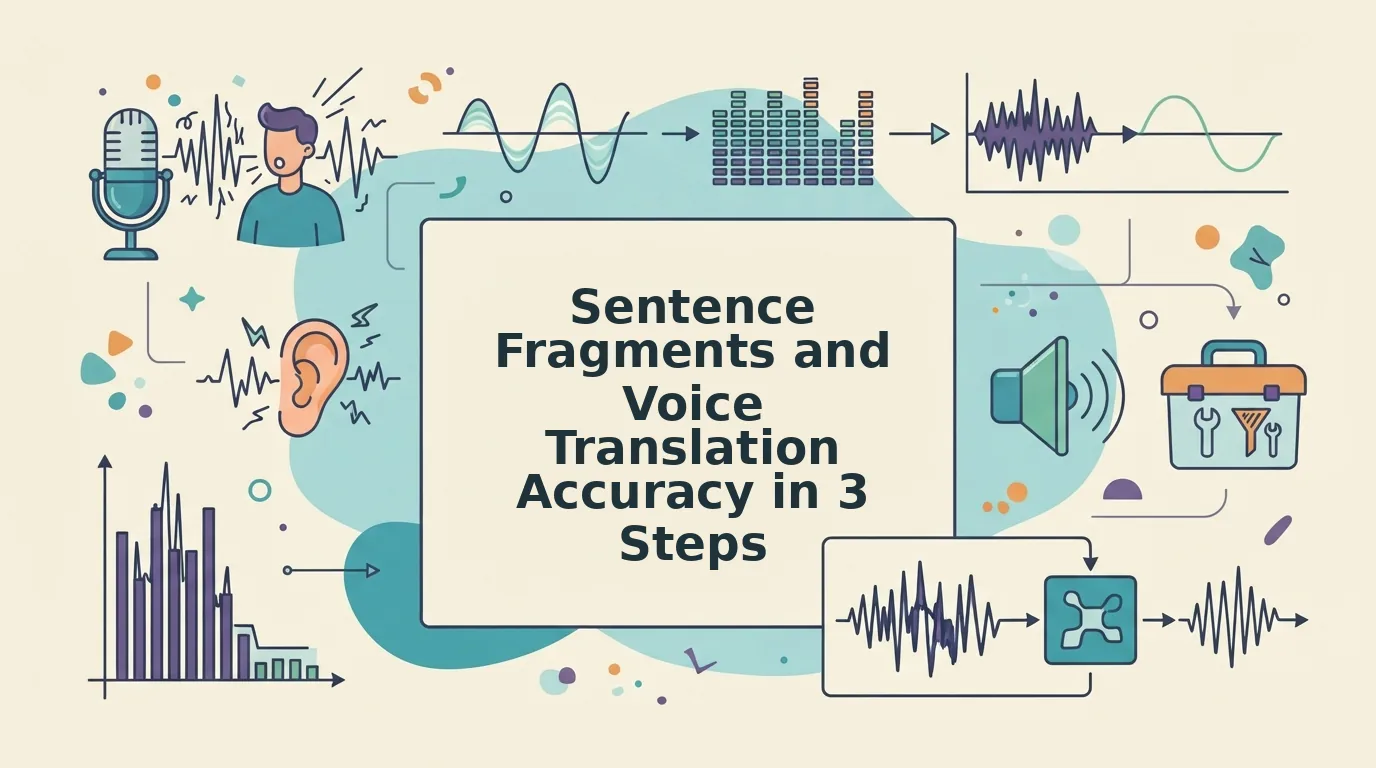
Sentence fragments make a translated voice note confusing because translation engines need a complete clause, meaning a subject, a verb, and a clear intent, to rebuild the sentence in another language's word order. When a spoken clause trails off or circles back on itself, the engine has to guess the missing piece or carry the verbal noise straight into the translation.
Picture a founder recording an English investor update full of half-finished clauses for a Japanese-speaking investor. VClar repairs the fragments first and then translates, keeping the founder's tone, accent, and rhythm. This is a common workflow for voice notes for founders.
You need three things: a recorded voice note, a target language, and a willingness to repair the source before translating. The goal is a translation your listener hears as complete sentences in their own language. Below, you will find the five fragment types, a risk map across languages, and a repair workflow. You will also see the one mistake a better translation model cannot undo.
Which Sentence Fragments in Speech Break Translation?
Five spoken fragment types break translation: trailing clauses, circular restatements, false starts, dropped subjects, and fragments mixed with filler words. Each one removes or blurs the subject, verb, or finished thought an engine needs to rebuild your sentence in another language.
A spoken sentence fragment is a clause missing its subject, its verb, or its completed thought, produced while thinking aloud. Think of it like a recipe card that stops mid-step. A cook in your own kitchen can guess the rest, but a stranger following it word for word cannot.
- Trailing clause: a thought that stops before its verb or conclusion. Before: "So the Q3 pricing, because of the vendor change..." After: "We are raising Q3 pricing because of the vendor change."
- Circular restatement: circular phrasing means repeating one idea in several ways while you search for words. Before: "It's the timeline, the schedule, basically when we ship." After: "The issue is our ship date."
- False start or self-correction: a false start is a sentence you begin, abandon, and restart. Before: "We should, actually the team, we'll send it Friday." After: "We will send it Friday."
- Dropped subject: the speaker leaves out who is acting. Before: "Talked to legal, should be fine." After: "I talked to legal, and the contract should be fine."
- Fragment plus filler: a broken clause padded with "um," "like," or "you know." Before: "Um, like, the demo, you know, next week?" After: "Can we schedule the demo for next week?"
Fillers cause damage in two ways. Either the engine carries them into the output as stray words, or the noise blurs the clause around them.
Why do fragments confuse translation? Translation is not word swapping. The engine reorders a complete clause to fit the target language's grammar, so it must first identify who acts, what happens, and what the speaker intends. A fragment removes at least one of those anchors. The engine then has two bad options. It can invent the missing piece, which risks changing your meaning, or it can translate the broken structure literally, which gives your listener a sentence that sounds unfinished in their language. Spoken input makes this worse because hesitations and restarts arrive in the same stream as the message itself.
Language-Pair Risk Map
A verb-final language places the main verb at or near the end of the sentence. An engine cannot render a verb-final sentence until it knows the verb, so a trailing clause leaves it nothing to place. The table below describes linguistic structure. It is not accuracy data.
| Word order | Languages | Fragment risk |
|---|---|---|
| SVO (subject-verb-object) | English, French, Spanish, Portuguese, Italian, Russian, Chinese | More forgiving, but the output still carries the confusion |
| Verb-late | German, Hindi | The engine needs the full clause before it can position the verb |
| SOV with frequent subject drop | Japanese, Korean | The engine needs both the verb and a clear subject |
Whatever your language pair, start by repairing the source. You can fix grammar in your voice message first, then translate voice notes into 11 languages with VClar.
How to Repair Fragments Before You Translate a Voice Note
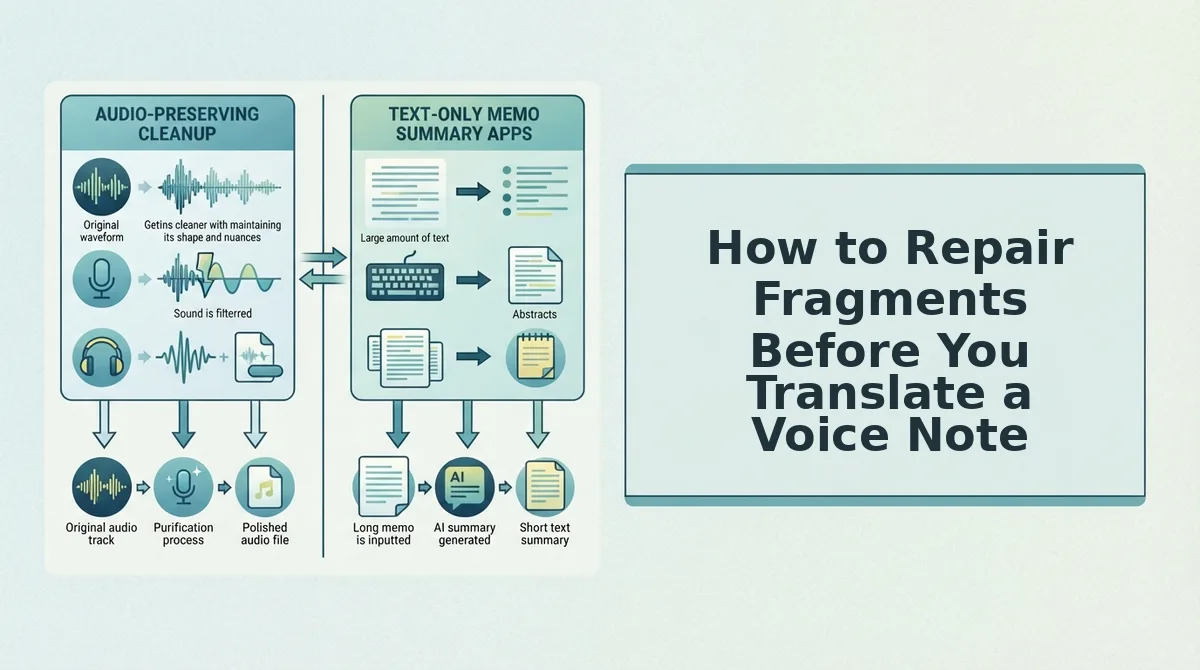
Repair fragments in this order: clean the audio, correct the spoken grammar, and only then translate. Translating before repairing is the fifth and costliest mistake, because a better translation model does not fix bad input.
Before you start, you need a recorded voice note or raw audio file, a chosen target language, and access to VClar.
- Clean the audio. Upload or record your message and remove filler words from audio, along with false starts, breath sounds, mouth clicks, and background noise. Allow 1 to 2 minutes to listen back to a short note. When this step is done, the message should sound decisive, with no "um," "like," or restarted sentences.
- Correct the spoken grammar. Complete trailing clauses, restore dropped
How to Check Your Voice Note Is Safe to Translate
A repaired voice note is safe to translate only when its transcript passes all five yes/no checks below. Each check matches one fragment type, and a single "no" means you repair again before translating.
- Every sentence has a clear subject. Dropped subjects force the translation engine to guess who is acting. Read each sentence and confirm you can name the doer.
- Every clause ends with its verb and finished thought. Trailing clauses leave the engine without the action it needs to rebuild the sentence. Finish any clause that stops mid-idea, or cut it.
- Each point is said once. Restated points translate as duplicate or contradictory sentences. Keep the clearest version and delete the rest.
- False starts and fillers are gone. A leftover "um," "like," or abandoned opening gets translated literally. Scan for any phrase that begins and goes nowhere.
- Verb-late targets get fully complete clauses. SOV languages such as Japanese, Korean, and Hindi sit in the highest-risk group of the Risk Map because the verb arrives last. Before sending into one of these languages, confirm that every clause carries its full verb.
Sentence Fragments and Voice Translation FAQ
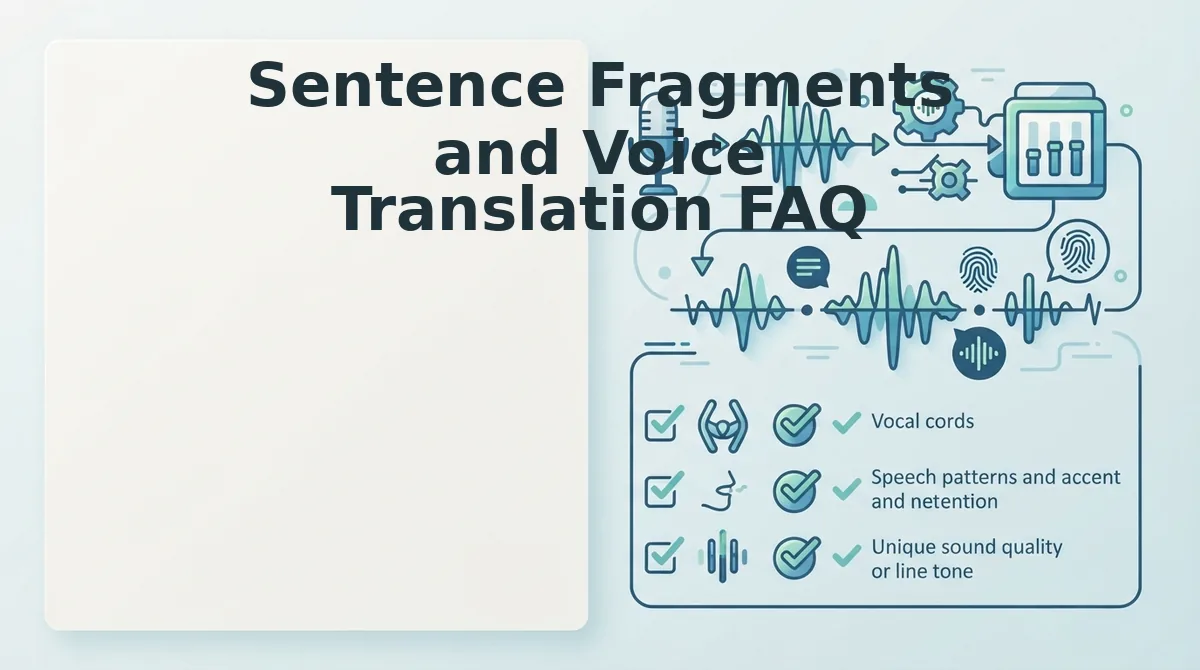
Sentence fragments ruin translated voice notes because translation engines need complete subjects, verbs, and thoughts to rebuild meaning. These answers cover the questions people ask most.
Will cleaning up fragments change my accent or voice?
No. VClar removes fillers, false starts, and grammar slips but keeps your natural tone, accent, and rhythm. It edits your words, not your vocal identity. The recipient still hears you, not a synthetic text-to-speech voice reading your message.
Do filler words get translated too?
Yes, if you leave them in. Translation engines treat "um," "like," and "you know" as content, which produces stray or confusing words in the target language. That is why you should clean the voice note before translating it, not after.
How do I translate WhatsApp voice notes to English?
Repair the recorded note first, then translate it. Upload the WhatsApp voice note to VClar and let it remove fillers and complete fragments. Check the transcript against the five-point checklist, then translate the cleaned version into English.
Why don't text grammar checkers catch spoken fragments?
Text grammar checkers analyze typed sentences, not audio, so they cannot hear false starts, trailing clauses, or restated points. A voice-first tool repairs these spoken patterns directly. See VClar vs Grammarly for the full comparison.
Record Once, Repair, Then Translate
Most translated voice notes break because of fragments, not vocabulary, so the fix belongs before translation, not after. Speak naturally once, repair the structure, then translate.
Picture a consultant who records a quick client update between meetings, complete with half-finished clauses, a restated deadline, and a few "ums." VClar completes the fragments, removes the fillers, and translates the update into French while keeping the consultant's own tone and cadence.
For your next voice note, run the five-point check, then translate your repaired voice notes across 11 languages and 110 translation directions. Your first take can be the one you send.