
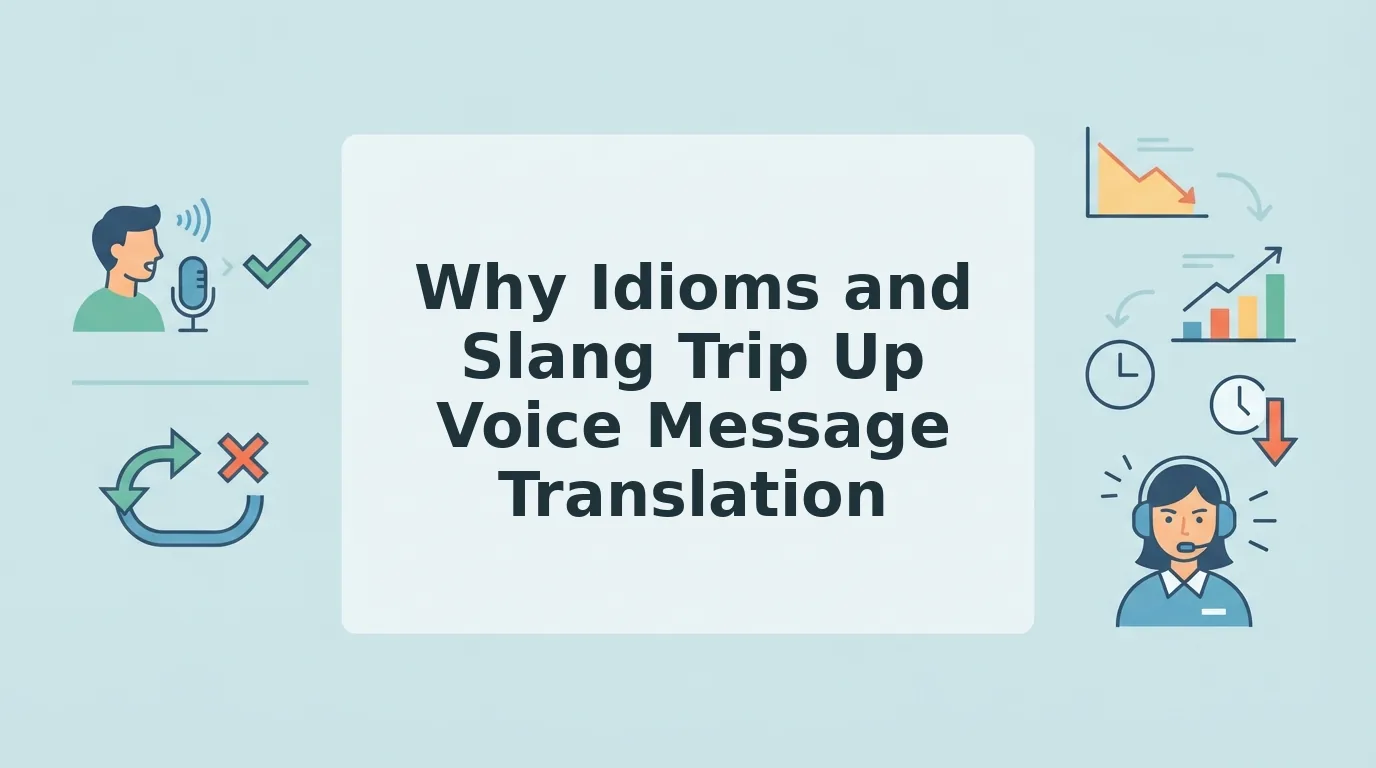

Do idioms and slang get translated correctly in voice messages? Usually not. Idioms almost never survive a literal render, and in-group slang often has no equivalent in the target language at all. That gap is where idioms and slang in voice message translation fail quietly instead of loudly.
You already have what you need to catch it: both transcripts, source and translated, on the same screen. What's missing is a triage rule, so every odd phrase gets the same shrug and the same send.
Below you'll learn the three ways a translation breaks â literal render, register collapse, and opaque shorthand â and then a fixed three-pass review you can run on any voice note in about five minutes. Two of those failures are easy to spot on sight. The third reads smoothly, sounds fluent, and is the reason a translated note can be perfect and still get the wrong reply back.
What actually breaks when an idiom crosses a language?
Idioms rarely translate literally, and slang often has no equivalent at all. An idiom is a fixed phrase whose meaning sits in the whole expression rather than in its parts, so any system that converts word by word keeps the nouns and drops the point.
Think of a literal render like a photocopier: it reproduces every mark on the page, coffee stain included, and has no way to tell you which marks were the message.
The breakage shows up in one of three shapes:
- Literal render â the words cross over but the meaning doesn't, so "break a leg" arrives as a sentence about an injury.
- Register collapse â casual speech returns as formal prose, so a friendly nudge reads like a legal notice; the words are fine and the tone is gone.
- Opaque shorthand â in-group terms, abbreviations and jokes have no target-language counterpart, so the output is grammatical, fluent, and describes nothing.
Those three headings hold the 11 traps:
- Literal render (4): false friends, body-part idioms, sports and gambling phrases, meeting idioms like "let's touch base."
- Register collapse (3): clipped casual grammar, in-group intensifiers such as "that's sick," and missing honorifics a language expects.
- Opaque shorthand (4): acronyms, inside jokes, wordplay, and culturally bound metaphors.
Why does a fluent-sounding translation still come out wrong? Because fluency belongs to the target language, not to the match between the two. A system can turn a Japanese idiom into a flawless English sentence and still miss the only thing that mattered, which is intent. The mismatch is visible only through comparison: put the source transcript beside the translated transcript, on one screen, before you make a single judgment call. The audio keeps the tone; the text keeps the defect. A clean translation on its own looks finished, and that is precisely why nobody rechecks it.
Fix the source before you fix the output. If you can't restate a phrase in plain words in the original language, nothing downstream can â so swap it for its plain meaning first, then fix grammar in a voice message so the sentence boundaries are clean. VClar's filler removal strips the ums and false starts that hide where an idiom starts and stops.
How do you review a voice message translation in three passes?
The three-pass review is a fixed sequence for checking a translated voice message: an idiom pass that flags phrases whose meaning won't survive a literal render, a register pass that confirms casual speech didn't come back as a memo, and a name/number pass that verifies dates, figures, product names and deadlines. Read for one category at a time, in that order, with the source transcript beside the translated one. The order is the point â idiom errors change the meaning, register errors change the tone, name errors change the facts â so working in sequence stops you from re-reading the same lines four times to catch three different problems.
Before you start, open both transcripts in the same window and keep the original audio within reach; you'll need it to hear the tone the text strips out.
- Run the idiom pass (~2 minutes). Read only the source lines you couldn't explain to a non-native speaker in one breath, then check whether each translated line delivers a meaning or just an image. You should come out with three to six flagged lines, each marked keep or reword.
- Run the register pass (~2 minutes). Compare the formality of the first and last sentence in each transcript, and check whether contractions, slang and directness survived. If your spoken "hey, quick one" came back as "Dear colleague," the tone flattened even though every word is correct. You should end with one verdict per message: matched or flattened.
- Run the name/number pass (~90 seconds). Highlight every date, figure, product name, deadline and proper noun in the source, then confirm each appears identically in the translation, digits included. You should see a fully matched list, or a short correction list you can act on immediately.
Here is the fix in practice. A founder ends a call with "let's touch base next week," and the translated note reads as a request for a physical meeting, so the reply comes back as a calendar invite. The correction doesn't happen in the translator: reword the source to "I'll send the pricing sheet Tuesday and we'll confirm Thursday" â a named day and a named deliverable â and translate that instead. The output is duller and it lands.
Accept one honest limit: a translator is not the place to save a pun. Wordplay that depends on sound has to be reworded upstream, in the source line, where you still control it. Pairing this review with a voice note translator that returns both transcripts in one view makes the comparison step nearly free, across 11 languages, without flattening your cadence.
Which words should you fix before translating, and which should you leave alone?
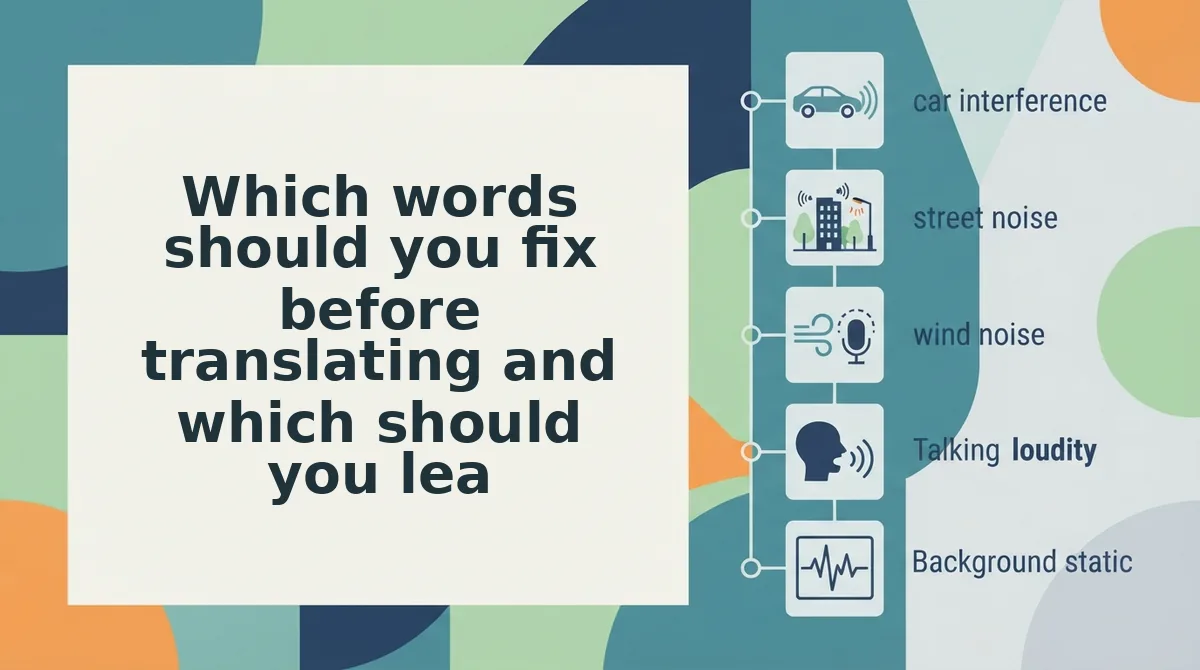
Which words should you fix before translating and which should you leave alone?
Keep names, numbers, dates, brand terms and contractual wording untouched, and reword slang, wordplay, culturally bound metaphors and in-group shorthand in the source before you translate. A translator should carry the first group through unchanged, so any change there is a real error.
| Keep as-is | Reword in the source |
|---|---|
| Names of people, companies, products | Community and crypto slang |
| Numbers, prices, quantities, units | Wordplay and puns |
| Dates, deadlines, time zones | Culturally bound metaphors |
| Brand terms and product names | In-group abbreviations and inside jokes |
| Contractual or legal phrasing | Idioms with no cross-language equivalent |
That split follows what each group can survive. Machine translators now handle many common idioms competently, and a human translator still catches register drift that software flattens, but neither recovers a pun whose anchor does not exist in the target language.
How do you check a translation before you send it?
Read the finished line as a stranger would and ask what action it tells them to take, then compare that action with what the original speaker wanted. If a note meant "delay the launch" arrives as "cancel the launch," the divergence sits upstream in the source phrasing, not in the translation. Spelling the request out in plain words repairs it in one pass. Judging by wording instead of requested action is how fluent output clears review while carrying the wrong instruction.
Hesitations blur where one phrase ends and the next begins, so the translator guesses the idiom boundary wrong, which is why the on-site question about filler words reducing accuracy has a yes answer. Clean the take with the remove filler words from audio tool first and both you and the engine get sharp edges.
Best for founders and sales teams sending cross-border updates: freeze the figures, reword the shorthand. Best for creators reusing a joke across markets: rewrite the joke rather than translate it. Then verify by requested action.
What else do people ask about slang and idiom translation?
Idioms and slang survive translation only when the target language has an equivalent. When it does not, three things fail: literal render (the words cross, the meaning does not), register collapse (casual shorthand arrives in formal dress), and opaque shorthand (in-group terms arrive with nothing to recover them).
Do idioms and slang get translated correctly in voice messages?
Often not, and fluency hides it. A phrase can return grammatical and still land as the wrong request, so treat output that reads smoother than your original as a review candidate rather than a win. Check the three failures above before trusting the meaning.
Do filler words lower voice message translation accuracy?
Indirectly, yes. Hesitations sit exactly where a phrase boundary should be, so "you know, it's basically a no-go" offers two possible edges for one idiom. Strip the fillers first, and the translator works from one boundary instead of guessing between two.
How accurate can slang translation be when no equivalent exists?
Accurate as a paraphrase, not as a translation. Where the referent does not exist in the target culture, the honest output explains the intent in plain words and drops the flavor. Paraphrase in your own language first, then translate that sentence, so the untranslatable part never enters the pipeline.
How do you translate WhatsApp voice notes to English without losing the joke?
Say what the joke is aimed at, in the source, then translate that. Humor resting on a pun or a local reference will not cross, and a forced equivalent reads as a non-sequitur. This translate WhatsApp voice notes walkthrough covers the export and upload steps.
That is the payoff on the finding this article opened with: polish is the warning sign, not the proof, and the only test that matters is whether the action requested matches the action intended. Run one cross-border note through the filler-word remover before you translate it, and you will hear the difference in the first pass.
You can also translate a voice message.